Why did Bandi Schima write a letter to Manó Adler?
The life of Bandi Schima
Bandi Schima, master craftsman awarded the distinction Master of the Gold Ribbon, found his place at the forefront of Hungarian and European ironwork and applied arts between the two World Wars with his high quality religious and secular, artistic and applied works. He donated his legacy to the museum in Győr, where it was received in 1962.
András Schima was born on 23 November 1882 in Orosháza in a poor, Swabian family. He inherited his manual skills from his father, a mechanical fitter, who himself had experimented with metal objects. Hoping for a better life, the family moved to Arad, where Bandi attended elementary school. As a schoolboy, he excelled in drawing. He continued his studies at the Arad Metal School, where he was a regular winner of school exhibitions and house design competitions. In 1898, he won a design competition at his vocational school with his entry under the title Miklós Toldi, and was awarded a scholarship to complete his studies.
Initially he worked as a locksmith, and then, with a scholarship from the Arad Chamber of Industry, he travelled to Berlin, where he graduated from the Academy of Applied Arts.
After graduation, he moved to Bratislava and became a teacher at the local school of wood and metalwork. His summary charts were used as teaching material in industrial schools throughout the country.
In 1909, at the age of 27, he arrived in Győr.
Head statue at the grave of Bandi Schima, by László Alexovics, bronze, 1958, kozterkep.hu
In 1914, he makes an ornamental axe for the German Emperor Wilhelm II, which wins the Emperor’s approval, so he sends Schima a brilliant-embellished tie pin as a gesture. In 1916, he sends a wreath of victory to the Turkish Sultan Mohammed V, who awards him the Silver Medal of Arts in recognition.
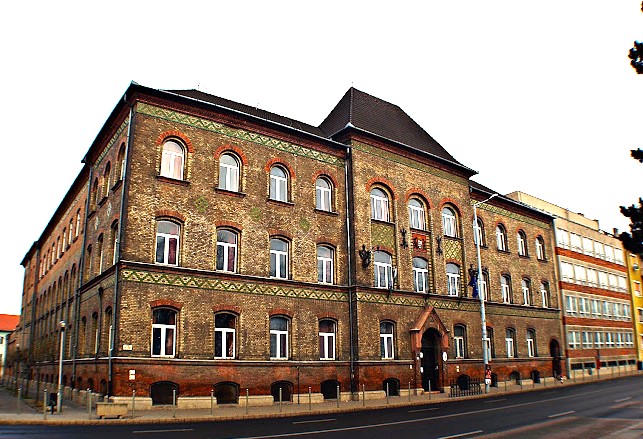
From 1919, Bandi Schima teaches at the Royal Hungarian State School of Wood and Metal Industry in Győr (now the Jedlik Ányos Mechanical and Information Technology College).
Jedlik Ányos Mechanical and Information Technology College in Győr today – Photo: Hegyaljai Imre
His career as a teacher lasted until 1927, from then on, he lived only for the art of engraving, and he opened a workshop in Zombor utca, Győr. He regularly exhibited at the Fine and Applied Arts Society of Győr.
In 1928, he visited Austria, Germany and France on a study trip to Western Europe.
In 1932, he was awarded the title of Master of the Gold Ribbon of Hungary at the 4th National Crafts Exhibition and Gold Ribbon Master Competition.
In 1936, he won an Italian scholarship to study in Italy, but only set off in 1937, partly because of the protracted work on his gift to Mussolini (!) and partly because he was short of money. On the occasion of this visit, he presented the Duce with a metal-ornamented oxen horn…
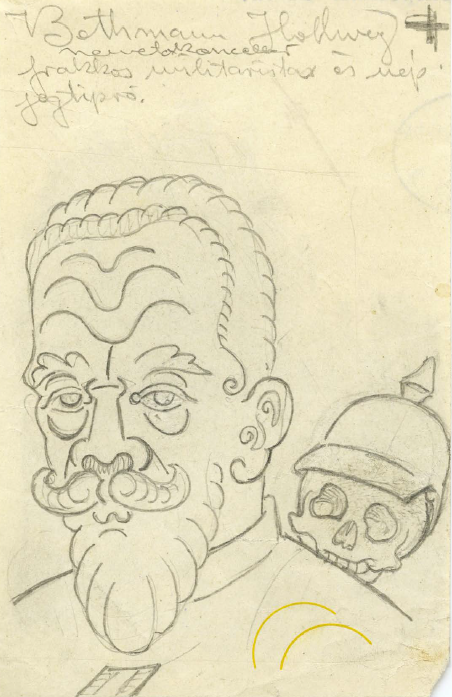
Bethmann Hollweg (1856-1921, German Imperial Chancellor 1909-1917), caricature sketch, Schima Bandi, Germany, 1920s, from the local history collection of the Rómer Flóris Museum of Art and History, reproduced from the Journal of Law and Political Science, Vol. 10, No. 1, 2018 (Jog- és Politikatudományi Folyóirat)
Back home, he created church ornaments, religious objects, home furnishings, signboards and much more.
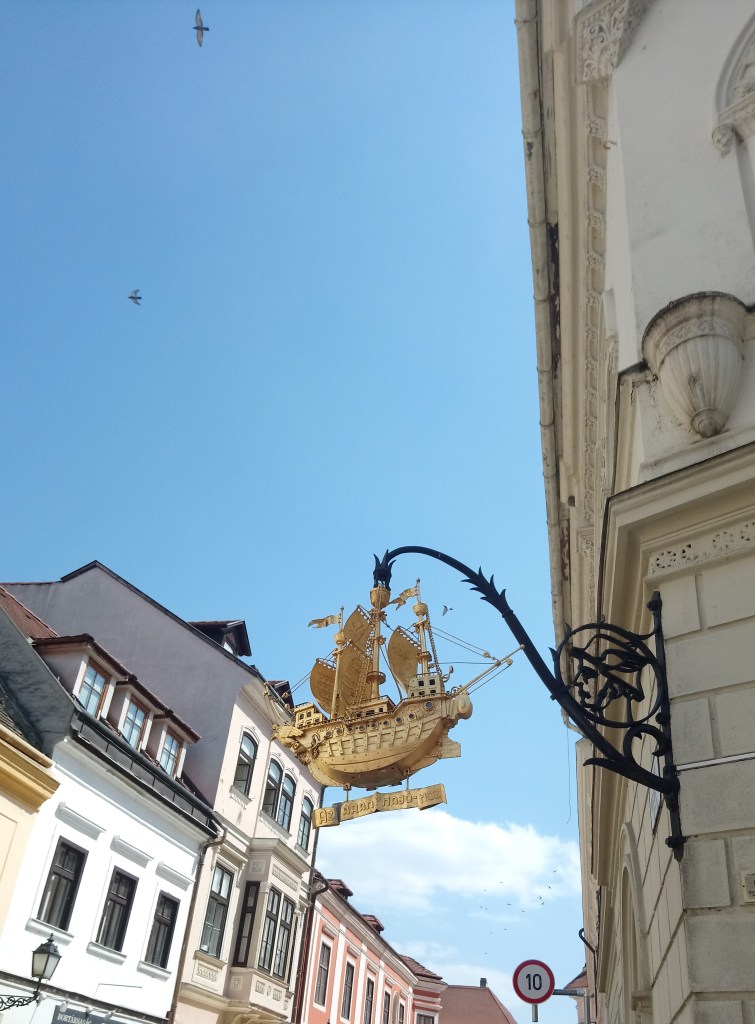
The famous Golden Boat Sign, by Bandi Schima, 1938, Győr, Jedlik Ányos u. 16 – Photo by Péter Krausz
His life was the subject of a reportage film, and in 1958 it was shown in many cinemas as “Iron Flowers” in the 22nd Film News. In the year of his death, he was nominated for the Kossuth Prize, but he fell ill and died of pneumonia in April 1959. He could not receive the Kossuth Prize.
A street in Győr bears his name near his former workshop.
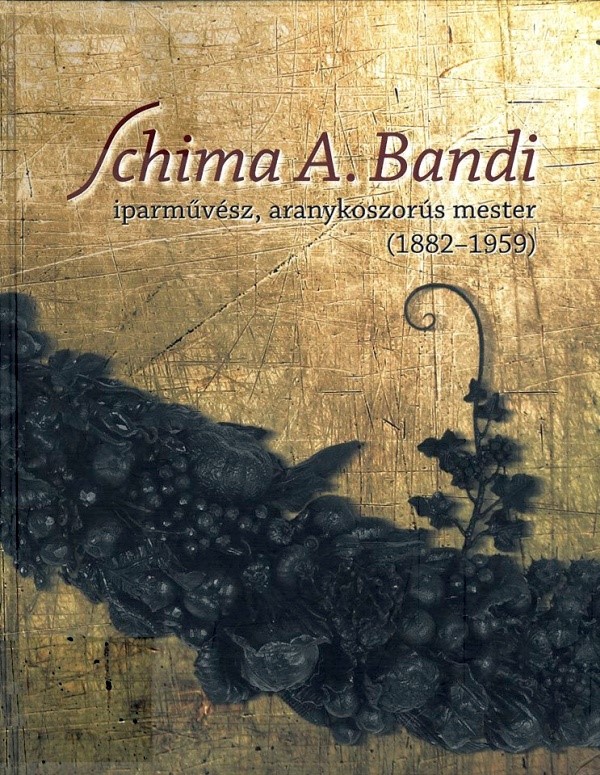
Cover page of the book Bandi A. Schima, master craftsman, Master of the Gold Ribbon (1882-1959), 2018, Emese Pápai (study and editor) – libri.hu
The Rómer Flóris Museum of Art and History has published studies on Bandi Schima, edited by Emese Pápai, art historian. The album is illustrated with a rich collection of photographs from the artist’s post humus exhibition (2017, Magyar Ispita, Győr). The studies in the album cover Schima’s life, work, correspondence and photographic legacy.
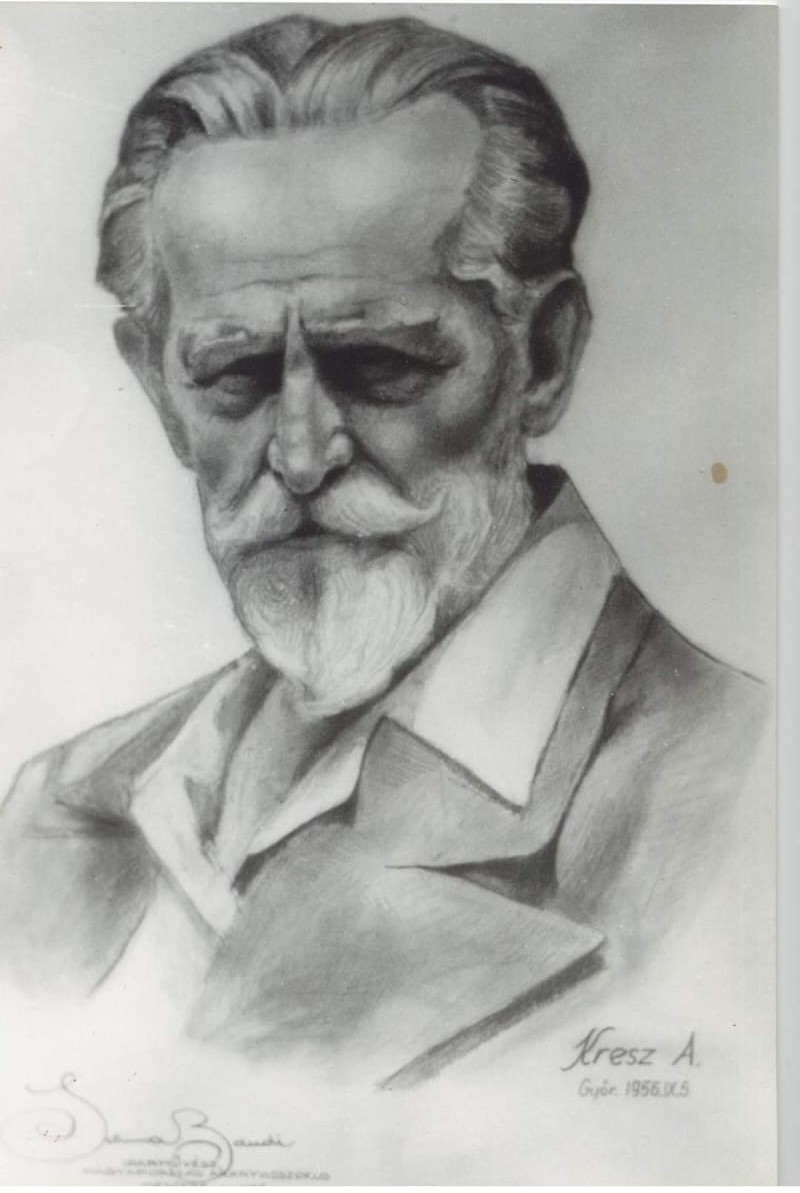
Portrait of Bandi Schima, graphic by A. Kresz, 5 September 1956
Why did Bandi Schima write a letter to Manó Adler?
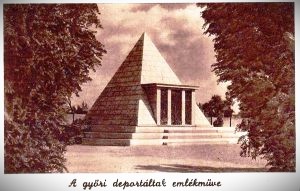
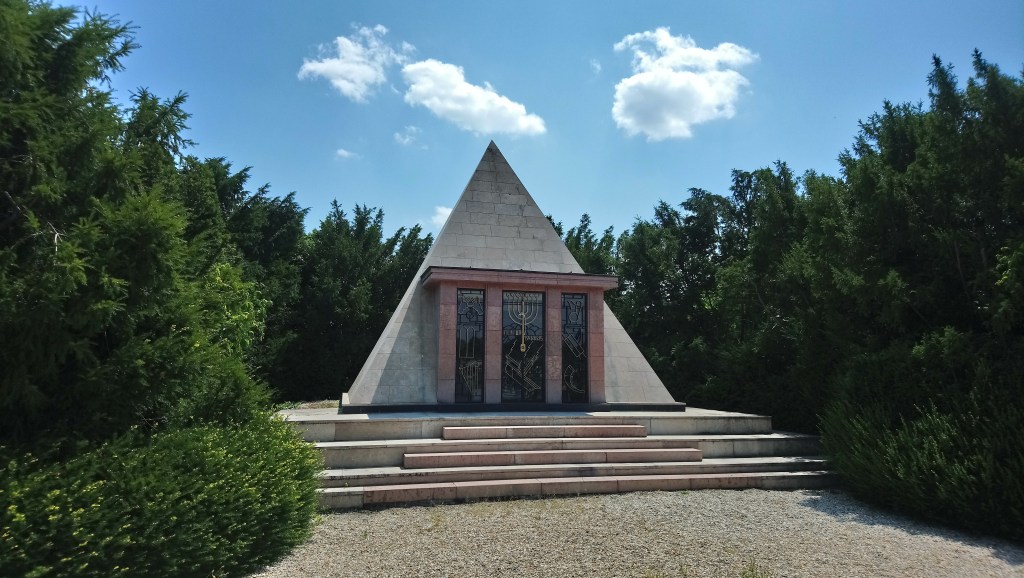
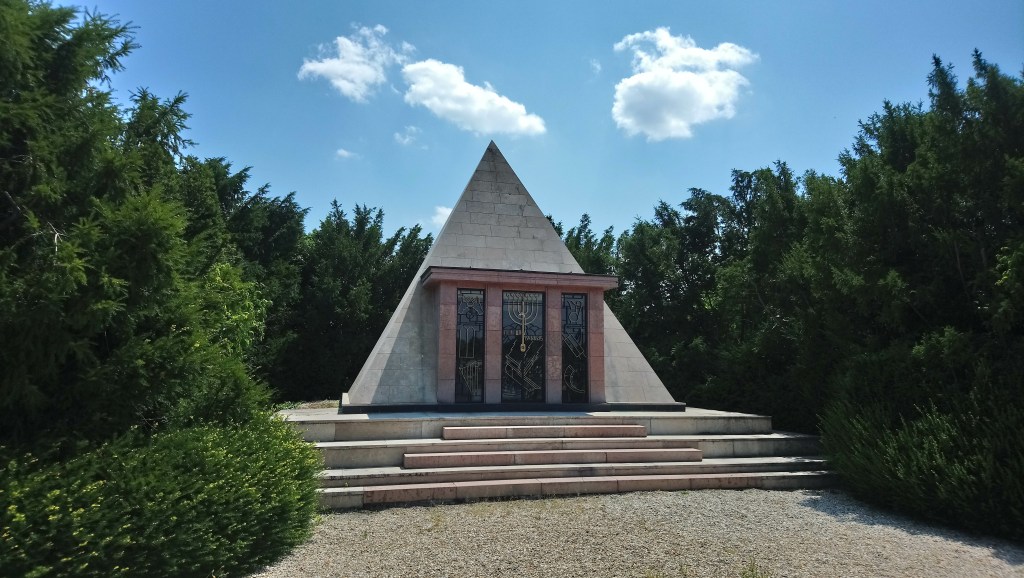
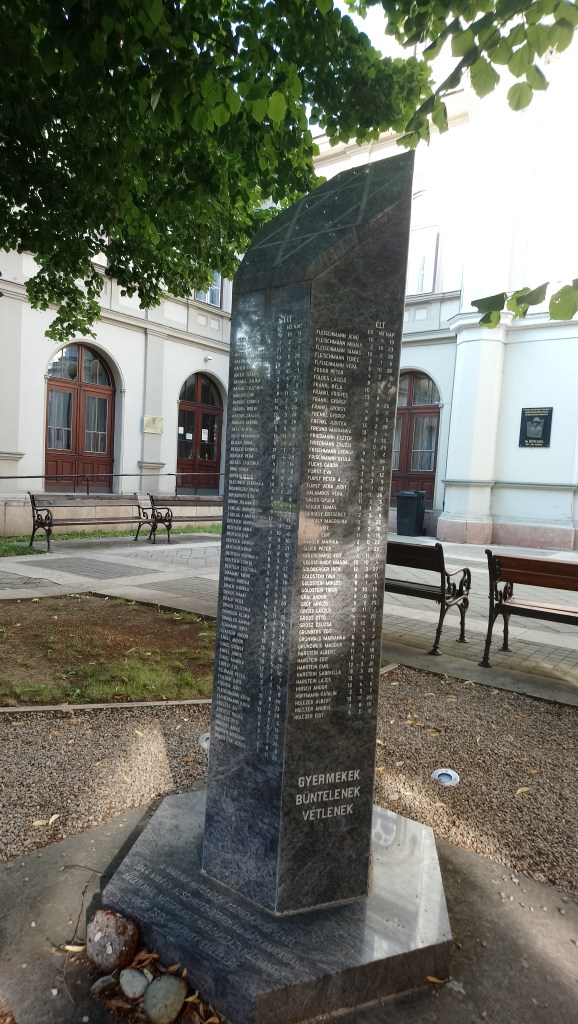
Manó Adler (known to the author of this article as “Manó Bácsi”), an architect from Győr, played an active role in the Győr Neologue Community and in the recovery of the bereaved community after his return from forced labour service and the tragic murder of his family in Auschwitz. He designed and led the construction of a completely unique pyramid-shaped Holocaust Monument in the Jewish cemetery in Győr-Sziget.
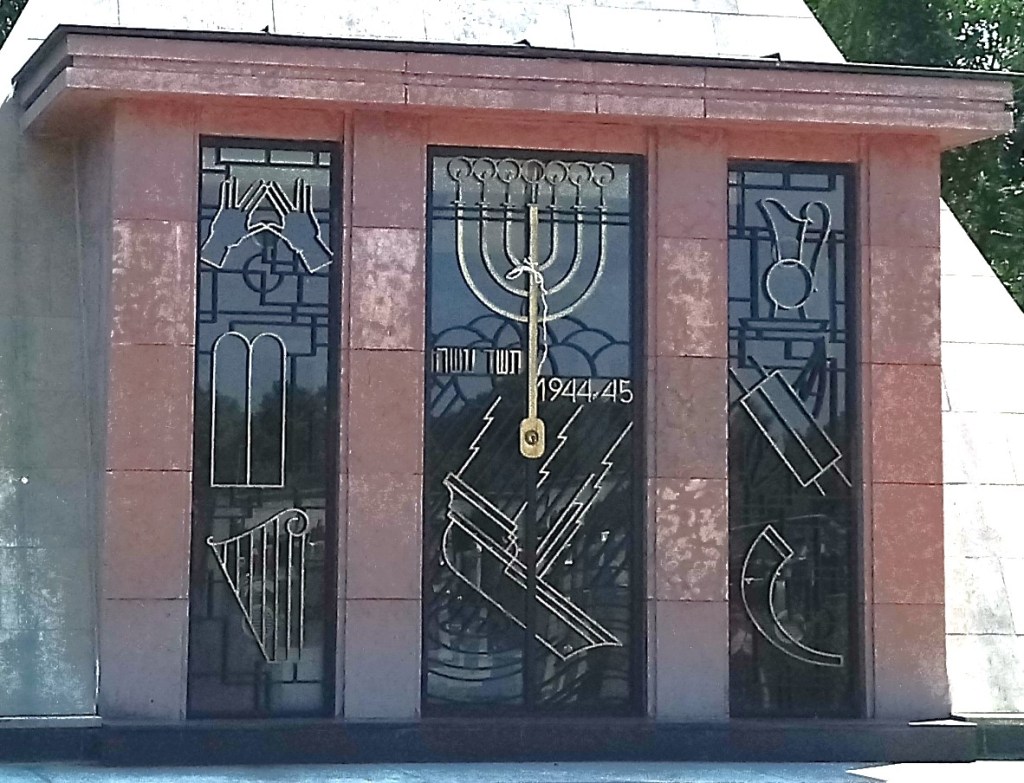
Bandi Schima was commissioned by the Jewish community leaders to create the decorative metalwork for the Monument .
Ernő Munkácsi (1896-1950, lawyer, legal writer, museum director, Jewish community officer) commemorates the merits of both the architect Manó Adler and the metal artist Bandi Schima – History of the Jewish Community of Győr, 1930-1947 (see Sources)
The Monument was unveiled on 15 June 1947. It is known that the ceremony was attended by Zoltán Tildy, President of the Republic, less known that he was accompanied by Prime Minister Lajos Dinnyés, and ministers István Dr. Ries, Gyula Ortutay and Ernő Mihályfi. Of course, national and local Jewish organizations, as well as top leaders of the American Joint and the town of Győr, were also present. Representatives of the Red Army were in attendance.
To recall an always topical quote from Prime Minister Dinnyés’ speech:
“… no truer and nobler verdict can be delivered by Hungarian democracy than that we all pledge to create a life under Hungarian skies that will make it impossible for hatred, inhumanity and evil to reappear within the borders of our country” – History of the Jewish Community of Győr, 1930-1947 (see Sources)
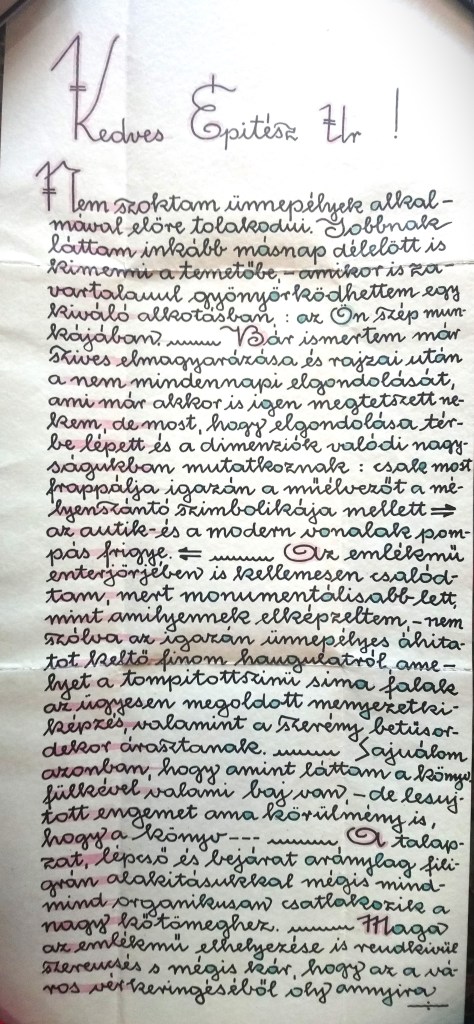
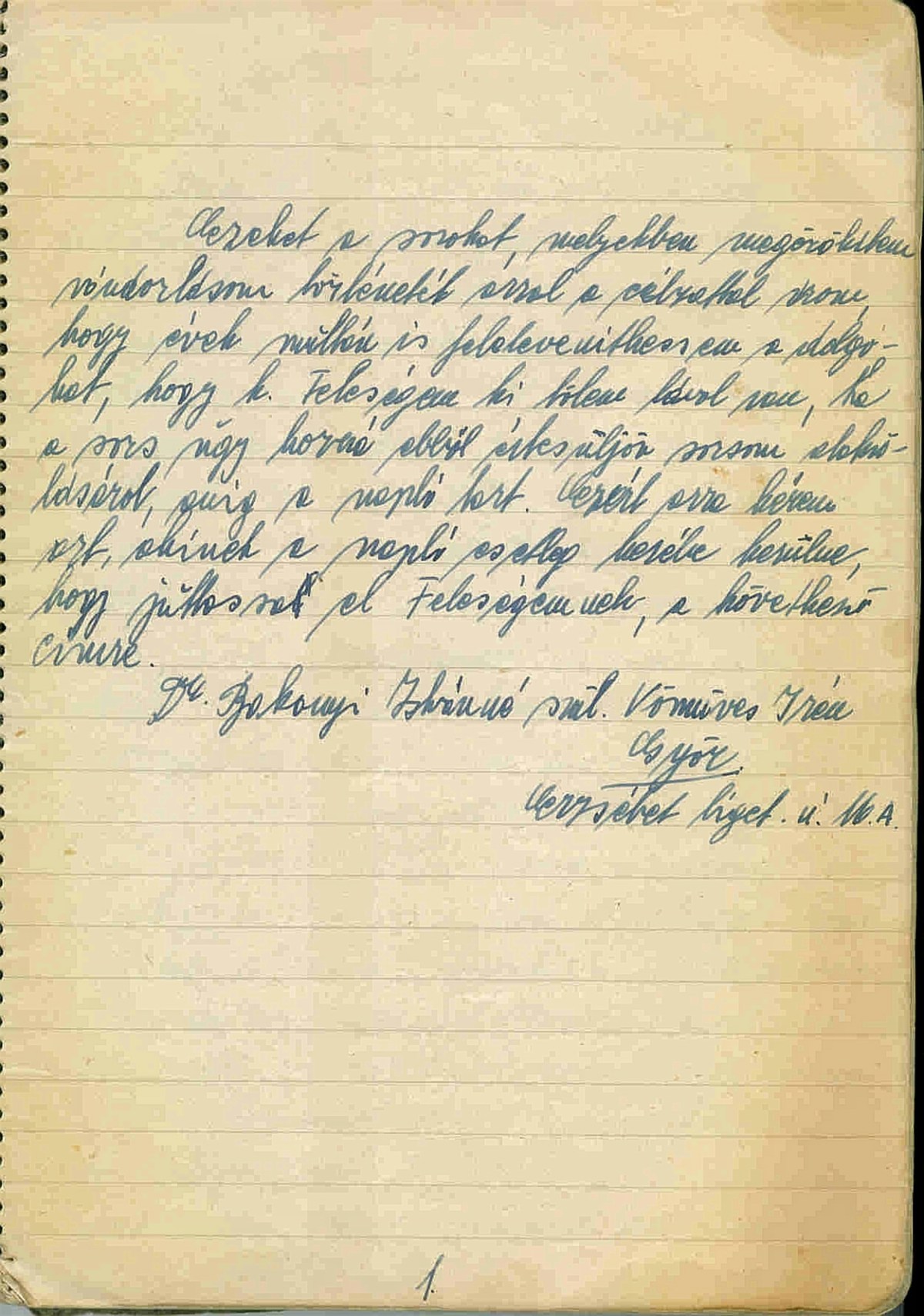
On 18 June 1947, three days after the unveiling ceremony, Manó Adler received a letter from Bandi Schima. This unique letter, reflecting Schima’s particular formal demands and the merits of Adler’s work as an architect, was preserved by the architect’s son György.
Here is the transcript of the handwritten letter:
„Addressed with due respect to Mr Manó Adler Architect Győr Dugonits utca 11.
From: Bandi A. Schima Master of Applied Arts H. Zombor utca 46
Dear Mr Architect,
I don’t usually push my luck at ceremonies. I preferred to go to the cemetery the next morning, when I could admire a magnificent work of art: your beautiful work.
Although I was already familiar with your unusual concept after your kind explanations and drawings, which already appealed to me, now that your concept has been translated into space and the dimensions are revealed in reality, only now does the artist really feel the magnificent juxtaposition of antique and modern lines, alongside the profound symbolism.
I was also pleasantly disappointed with the interior of the memorial, which is more monumental than I had imagined, not to mention the subtle atmosphere of solemn reverence created by the subdued smooth walls, the cleverly resolved ceiling design and the modest decorative band of letters. I regret, however, that, as I saw, there is something wrong with the book cabin, but I was also struck by the book … (Schima does not continue the sentence; here he speaks certainly about the Book of Martyrs listing the deportation victims – ed.).
The pedestal, staircase and entrance are all organically connected to the large mass of stone by their relatively filigree design.
The placement of the monument itself is extremely fortunate, and yet it is a pity that it is so far away from the city’s bloodstream and so isolated in a cemetery.
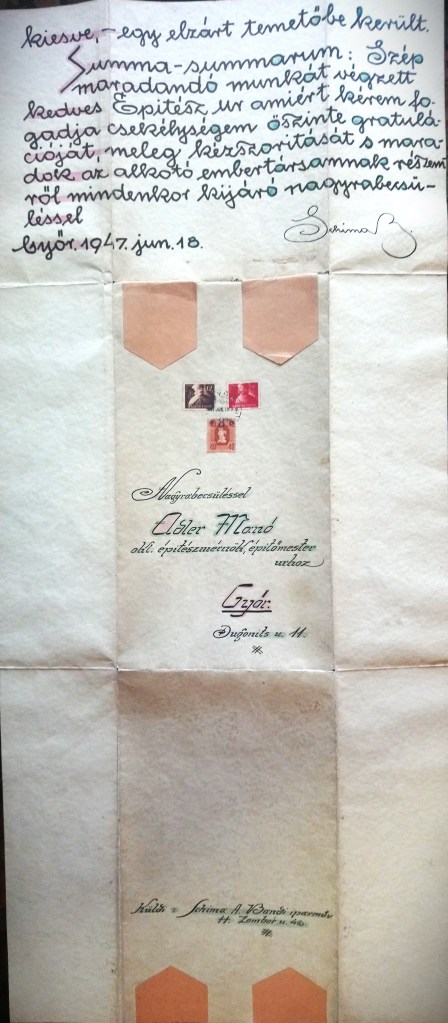
Summa-summarum: a fine and lasting work accomplished by you, dear Mr Architect, for which I offer you my sincere congratulations and warm handshake, and I remain with the high esteem which I always hold for the creative fellow human being.
Győr, 18 June 1947
Schima B.
Bandi Schima’s original letter to Manó Adler, 18 June 1947 – the letter is in the possession of György Adler, photo by Péter Krausz
The Pyramid Monument in 1947, postcard, 1947, regigyor.hu
The Pyramid Monument today, photo by Péter Krausz
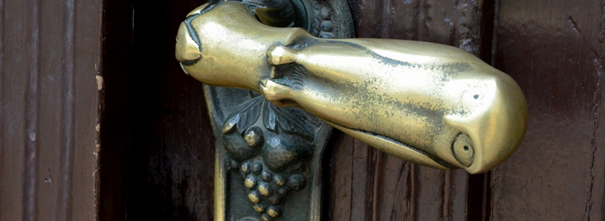
The gate to the Pyramid Monumentwith Menora, Kohana and Levite symbols as well as that of the great disaster, created by Bandi Schima for the Jewish Community of Győr – Photo by Péter Krausz
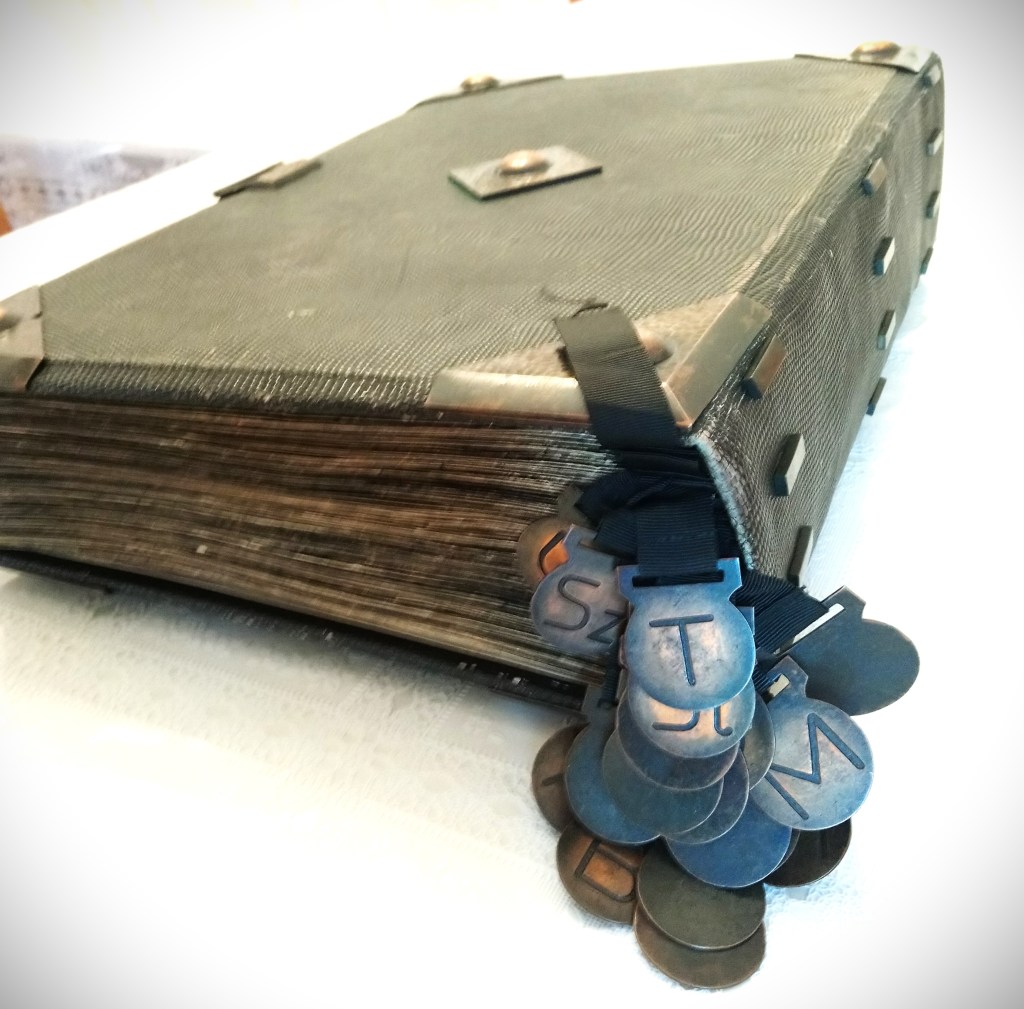
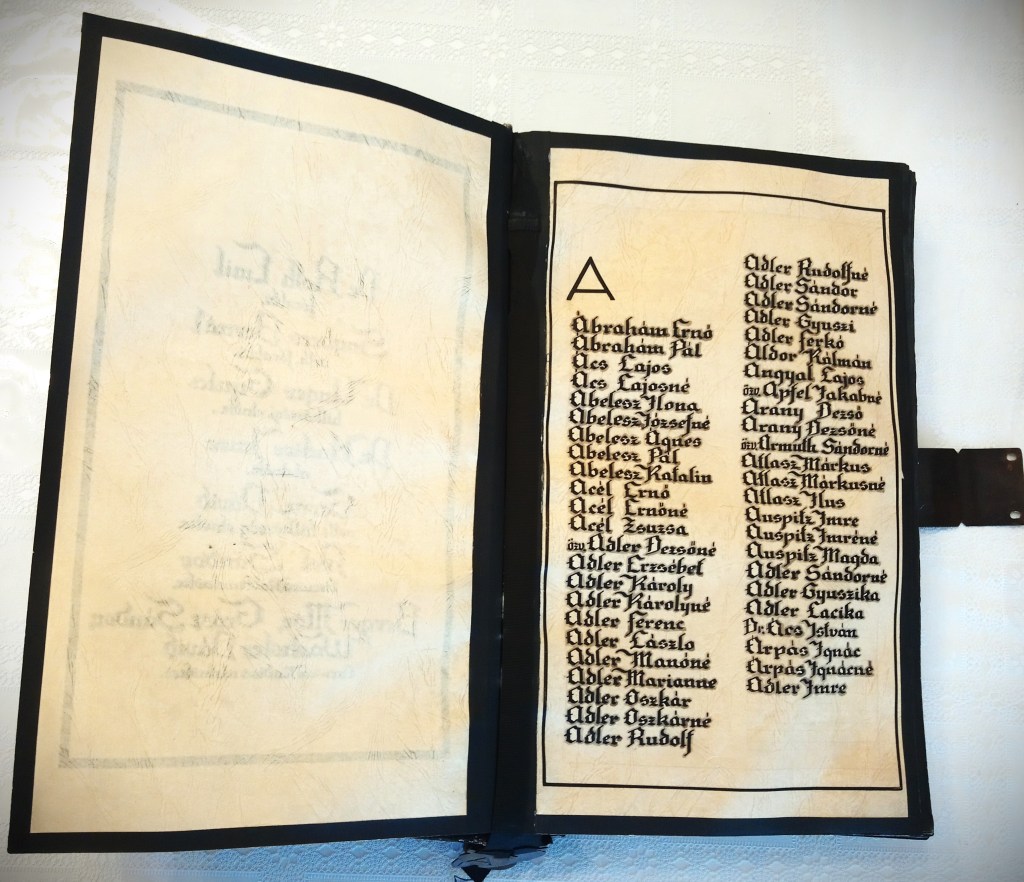
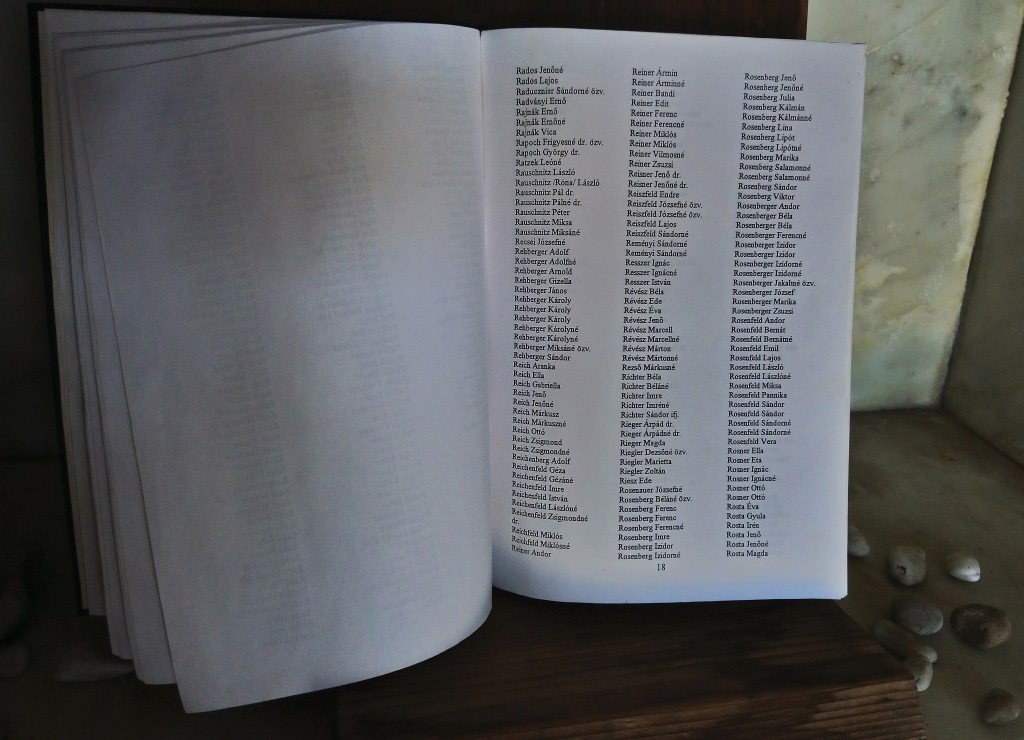
Bandi Schima also created other works to preserve the memory of the tragedy of the Jews of Győr, namely the Book of Martyrs, which contains the names of the victims. For many decades, this completely original metal work, which preserves the names of the murdered, was on display in the Pyramid Hall, where relatives could search for entries about their family members, also in Schima’s handwriting.
The Book of Martyrs, cover plate, by Bandi Schima for the Jewish Community of Győr – Photo by Péter Krausz
For several years now, the book has been housed in the Prayer Room of the Jewish Community of Győr, where its physical integrity is better ensured. It has been replaced by a printed list of names in the cemetery. As new names of martyrs appear, Schima’s original list of names is always completed in his style, by hand.
The Book of Martyrs, bookmarks, by Bandi Schima for the Jewish Community of Győr – Photo by Péter Krausz
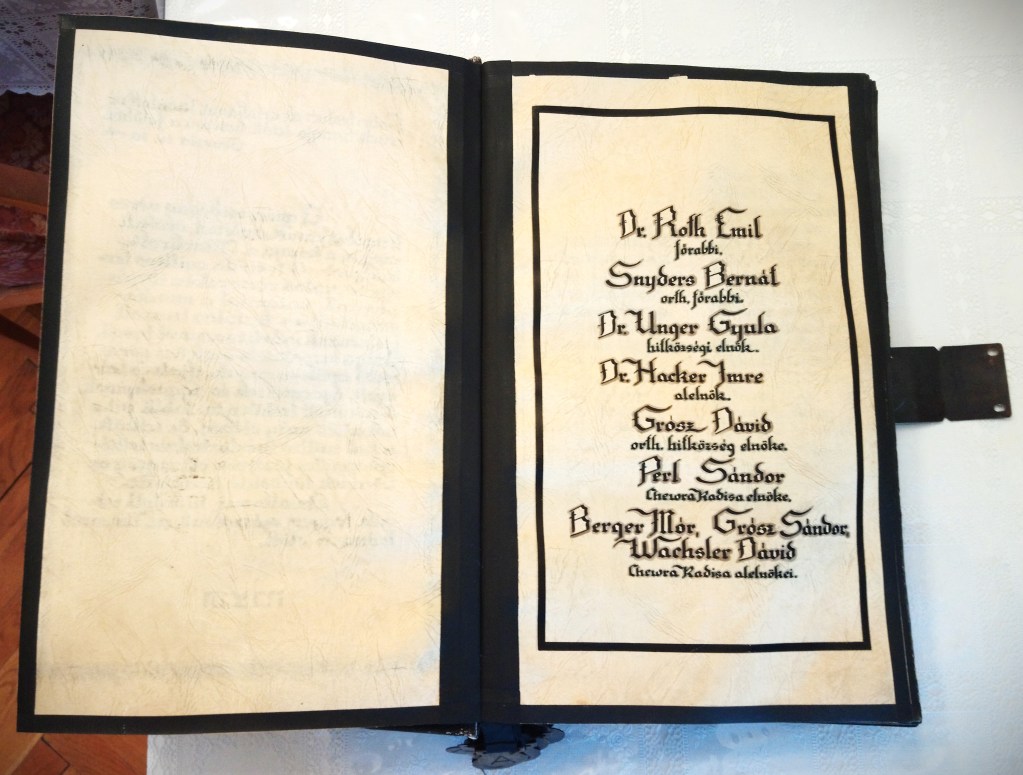
The Book of Martyrs, a list of the murdered Community leaders, by Bandi Schima for the Jewish Community of Győr – Photo by Péter Krausz
The Book of Martyrs, the beginning of the list of the martyrs, where you can see the names of Architect Manó Adler’s wife and daughter (!), by Bandi Schima for the Jewish Community of Győr – Photo by Péter Krausz
Schima, the great metalsmith was attracted to the powerful (Turkish sultan, German emperor, Italian dictator). Apart from this moment, I have not been able to find out his views about the world, since there are hardly any trace of them, except perhaps the caricature of the German Chancellor of the First World War published in this post and similar drawings.
His art and works in memory of the victims of the Holocaust are definitely enduring.
My father, whose extensive family, including wife and children had also perished in the Auschwitz hell, held the artist in high esteem.
Compiled, edited and translated from Hungarian by Péter Krausz
Special thanks to Gyuri (György Adler) for making Bandi Schima’s letter available for this publication and for his useful remarks on the draft text.
I would also like to thank Dr. Emese Pápai, art historian, chief museologist, Head of Department, Contemporary Cultural Centre, Rómer Flóris Museum of Art and History, Győr, for her important comments, which greatly improved the first part of the article.
„Once in Ecuador she was mesmerized by the colors textures and tradition of folk art and began to collect and curate the first popular art collection in Ecuador, a collection that would later be touring the world.” [1]
Olga Fisch Anhalzer, painter and textile artist, was born in Budapest in 1901 and died in Quito (Ecuador) in 1990. Her father was a porcelain merchant and she was the fifth child in a line of four brothers.
From an early age she wanted to be a painter.
Győr in 1913, Rába bridge, the Synagogue building on the upper left side – regigyőr.hu
Her family moved to Győr in 1906.
The gravestone of Olga Fisch’ parents in the Győr cemetery – gyorjewish.org
Olga attended the Hungarian State High School for Girls and Gymnasium in Győr (Kazinczy Ferenc Gimnázium today) as from 1911 until the end of the 1915-16 school-year, thereafter she became a private student at the Benedictine Gymnasium in Győr.
During the Council Republic in Hungary, she painted political posters. She then moved to Vienna, where she became a ceramics designer at the Wiener Werkstätte. [2]
The logo of Wiener Werkstätte – Wikipedia
Besides her work, she illustrated books and worked for Népszava in Budapest (daily paper of the Social Democrats established in 1873 – ed.).
Female head, by Olga Anhalzer, engraving, cold needle, 1925 – axioart.com
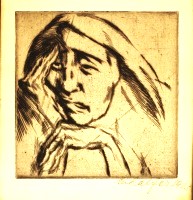
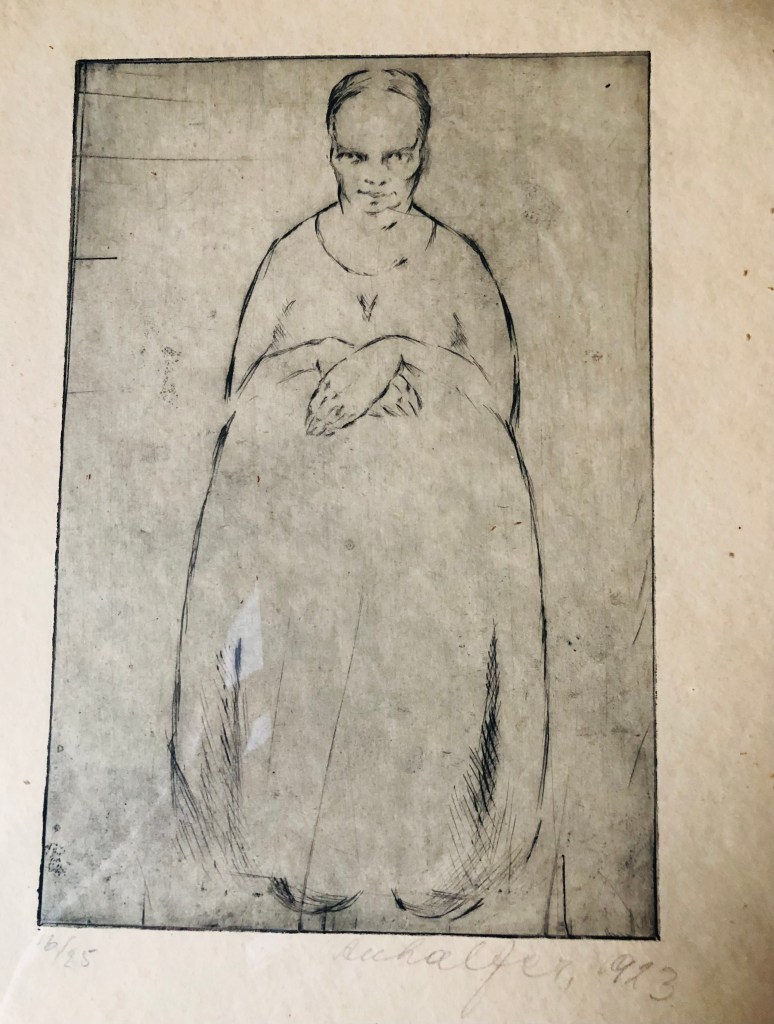
Old woman, by Olga Anhalzer, etching, signed, 1923 -the collection of the Bánki family, The Netherlands, photo by Esther Bánki
In 1920, she used her paternal inheritance to move to Düsseldorf, where she met and married the sculptor Jupp Rübsam.
Family Anhalzer, the parensts on the left, Olga second from the left in the 2nd row, her first husband, Jüpp Rübsam to her right, 1920s – collection of family Anhalzer, Quito
She studied at the Düsseldorf Academy of Arts. She and her husband worked together, creating public sculptures, painting and drawing. Around 1930 they divorced, but remained on good terms – shortly afterwards she married Béla Fisch, a trader in an Italian-Yugoslavian cement factory.
The staircase of the Düsseldorf Academy of Art today (the National Socialist “purge” in 1933 led to the dismissal of several lecturers, including Paul Klee) – kunstakademie.dusseldorf.de
She and her husband travelled a lot, and she was able to spend a whole year in Africa (Algeria, Senegal, Eritrea). They returned to Germany in 1934, but sensing the spread of Nazi ideology, they returned to Győr.
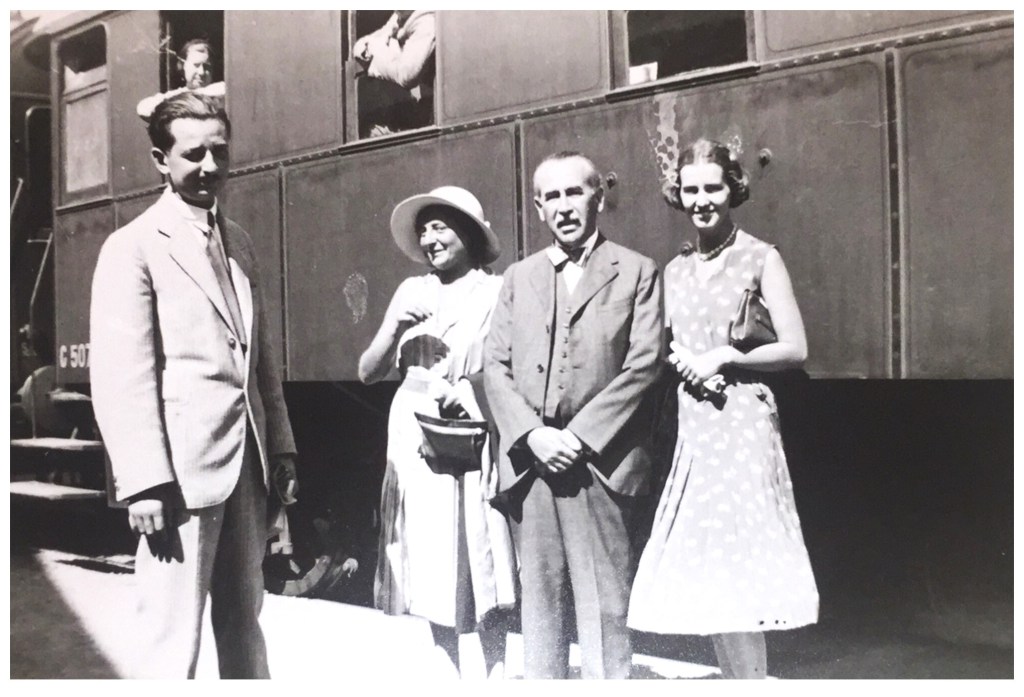
Somewhere at a railway station, from left to right Pál Anhalzer, Olga’s brother, Olga and friends of the family, 1930s – Esther Bánki’s collection, The Netherlands
But they also perceived the historical dangers in Hungary. So, they left for Brazil aboard a Zeppelin airship. In 1939, they finally settled in Quito, capital of Ecuador, with the support of Olga’s brother. Here she became a professor at the local school of fine arts.
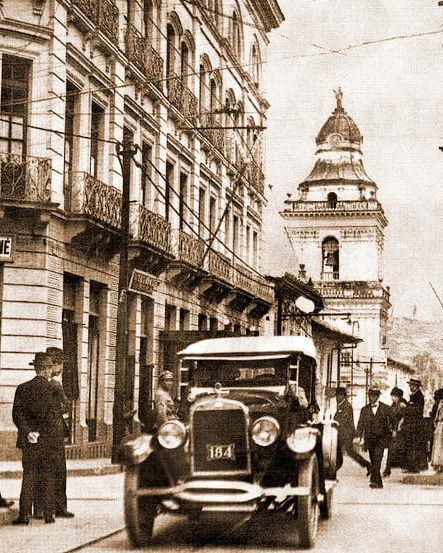
Quito in 1930 – facebook.com
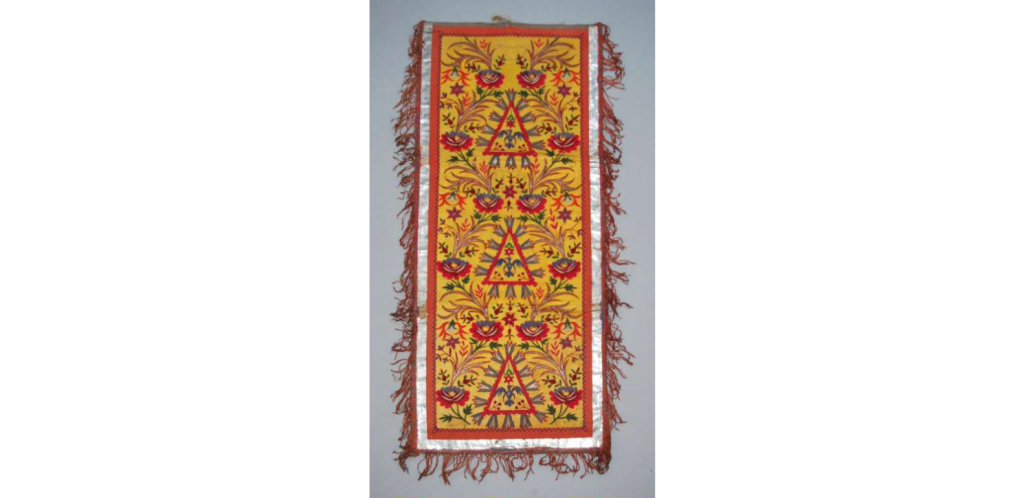
She started weaving her own unique carpets combining Hungarian and Indian motifs, and discovered the art of the craftsmen of the Indian villages around Quito. In 1940, by chance, he ran into Lincoln Kirstein, then director of MoMa New York [3], who made her an offer to buy a rug for 300 dollars, an important sum at that time. Olga Fisch used this money, among other things, to open her folklore gallery in Quito in 1942, which is still in operation today.
Gallery Olga Fisch in Quito today – tripifyapp.com
Her relationship with the Native American folk artists soon became a two-way street: she learned from them their motifs, weaving techniques and exotic use of materials, and taught them to use stronger knotting, typical of Persian rugs, instead of the local loose weaving. At the same time, she became a regular customer and buyer for the Indian artists. She was not only interested in carpets: she also had interest in costumes, masks, musical instruments, paintings and ceramics, as well as clothing, from classic ponchos to modern garments.
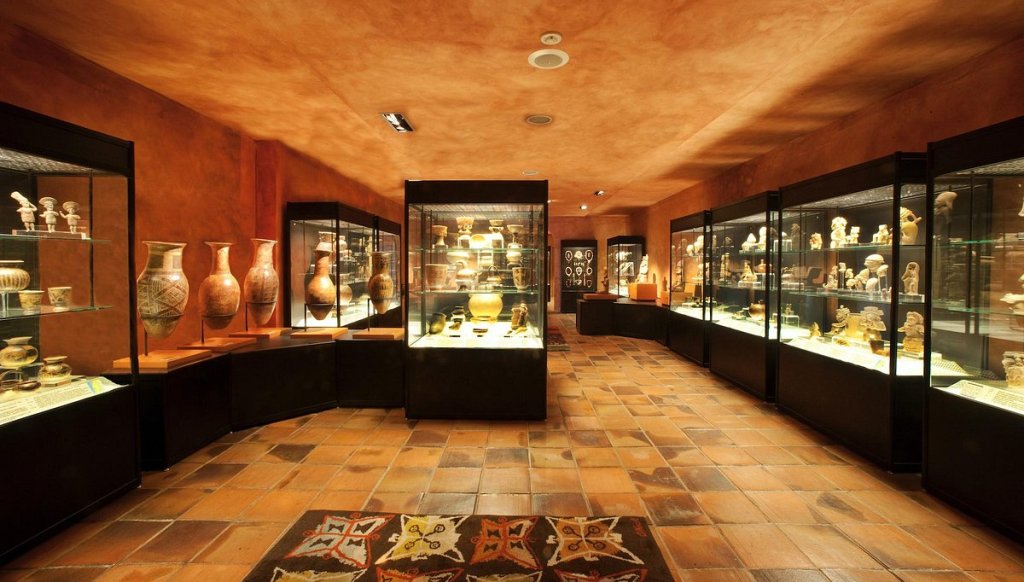
The jewel of the gallery is a unique collection of pre-Colombian art – tripadvisor.com
Next to the gallery, she ran her own carpet weaving workshop, where she also worked a lot. She organised fashion shows, the business became internationally known and she had to move to larger premises in the 1960s. Her husband died in 1958, from then on, she ran the business alone, later with her niece and her descendants.
Not only did she collect and trade, but in 1962 she was instrumental in the creation of the Instituto Ecuatoriano de Folklore (Ecuadorian Institute of Folklore), documenting art that had previously been of no interest to anyone, and founding a scientific journal. Her role in drawing the attention of Ecuadorian intellectuals to ancient indigenous art is indisputable.
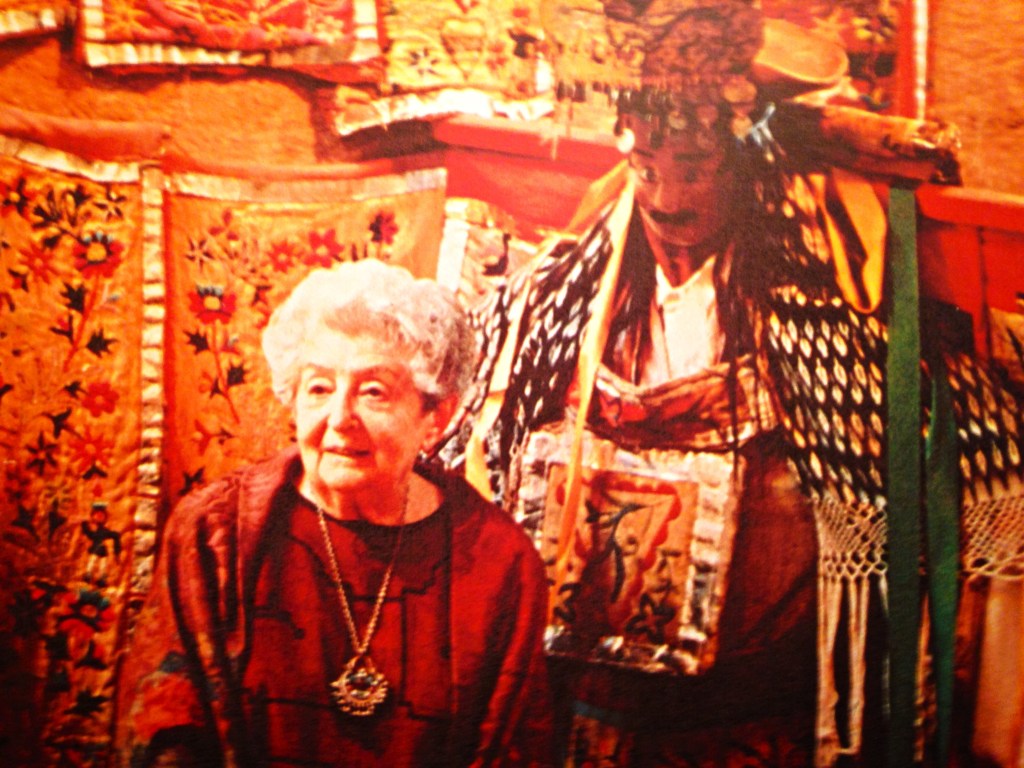
Olga Fisch in old age – twitter
Some accuse Fisch of “commercialising” Indian folk art, as she replaced the free hand of the artist with commissioned pieces. Others argue that the unintentional infiltration of Hungarian forms and the mixing of Indian and Hungarian folk art has broken the integrity of Ecuadorian folk art. Others consider it most significant that she discovered and made visible to others the indigenous values and that the inhabitants of many villages were able to earn a secure livelihood through Fisch’s work in the organizing and trading of the indigenous culture.
The Christian Science Monitor quoted her in 1980 and wrote this: “‘When I first started collecting the local Indian art and then opened this gallery, people were shocked,’ she says. I remember someone asking, ‘How can you, as a cultured European woman, collect this trash?’ Largely because of the efforts of Olga Fisch the artifacts produced by Ecuador’s 250 Indian tribes are no longer regarded as trash. Over the decades she has helped thousands of Indian artists and craftsmen acquire the means of placing their wares in the world market.”
Fisch visited her home country once more in 1987. Several exhibitions were held in Hungary: in 1988, her collection of Indian art was shown at the Ethnographic Museum.
The British Museum has bought dozens of works of art from Olga Fisch – britishmuseum.org
In Ecuador, Fisch’s name is well known, but even in the United States of America, several public collections, the Lincoln Center, the MoMa and the United Nations Palace hold a weaving of her. In 2025, a major exhibition of Olga’s legacy will be organised at the National Museum of Ecuador. Her niece, Margarita Anhalzer, is working on a book about the adventurous life of Olga Fisch.
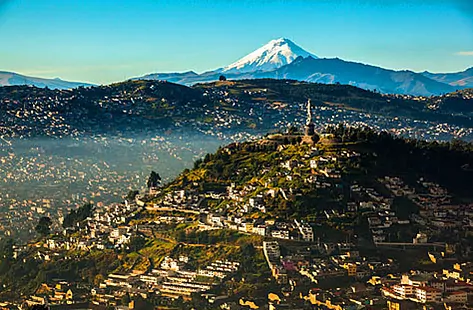
Quito, with Cotopax volcano in the background – elmundo.es
Hungarian State High School for Girls and Gymnasium, Budapest, Könyvtár | Hungaricana; Arcanum (thanks for the information to Esther Bánki, Netherlands)
St Benedict’s Catholic High School, Győr, 1917 Könyvtár | Hungaricana (thanks for the precision to Esther Bánki, Netherlands)
Thanks to Olga Fisch’s niece, Margarita Anhalzer, who lives in Quito, for her personal details and clarifications.
[2] The Wiener Werkstätte (Engl.: Vienna Workshop), established in 1903 by the graphic designer and painter Koloman Moser, the architect Josef Hoffmann and the patron Fritz Waerndorfer, was a productive association in Vienna, Austria that brought together architects, artists, designers and artisans working in ceramics, fashion, silver, furniture and the graphic arts. The Workshop was “dedicated to the artistic production of utilitarian items in a wide range of media, including metalwork, leatherwork, bookbinding, woodworking, ceramics, postcards and graphic art, and jewelry.” It is regarded as a pioneer of modern design, and its influence can be seen in later styles such as Bauhaus and Art Deco.
[3] The Christian Science Monitor, 15 September 1981
Handicrafts by Judit Siklósi in memory of those killed in the Holocaust
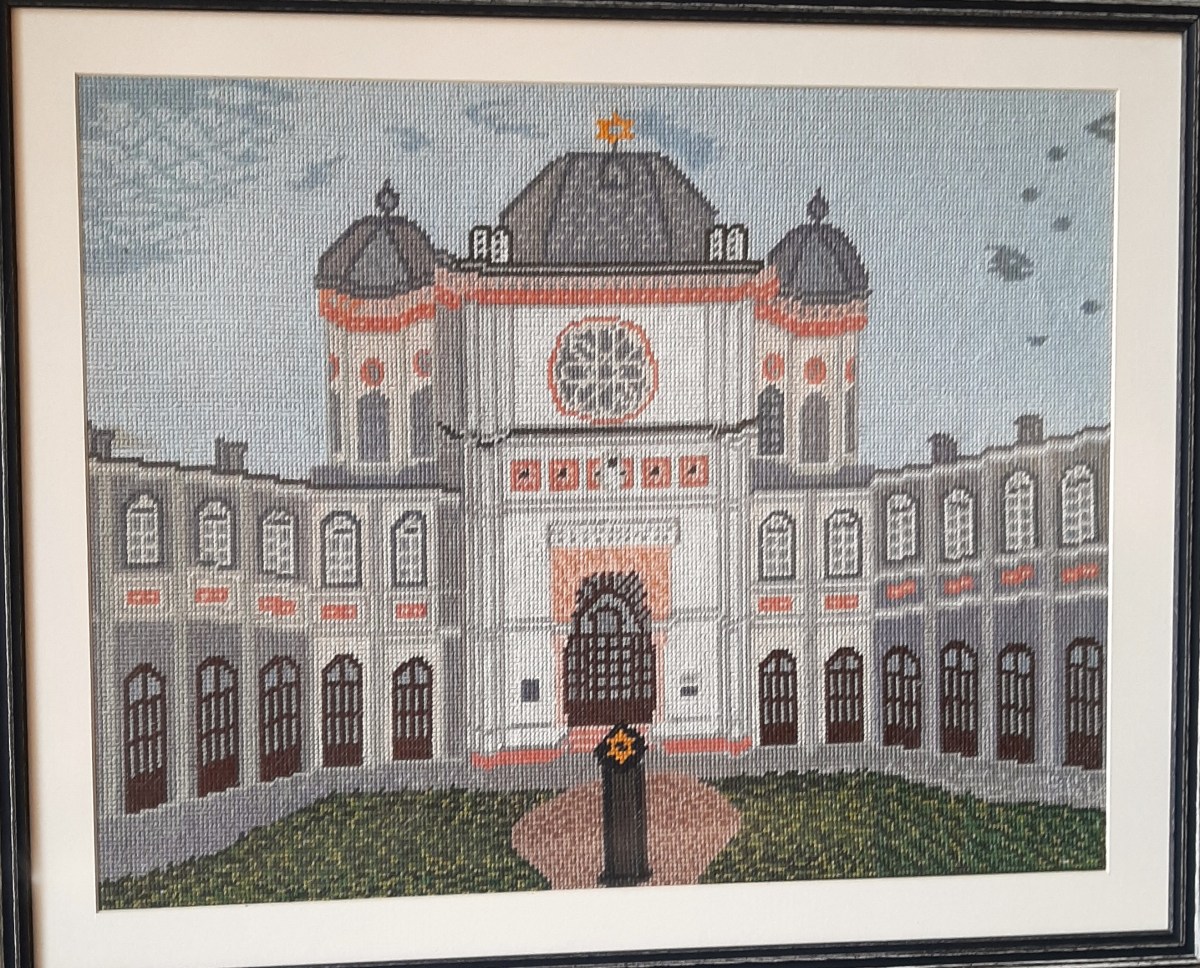
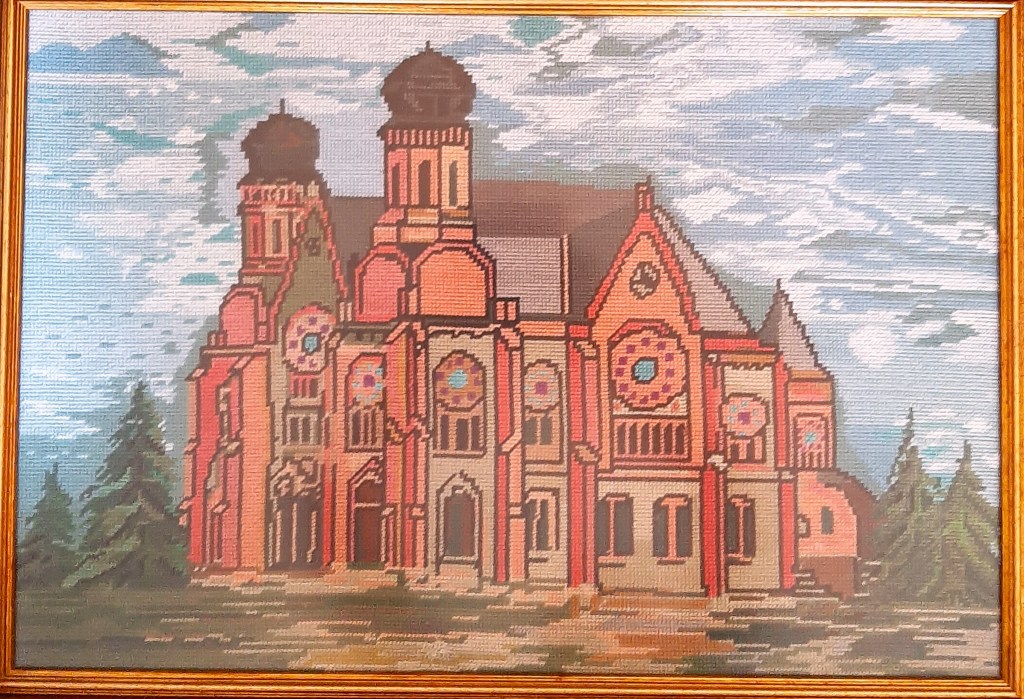
I started creating tapestries depicting Hungarian synagogues because my husband, Vilmos Siklósi, born in Budapest was a child of survivors. When we moved to Zalaegerszeg in 1991, he founded the “Peace Shalom Hungarian-Israeli Friendship Society” to promote cultural and economic exchanges between the two peoples.
Synagogue of Zalaegerszeg, tapestry by Judit Siklósi, 2004 – Photo by Judit Siklósi (built in 1903-04 based on the designs of József Stern using elements of Romanesque and Oriental styles – editor)
In 1995, the Jews of Zalaegerszeg awoke from their sleep and re-established the local Jewish community. At that time there were still survivors in and around Zalaegerszeg. My husband led the community until his death.
In 2004, the synagogue in Zalaegerszeg turned 100 years old currently serving as an exhibition and concert hall. For this anniversary I sewed the first tapestry depicting the synagogue in Zalaegerszeg. Aunt Bözsi, Imréné Anhalczer, a survivor, helped me to buy the material for my first creation. The tapestry measures 130×160 cm, has 500,000 stitches and was made in 1’700 man-hours.
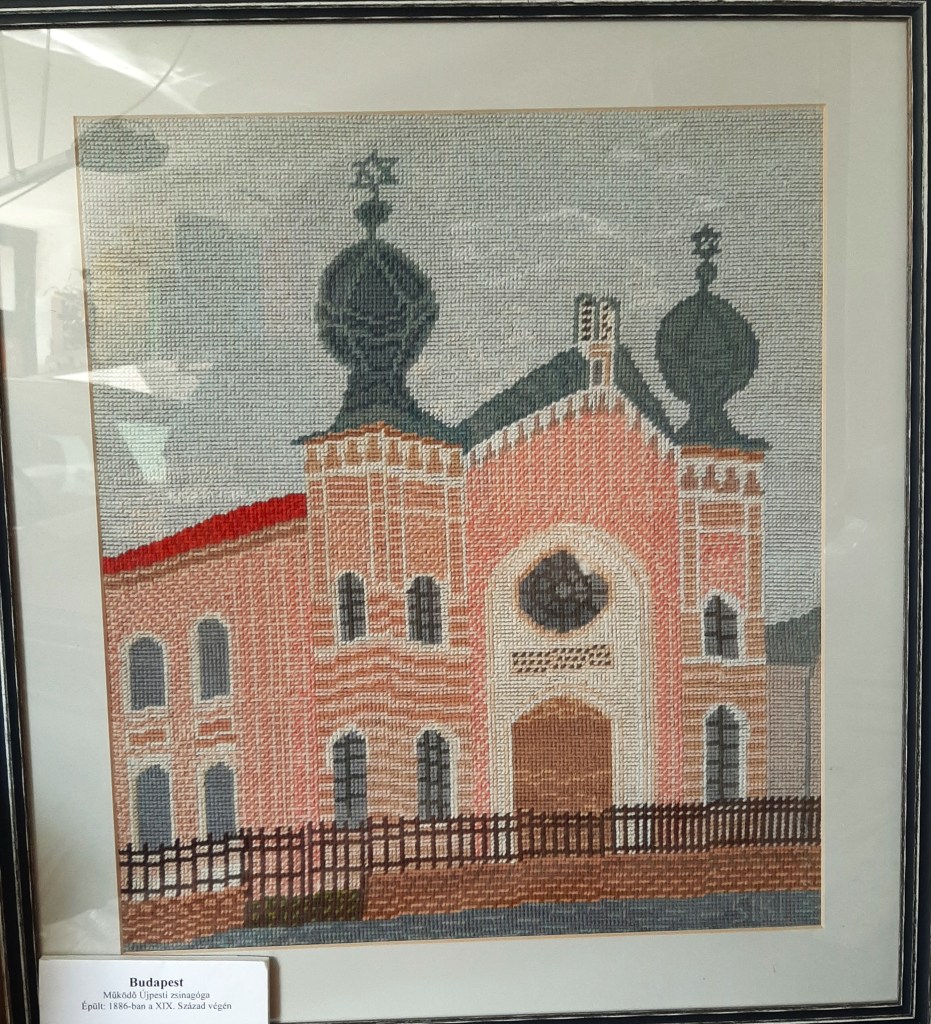
Újpest Synagogue (Budapest), tapestry by Judit Siklósi, 2014 – Photo by Judit Siklósi (built in 1885-86 based on designs by Greier or Gränner (first name unknown) or Jakob Gärtner, featuring neo-Moorish motifs – ed.)
Seeing this work, Borgó (Dr. István Csaba György István [BORGO] (b. 10 May 1950, Marosvásárhely, RO, 10 May 1950), a Hungarian painter, graphic artist, tapestry designer, sculptor and teacher of Transylvanian origin – editor) said that what I had realized was so beautiful that he would organize an exhibition of it if there were more such works. After all, it was not he who organised my first exhibition, and I haven’t met him since, but it was on his suggestion that I should sew more that I took up preparing synagogue tapestries.
Synagogue of Debrecen, tapestry by Judit Siklósi, 2011 – Photo by Judit Siklósi (built in 1884 based on plans by Jenő Berger, architect of Debrecen, featuring late eclectic motifs – ed.)
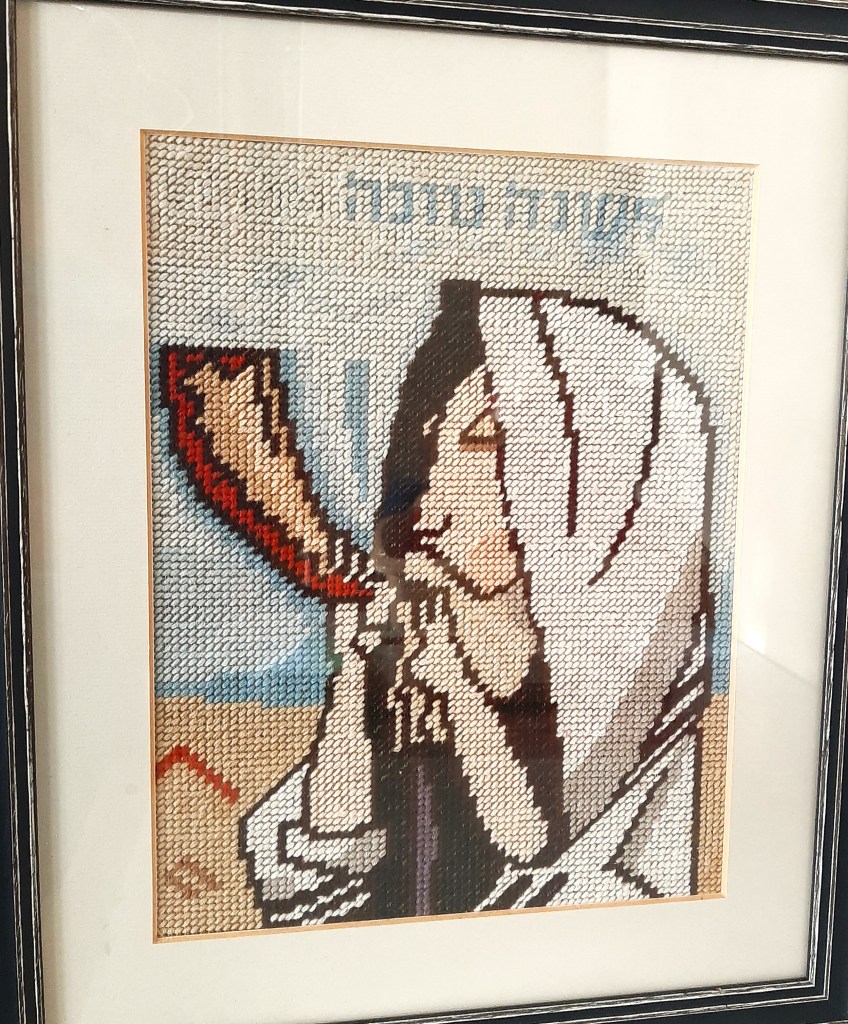
In addition to synagogues, I also sew Jewish holiday images and symbols.
Synagogue in Lendava, tapestry by Judit Siklósi, 2004 – Photo by Judit Siklósi (built in 1866 in present-day Slovenia under Rabbi Moses Schacherlesz – ed.)
How are these pieces made? I draw the synagogue building myself on the tapestry fabric and follow the drawing with tapestry stitching. Most of the pictures are sized 40×50 cm.
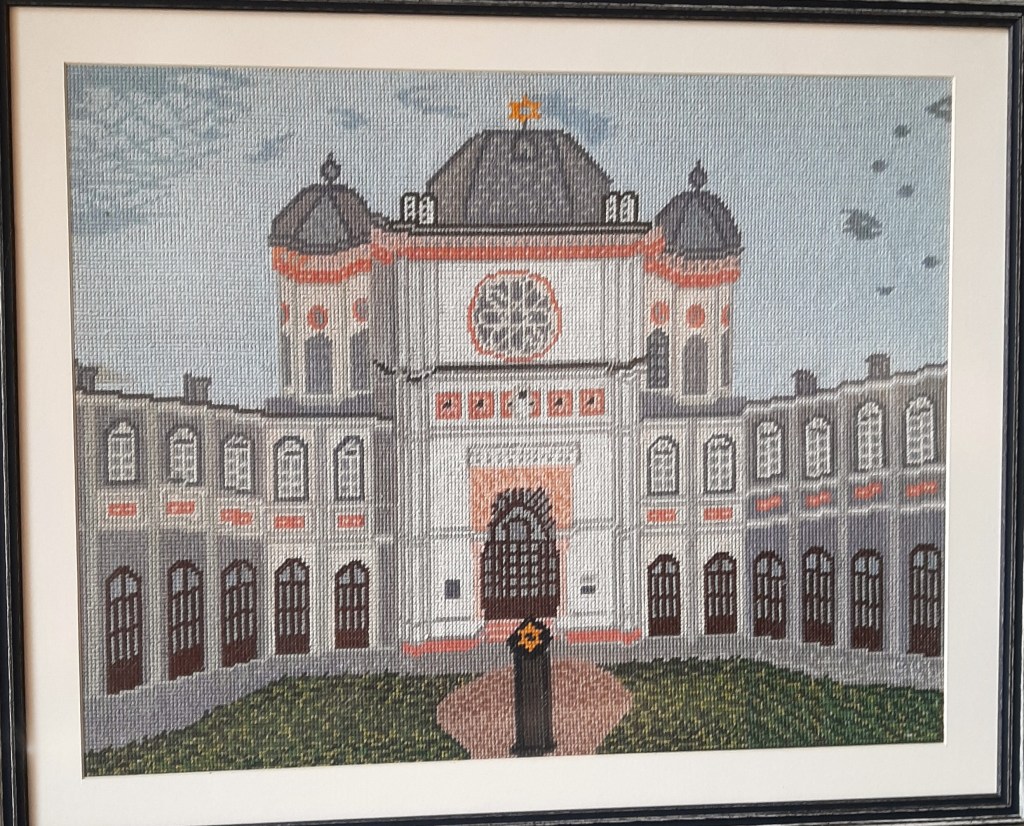
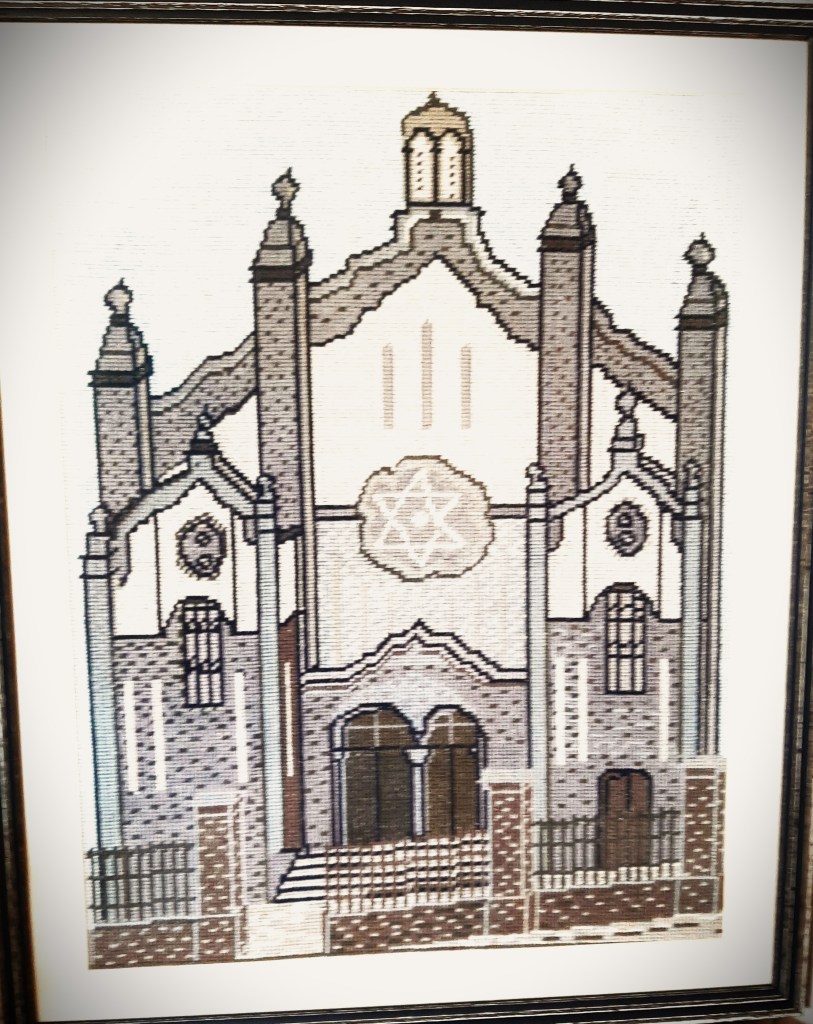
Synagogue of Győr, tapestry by Judit Siklósi – Photo by Judit Siklósi (built in 1869-70, based on the Moorish and historicist-art nouveau designs of architect Károly Benkó – ed.)
So far, I have had eighteen exhibitions including abroad, e.g. in Marosvásárhely. Other venues include Hévíz, Zalaegerszeg, Bak, Szombathely, Mosonmagyaróvár, Győr, Pécs, Budapest (ORZSE), Szolnok, Tiszafüred, Szekszárd, Újpest, Siófok, Nagyatád (all in Hungary – editor). Several newspaper articles about these exhibitions were published, for example in Új Élet (“New Life” – newspaper of the Association of Jewish Communities in Hungary – editor). If I am invited to an exhibition anywhere, I am happy to go and produce a tapestry of the synagogue of the inviting city as a memento.
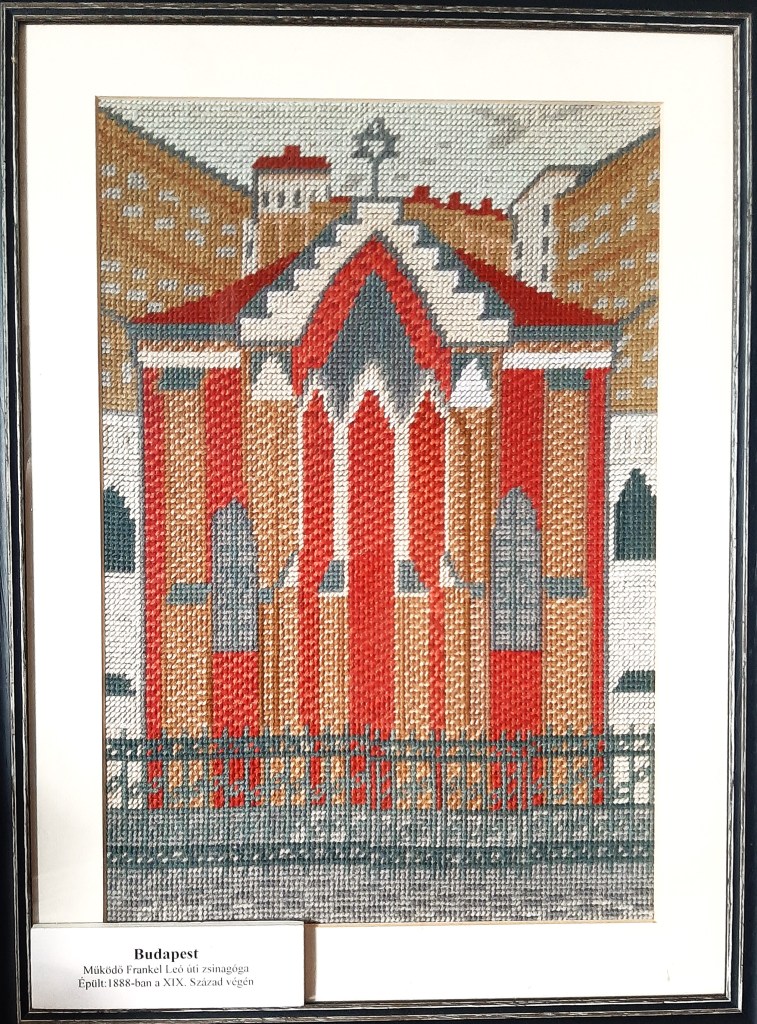
Synagogue of Frankel Leó Street (Budapest), tapestry by Judit Siklósi, 2011 – Photo by Judit Siklósi (built in 1887 based on the neo-Gothic style plans of architect Sándor Fellner – ed.)
In Nagyatád, I was confronted with the fact that the people of the countryside do not even know that a synagogue and a Jewish community once existed in their town. It was then that I realised that preserving the memories of synagogues is a tribute, a kind of “cultural mission” to the memory of our fellow human beings who were cruelly killed in the Holocaust.
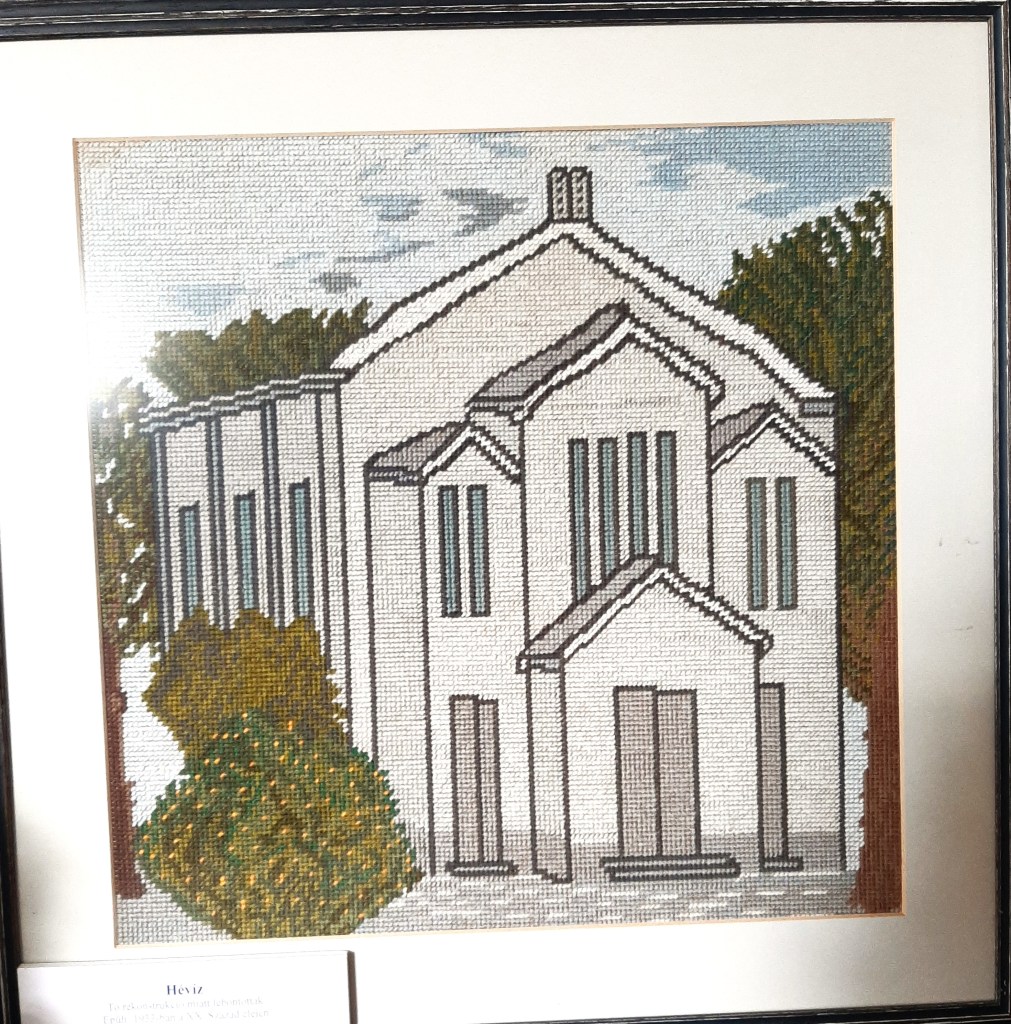
Synagogue in Hévíz, tapestry by Judit Siklósi, 2005 – Photo by Judit Siklósi (built in 1933, demolished in 1977, in its place stands a Holocaust memorial – ed.)
I sew colour and black and white tapestries, the latter of synagogues that no longer exist because even the buildings have been destroyed, leaving no trace or memory of them.
Synagogue in Tiszafüred, tapestry by Judit Siklósi, 2012 – Photo by Judit Siklósi (built in 1912 in Art Nouveau style; no longer exists, the remaining block of the building is a furniture shop; there is a small plaque on the side of the building commemorating the victims of the Holocaust – ed.)
In short, I started the series to create pieces that would serve as a reminder and at the same time strengthen the connection of the local audience, of the city, to a destroyed piece of our common past.
Judit Siklósi
Those interested and wanting to purchase or order a piece may want to contact Judit at the following address: zegjuti@gmail.com (ed.)
Historical model changes in Győr and their relationship with the religious (ethnic) structure and spatial location of the population
Excerpts from a study by Dr Gyula Szakál, Associate Professor in ret., Economic Historian, Széchenyi István University, Győr
In the first part, you learned how the Jewish population of Győr came into being and how it co-existed with the majority community of other religions over the centuries. In part two, you will learn how the elite of Győr responded to the political crisis and human tragedy of 1944.
The reaction of the Győr elite to the political and human crisis of 1944
An important component of the economic mentality is the ability to gain, keep and overcome disadvantages. We have seen that from the 1850s to the turn of the 1890s, all the behavioural traits appeared in Győr. To what was due this flexibility and sense of reality? Here we must return to the historical path and the time factor. In our city – as in the country as a whole – the organic development of local society from the 1848-49 War of Independence to the Second World War or its eve (here I mean the time of adopting the restrictive laws on Jews) was not disrupted by external political forces. Within families and in the micro- and macro-textures of the urban elite, two or three generations of experience and patterns of behaviour were passed on. [5]
The roots of this pattern of behaviour go back to the city’s more distant past. The need and struggle to change from military town, episcopal city, patrician town, open trading town and then industrial town, the acceptance of the New has always won. Economic and human relations have always been open. This is the reason for the city’s inclusiveness.
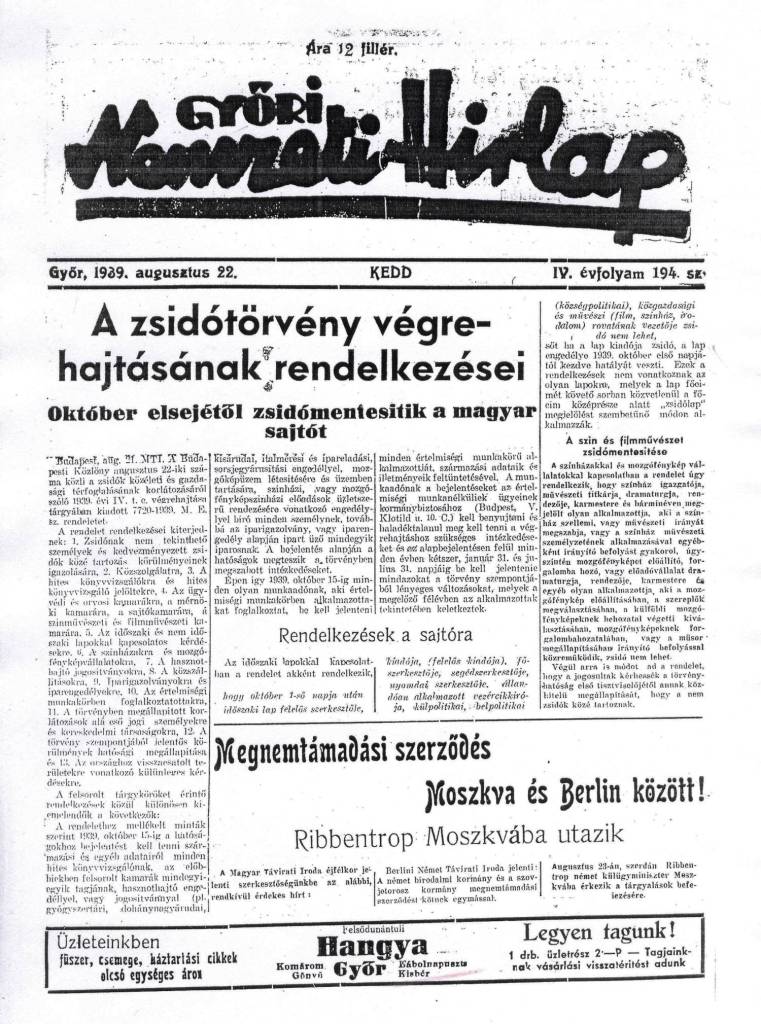
Győri Nemzeti Hírlap announcing the 2nd law oj Jews – rieth.hu
The attitude of Győr’s elite was characterised by a sense of reality and social awareness, solidarity and personal responsibility. … In spite of overcoming economic crises and successful model changes, urban elites and their values were also affected by the events of the Second World War, including the laws on Jews and attitudes towards them.
In any case, from the mid-19th century onwards, Győr’s Jewish society became very quickly integrated with the city’s other religious populations. This was a consequence of the overwhelming majority of the Jewish population of the town belonging to the Neologue community and the resulting physical appearance and, crucially, mentality. Naturally, this also required the welcoming, opportunity-seeking attitude of the Christian economic and political elite as a partner. In industrial joint-stock companies seeking to modernise local economic life, or even in Masonic lodges attempting to improve society, the city’s most prominent citizens could cooperate regardless of their religious affiliation. One, if not the decisive, reason for this was that business competition was not linked to ethnicity but to personal performance.
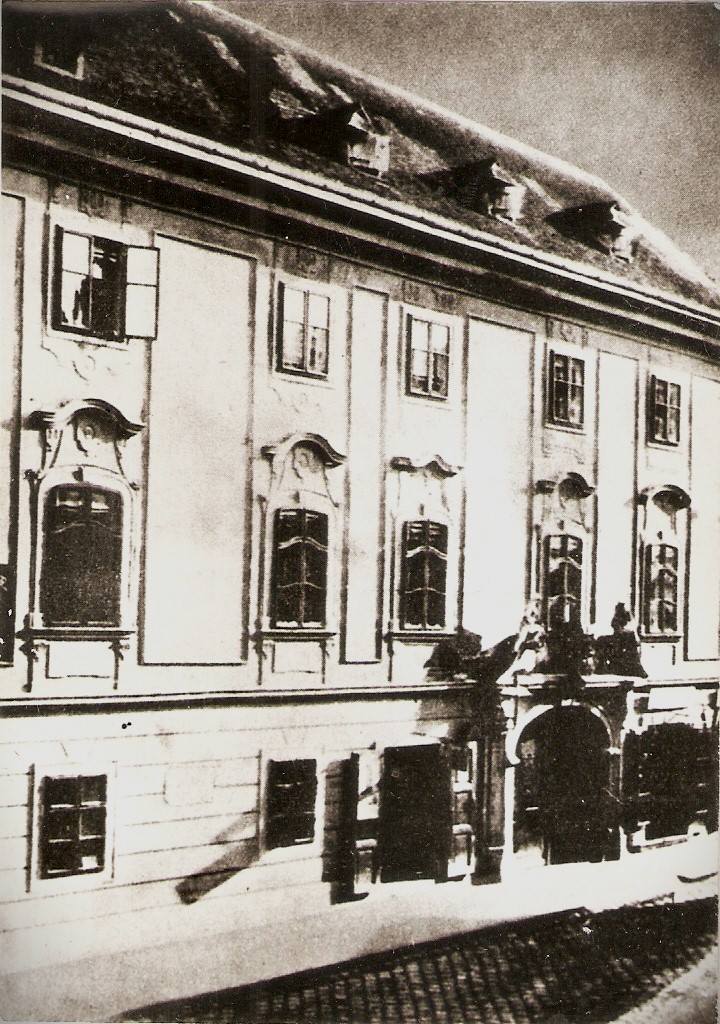
The Józsa-house or Zichy Palace in Győr,with Atlases and commercial publicity, Liszt Ferenc u 20 – Photo: József Glück, around 1920
The quality of a society – and this is even more true for local communities – depends on how it treats immigrant aliens, minority religious and ethnic groups. In the case of Győr, 10% of the population after the turn of the century was Jewish. Among the economic elite, they held a stable position of around 30%, while in the Legislative Committee (of the city) they accounted for 20-30% of the members. They were therefore an inescapable part of the economic and political life of Győr. If we look at the network of relations and the culture of interaction in the bourgeois society of the time, we do not find any tensions that were specifically induced by the antagonism between the Jewish and Christian communities. The best example of this is the Masonic lodge Philanthropy, founded in 1901, in which Christian citizens were involved in addition to Jewish members. Two memoirs, in which no grievances are mentioned, testify to the smooth relations between the two religious groups. [6]
Bishop’s Palace- Photo: József Glück, around 1920-30
However, it is worth mentioning the daily Dunántúli Hírlap, published by the Bishop’s Office of Győr, in which more cautious, sometimes harsher, biting articles were regularly published. Their impact was negligible. We asked about this in conversations with the descendants of successful entrepreneurs (the second generation could still remember the 1910s and 1920s), but they did not perceive such a problem.
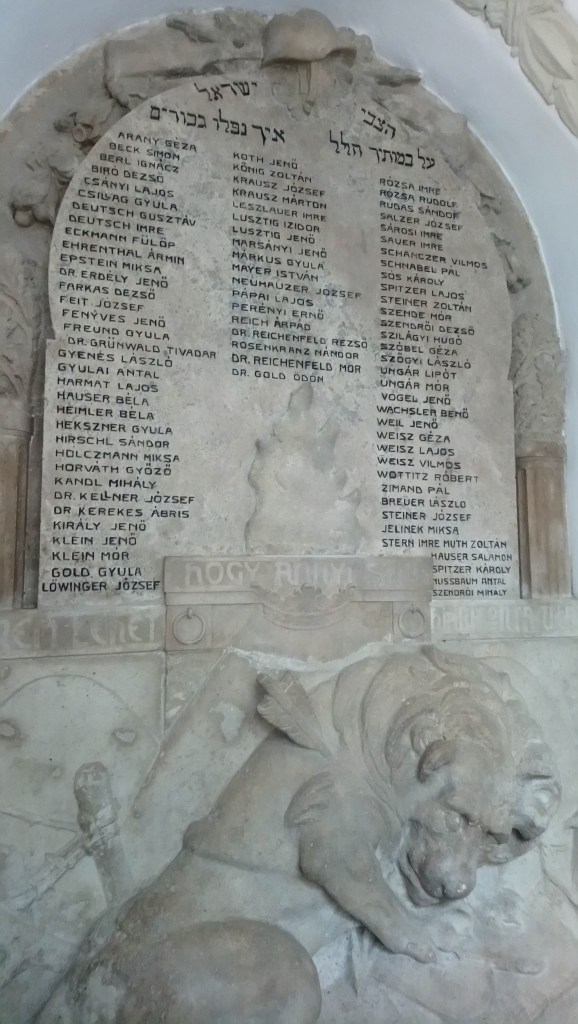
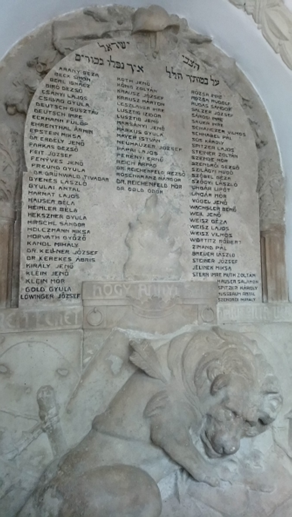
This seamless relationship, the interplay of social events and obligations, is illustrated by a series of ceremonies that accompanied the unveiling of a marble plaque commemorating the 85 Jewish heroes of Győr who died in World War I. It was the autumn of 1923 … The ceremony was attended by a delegation from the Ministry of Defence, the Győr Regiment, the leaders of the city and county administration and representatives of Christian churches. [7] The county bishop of Győr, Antal Fetser, himself spoke moving words of remembrance.
Memorial to the Jewish soldiers victims of WW1 in the Synagogue – Photo by P. Krausz
Peace continued and was extended well into the 1930s. In the spring of 1931, on the occasion of the quarter-century anniversary of the inauguration of the county bishop, Dr. Mór Schwarz, Chief Rabbi of Győr, praised the activities of the high priest with striking respect, obviously not without oratorical turns. Almost all Jews in Győr remembered that the wave of anti-Semitism that had appeared at the beginning of the 1920s had largely bypassed the city.
The Back Mill at the turn of the century- regigyor.hu
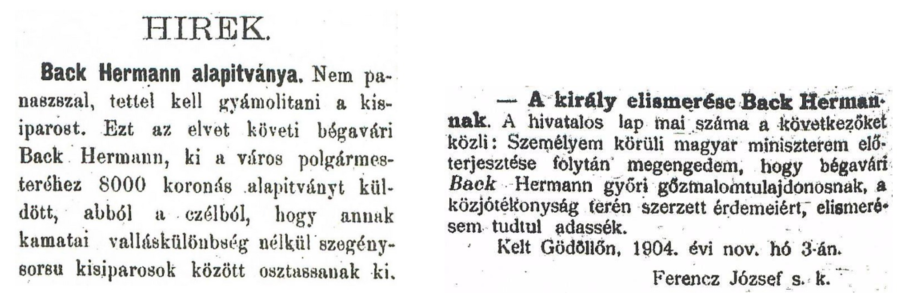
Coexistence and supportive relationships worked on several levels. Around the turn of the century, Ignác Schreiber, a descendant of a former wealthy grain merchant family, set up a foundation to support students, helping those in need regardless of their religious affiliation. The foundation of Hermann Back – the family had long been baptised – helped start-up entrepreneurs.
News about Hermann Back’s foundation and the emperor’s recognition, Győri Hírlap, 9 November 1904 – gyoriszalon.hu
Even after the First World War, the establishment of various foundations was linked to Jewish citizens of Győr. Berta Kohn and her sister Jenny Kohn support the city hospital with a substantial sum of money, which is even appreciated by the Minister of the Interior, Ferenc Keresztes Fischer. In June 1925, the industrialists Lajos Buchwald and János H. Schmiedl registered a foundation to help workers. No wonder that the city’s authoritative bourgeois elite does not allow any anti-Semitic voices anywhere near it. In August 1934, the mayor, Dr. Ferenc Szauter, praised the activities of the Chief Rabbi Dr Mór Schwarz, a member of the General Assembly, and the Legislative Committee recorded this in a resolution.
It cannot be considered a coincidence that the combined support of the liberal and social democratic parties in Győr far exceeded that of the conservative parties in the Horthy regime. In fact, when in 1939, in the absence of liberal parties, only the Hungarian Social Democratic Party existed, it received far more support from local voters in percentage terms than in Budapest. The relations described above thus not only reflect the values of the wealthy bourgeois elite, but also the opinion of a broad section of the population of Győr.
Whereas the economic power field was reorganised earlier, the major political power field was reorganised later. The Second law on Jews abolished the daily Győri Hírlap and from 1 October 1939, with the publication of the Győri Nemzeti Hírlap (National Newspaper), the right-wing and even extreme right-wing media took over the provision of information to the citizens of the city. Among the local bourgeoisie, an attempt had already been made to bring about a (political) realignment, also at the behest of the central authorities.
Just look at the titles. The first page of the Győr National Newspaper (Győri Nemzeti Hírlap), 5 April 1944 – gyor1944.hu
In July 1937, a local group of the Baross Szövetség (Baross Association, a nationwide social association founded by tradesmen and craftsmen in 1919. Only members of Christian denominations were admitted – ed.), founded in 1919, was set up in Győr.[8] Its first hesitant local steps were limited to communicating the news from the capital and the central patterns of behaviour (expectations). A review of the association’s local membership list suggests that the mainstream urban bourgeoisie approached the organisation with due caution. Despite all the enticements of benefits, they were preoccupied with a lot of petty personal matters. Until they gained local publicity, their visibility was not very high. It was not only the more moderate bourgeoisie of Győr that kept their distance, even their leaders were not very prestigious. This organisation of so-called national Christian craftsmen and merchants was headed first by a lawyer and then by a doctor. It is true that the latter was extremely ambitious, but few people joined him in his activities.
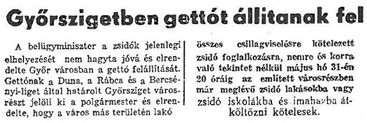
Simultaneously with the events of the war, anti-Semitic language became a permanent feature of the local press. It was constructed quite simply. Jews were either helping ‘foreign agents’ to undermine the chances of victory in the war, or ‘trying to corrupt young Christian girls’, or spreading rumours. The citizens of Győr were bombarded with factoids (in today’s parlance, “fake news” – ed.). And from 1944 onwards, measures taken against the Jews were regularly reported on. Of course, news stories condemning Christian citizens who helped the Jews, highlighting the punishment imposed on them by the law, could not be neglected.
The question for us is how the people of Győr reacted to this. The effect of the fervent anti-Semitism fomented by the local newspaper was not satisfactory to the editors, and in several cases, it was reported with strong disapproval.
On April 21, 1944, 15-20 members of the Attila József Circle of Győr (Attila József (1905-1937), a progressive Hungarian poet – ed.) held a protest walk on Baross Street, wearing yellow carnations in their jackets. It took no small courage to do this simple act in those days, we might add. What we have here is essentially a humane expression of the cultural elite. But just as important for us is what the city’s political elite have been doing in these weeks.
The most difficult test has been the implementation of the decree on ghettoisation. It should not be forgotten that this had to be carried out against Jewish citizens who were members of the municipal council for a longer or shorter period of time, and therefore had a working relationship with the mayor and the drafters of the decree. Their number was not small, since over the previous 20 years or so, between 50 and 100 people had appeared in the municipal Legislative Committee as members of the Jewish community, either as important tax payers and voters or as members of the religious representation.
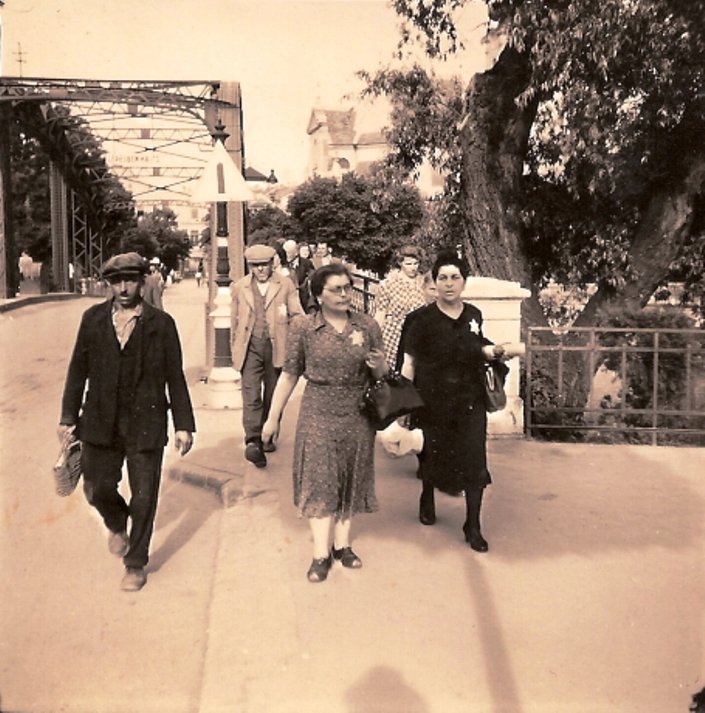
Forced removal to the ghetto across the Révfalu Bridge, mid-May 1944 – regigyor.hu
The mayor of the city, Jenő Koller, presented the most humane solution to the Prime Minister. Based on the model of the capital city, he formed three groups of houses. Accordingly, there would be pure Jewish, pure Christian and mixed streets. Looking at the first plan, we can see that the so-called Jewish streets and squares (Batthyány Square, Bisinger Promenade, Deák Ferenc, Kisfaludy, Király, Dunaszer, Czuczor and Dr Kovács Pál Streets) already had a large number of Jewish-owned houses and apartments, as well as large floor areas and very good running water and bathroom facilities. As few people as possible would have had to move, families could have helped each other, and sanitary conditions were good.
The ghetto was established in Győr-Sziget – Photo: István Nagy
The move to the ghetto had already begun when Interior Minister Andor Jaross disagreed, saying that the Jewish population of Győr should be relocated to a well-controlled and isolated area. The new location of the ghetto was designated on 15 May 1944, and was situated in the area bordered by the Moson-Danube, the Rábca and Bercsényi park. Needless to say, this was a decidedly inhumane solution on the part of the Minister of the Interior. From the 1870s onwards, the Jewish and non-Jewish populations of Győr gradually became mixed. The wealthier citizens moved from the former Jewish district to the central parts of the city. From 1904, with the unification of Sziget and Győr, this process accelerated even more. Christian citizens bought the smaller houses and flats, which were left empty and of low comfort there. Here, too, there was finally a thorough mix-up … Conditions here were much worse. Houses were small, space was tight and sanitary conditions were very poor. Even this did not please the Home Secretary. The city tried to postpone the resettlement to the third and absolutely horrible ghetto, but the elite of Győr were completely helpless, although even the church leaders tried their best. …
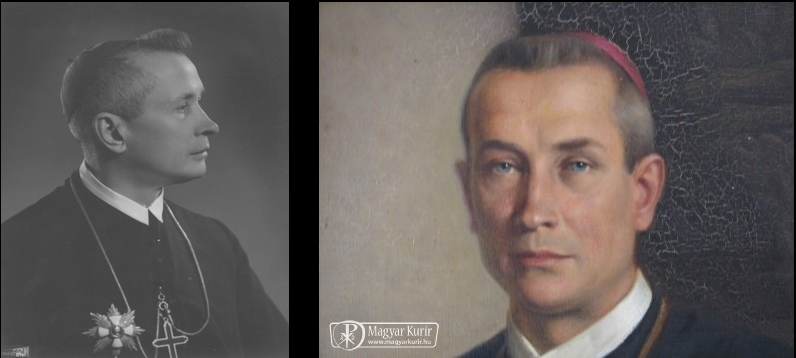
Vilmos Apor, who took up his episcopal office in Győr during the period of the adoption of the third law on Jews, did his best to help the persecuted. He used all the means at his disposal for their protection. As president of the Hungarian Holy Cross Association, he provided them with legal and material aid and also sought to relieve the pressure on the Jews through his contacts. He wrote letters and sent telegrams to church and secular leaders. Archival records show that, in his defence of the Jews, he became involved in a heated exchange with the county’s government commissioner, who was forced to tell him that there was nothing more he could do. In June 1944, he personally visited the barracks on Buda Street to bring food, medicine and spiritual aid to Christians of Jewish origin. But the guards turned him back in a brutal and humiliating manner. The barracks on Buda Street were built as an emergency military hospital during World War I. By 1944 they were almost uninhabitable. Who would have thought that this ruin would be the home of thousands of citizens of Győr, even if only for a short time.
Since 1953, a school has occupied the site of the Budai út barracks – pasch-net.de/pasch-schulen
The Arch-abbot of the Benedictine Order in Pannonhalma, Kelemen Krizostom, who was closely connected to Győr, was more successful thanks to his position. He contacted the Hungarian representative of the International Red Cross and they agreed to consider the whole settlement of Pannonhalma as a children’s shelter and thus put it under the protection of the Red Cross. His goal was achieved, and thousands of Jews among the refugees managed to survive the war. In 1998, he was awarded the “Righteous Among the Nations” medal for his achievements.
Kelemen Krizostom, Abbot of Pannonhalma, was awarded the title of Righteous among the Nations on 22 June 1998 – hdke.hu
The civic tolerant value model of Győr, which permeated the churches here, tried to do something for the persecuted even during the time of the Holocaust. However, greater historical power structures overruled the destiny of the country and the life of the settlements within it.
Unfortunately, the values and attitudes that had been formed over a long period of time could not be handed down through the generations, as the life of the country and its towns and villages was repeatedly shattered from the late 1930s onwards, and the guiding principle became the denial of the past rather than its continuation.
[5] As a result of the traumatic changes following the First World War, Győr suffered perhaps the least loss of all the large towns close to borders. (There are no specific studies on this.)
[7] Lónyai 2004. The years between the two world wars and the events of the Holocaust have so far only been briefly reviewed from this perspective by Sándor Lónyai. Detailed knowledge of the events still requires much research.
[8] Archives of the City of Győr X/1. Documents of the Győr group of the Baross Association 1937-1944. These documents are still completely unprocessed.
SOURCES
Computer processing of ecclesiastical sematisms in the Győr-Moson-Sopron County Archives
Computer processing of the list of the instructions of the second law on Jews, which is kept as a separate list in the archives of the City of Győr
Archives of the City of Győr X/1. Records of the Győr Group of the Baross Association 1937-1944. Data have been taken from the records, but the source as a whole is completely unprocessed
LITERATURE QUOTED
Borovszki Samu: Counties and towns of Hungary, Győr county; Budapest, 1910
Eva Quittner: Pebbles of memory Győr, 1996
József Kemény: The History of the Jews of Győr, Győr, 1930.
András Körner: Taste of the past, Budapest, 2005
Sándor Lónyai: From the numerus clausus to Auschwitz, Budapest, 2004
Lajos Gecsényi: Győr guilds in the second half of the 16th century and the first half of the 17th century; Arrabona 21, 1979.
Lajos Gecsényi: Soldiers and citizens in the fortresses of Győr in the 16th and 17th centuries; Military History Publications, 1984
Gyula Szakál: Citizen entrepreneurs in Győr; Budapest, 2002
This study was published in the journal Műhely (Vol. 36, No. 2, 2013). Republishing rights were granted by Dr. Gyula Szakál.
The pictures are not included in the study, they are for illustration purposes only.
Edited and translated into English by Péter Krausz.
Historical model changes in Győr and their relationship with the religious (ethnic) structure and spatial location of the population
Excerpts from a study by Dr Gyula Szakál, Associate Professor in ret., Historian of economic relationships, Széchenyi István University, Győr
Introductory reflections
Győr … in 1743, having bought its way out, was elevated to the rank of free royal city. It could have remained a peaceful patrician town, but two generations later it was already on the path to becoming a grain trading city. Subsequent to the opportunity to trade in agricultural produce closing (1870s), there was a brief period of livestock trade, and then, recognising its limitations, the local elite quickly moved towards the establishment of modern manufacturing industry. …
Coat of arms of the Free Royal City of Győr – gyorplusz.hu
How was this linked to the ethnic and religious structure of the city and its spatial location? The uniqueness of Győr was that within a relatively small radius, four settlements were divided by rivers and legally separated, while these parts were functionally completely united. For a long time, the three rivers were also the boundaries of the municipalities. Győr and the associated Újváros were located in the inner part of the city, bordered by the Danube, the Rába and the Rábca, while Sziget, Révfalu and Pataháza were located in the outer parts as independent villages. This legal status was maintained until 1905. The spatial separation also meant the division of religious groups.
…
Religious conflicts and the urban space
… the evangelical population, or its elite, was an economically innovative, successful stratum. This group represented 6-7% of the urban population, and among the richest (a group of 250 of the richest taxpayers) their share was around 15-20% until the early 1900s. The proportions are very similar to the performance of Jewish entrepreneurs. …
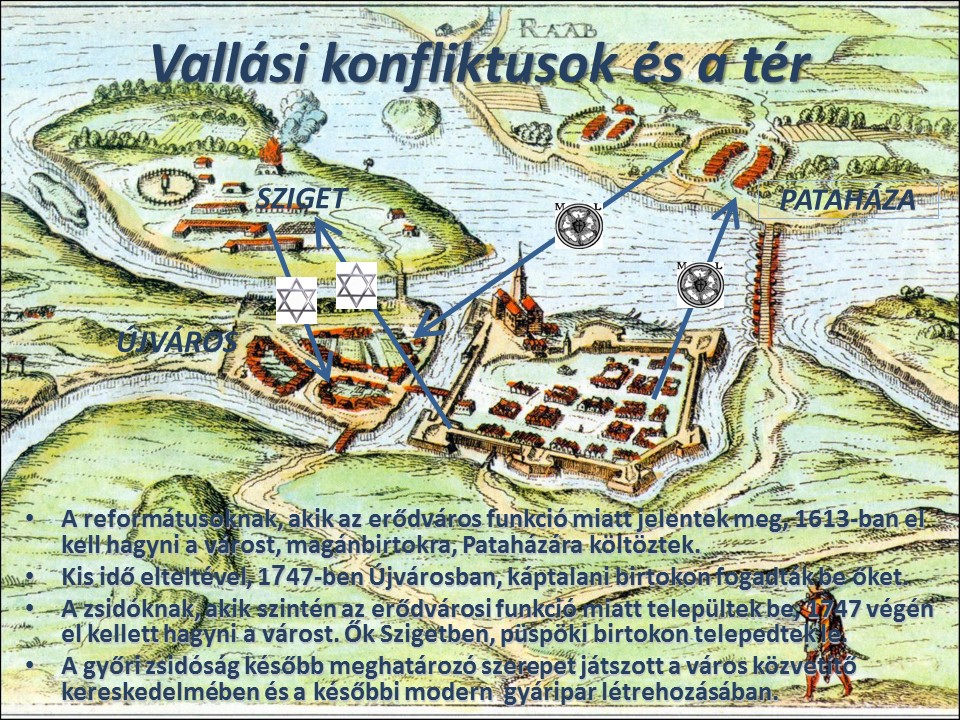
The movement of the Reformed (Christian) and the Jewish communities in the region of Győr in the 17th and 18th Centuries – Study by Gyula Szakál
Emergence of the Jewish population
The third religion and ethnicity whose increase in numbers was linked to the function of the military town was Judaism. There are no direct archival records until the 1800s, but there are indirect references to their presence. The number of soldiers increased or decreased, but it certainly meant an increase in consumption. In particular, the role of mobile traders grew in the preparation of military campaigns. There are also indications that military commanders did not despise the share of the surplus income of military contractors. In another period – 1720 – there are also indications that under the protection of General Heister, ‘large numbers’ of Jews, Greeks, Serbs and Armenians settled in the city, paying only to him for protection. [1] It is quite certain that this practice could not have been otherwise in the past. There are also indications that in the town, which was rebuilt after the fire of 1567, there was already a ‘Judengasse’ and a house used as a synagogue close to it. If we look at the geographical location, these were located right on the edge of the most dangerous part of the city wall.
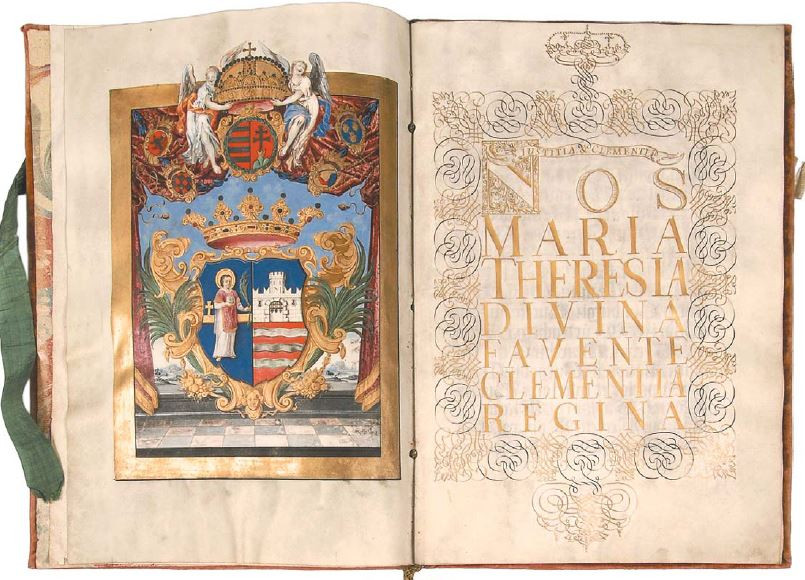
The intolerance of Maria Theresa, German-Roman Empress, Queen of Hungary, towards the Jews (e.g. their extermination in Prague, the introduction of the Jewish tax, ambiguously called “tolerance tax”) had a great impact on the fate of the Jewry in Hungary, including Győr – wikipedia.org
The fate and geographic movement of the Jews of Győr took on a particular shape as the role of the military town faded. The settlement became a free royal town from 1743, but a council decision to expel the Jews from the town was taken as early as 11 December 1747. We do not know exactly how many people were affected, but it could not have been more than 300. As in the case of the evangelists, the expulsion was symbolic. They were moved to the village of Sziget, on the other bank of the Rábca River, which was owned by the bishop. The earliest record we have is from 1791, when the catholic church allowed 30 families to settle there for 200 Ft a year. Although it forbids the admission of further families, it also grants the community full autonomy. They can maintain a house of prayer, elect a judge who, in addition to internal affairs, settles disputes even between Jews and Christians. [2]
If you look at the number of families, you can only think of large families. The first accurate data is recorded in the ecclesiastical sematisms (directories; kept by village parish priests, including data on the denominational distribution of the settlement – ed.) from 1804. Only 13 years have passed since the forced emigration, but this census mentions 351 Jews, which was 9.6% of the population. The space cut up by the rivers and the divergence of jurisdictions provided an opportunity to exclude them fully from the city, but in essence it did not happen, having moved only a few hundred metres away from the centre. From then on, however, this area became the centre of their geographical identity, even when most of them no longer lived there.
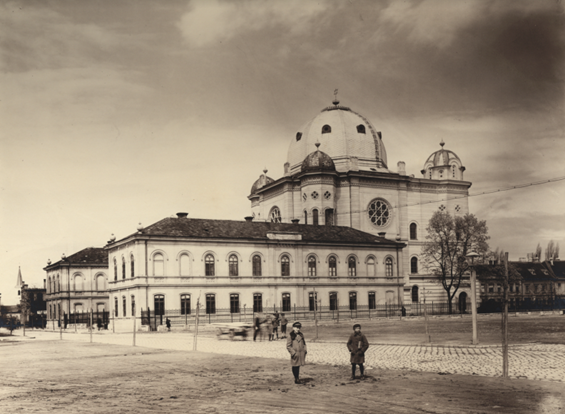
The case of the construction of the new synagogue is a good example of this. A religious community, when it becomes financially strong enough, wants to visually present its existence. From the Middle Ages to the present day, the most concise form of this has been the building of churches. It was not only a simple place of worship that was needed, but also, depending on financial strength or even political influence, its location was also important.
This was the case in Győr, when the community, which had become financially stronger thanks to the grain trade, wanted to build a representative synagogue instead of a very modest and unimpressive prayer house (one was on Kígyó Street – a very small street – and the other was hidden on the floor of a guest inn). At this time, still the early 1860s, the more affluent sections of Jewry already began to move out of the village of Sziget which had once housed them.
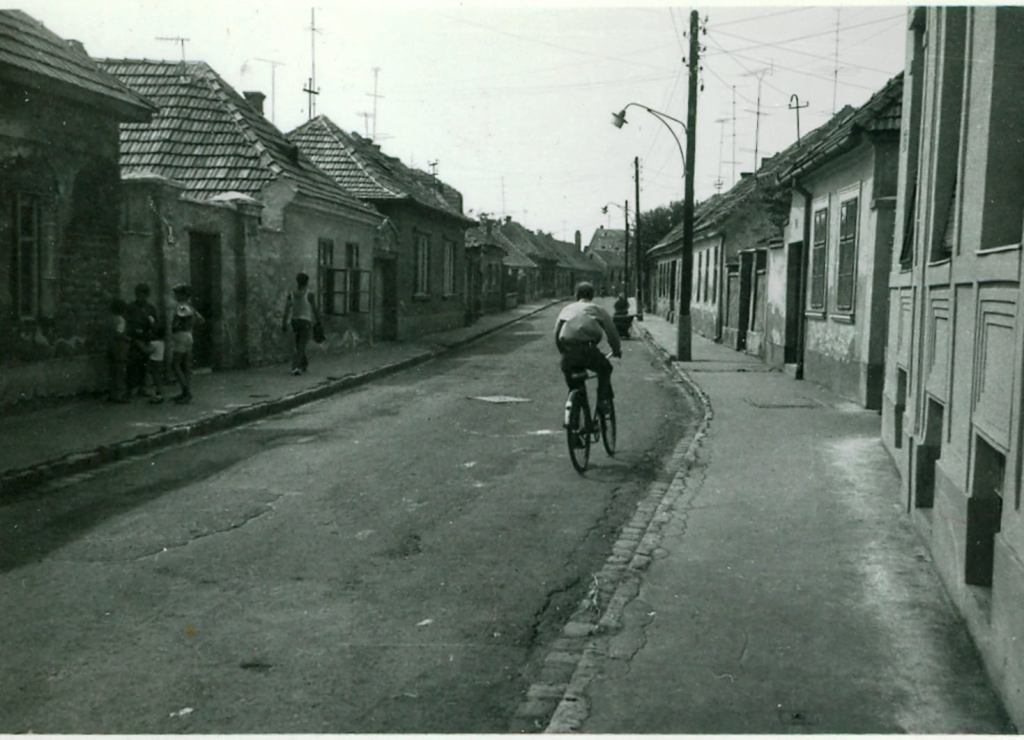
Szarvas utca in Győr-Sziget was a poor neighbourhood even in the 1970s – facebook-régigyőr-photos
The internal tension in the community was palpable. Those pf the Sziget district – the poorer section of the group – felt that the townspeople were ‘trying to force them’ to leave the ancestral soil. Looking back to the late 1920s, József Kemény says there were serious struggles, various alternatives were considered, and finally the assembly of representatives, almost exclusively made up of very wealthy entrepreneurs, made the decision. … József Kemény assessed this decision: ‘The decision shows that the majority finally came to the conclusion that if the Jews were to develop their economic and cultural strength, if the centre of their activities is to be increasingly shifted to the city, their representative temple … must not remain in the former ghetto.’ [3]
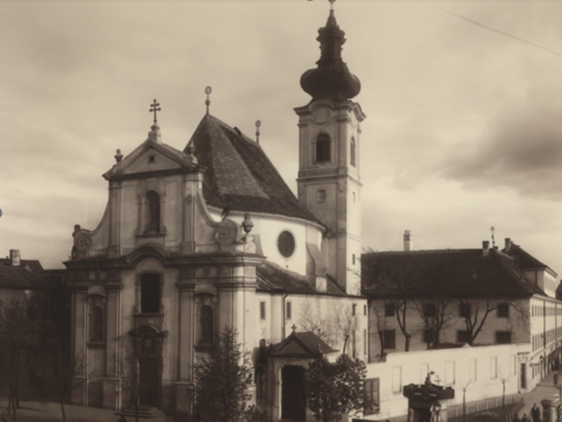
It is worth noting that the land purchased was very close to the church of the Evangelical community (separated by a street), the church of the Carmelite Order (bordered by a river) and the bishop’s residence was only a few hundred metres away. The area was large enough for the planned synagogue to serve as a suitable landmark, or even a counterpoint. The city government of the time did not at all hinder this ambition (it should be noted that the representative body at this time was composed almost entirely of Christian citizens).
The Synagogue in the 1910s – Photo by József Glück , DrKovács Pál Library
We have already mentioned that the realisation of these dreams was made possible by the intermediary trade in grain. Grain from Bačka-Banát and partly from the lowlands was transported via the Danube and Győr to the markets of Vienna, and from there onwards. This trading role directly provided a livelihood of some kind for 15-20% of the population. But the multiplier effect was greater.
The huge housing and public buildings (schools, law courts, other public buildings) in the city centre were built with the capital generated. And for the top merchants, the profit margins, sometimes in the hundreds of percent range, made it possible to pursue almost ‘American’ careers. For the Jewish population of the settlement, this situation provided an excellent opportunity. All the opportunities were open to them to develop their previously accumulated knowledge, capital and contacts. This two-decade period from the 1850s onwards was exploited most skilfully by Jewish entrepreneurs. The names of families such as Fleischmann, Ehler, Kőnig, Keppich and Schreiber became known and, at the same time, respected.
These wealthy entrepreneurs started a spatial movement towards the most frequented streets of Győr’s city centre. In the absence of research in this direction, we can only deduce from scattered data that the properties they owned were not only of considerable size, but also served as landmarks. The spatial movements of the wealthiest group were later followed by others.
From the processing of the ecclesiastical sematisms, the numerical growth of the Jewish population of Győr can be clearly seen.
Increase in the Jewish population of Győr
Year
Capita
Proportion of the population, %
Location
1804
351
9,6
Sziget district
1809
358
12,0
Sziget district
1819
354
20,5
Sziget district
1830
720
17,3
Sziget district
1840
850
19,8
Sziget district
1851
1243
31,0
Sziget district
1861
1318
35,2
Sziget district
1872
2885
12,0
Győr, entire city
1881
3826
14,6
Győr, entire city
1891
4036
17,3
Győr, entire city
1901
5317
15,7
Győr, entire city
1910
5418
9,6
Győr, entire city
1917
5647
13,2
Győr, entire city
1928
6023
12,3
Győr, entire city
1940
4967
9,7
Győr, entire city
Source: own editing based on data from ecclesiastical sematisms.
Beyond tracing the numerical movement, the more interesting question for us is the relationship between the Christian and Jewish populations. Looking through the most diverse sources of contemporary social publicity – newspapers, publications – and oral recollections, we find only minimal manifestations of anti-Semitism in Győr.
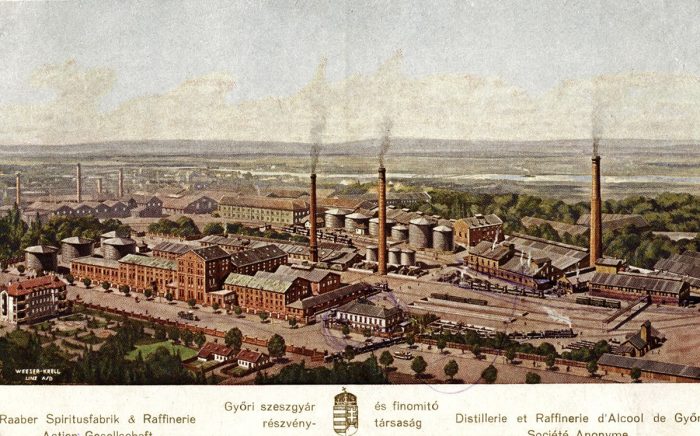
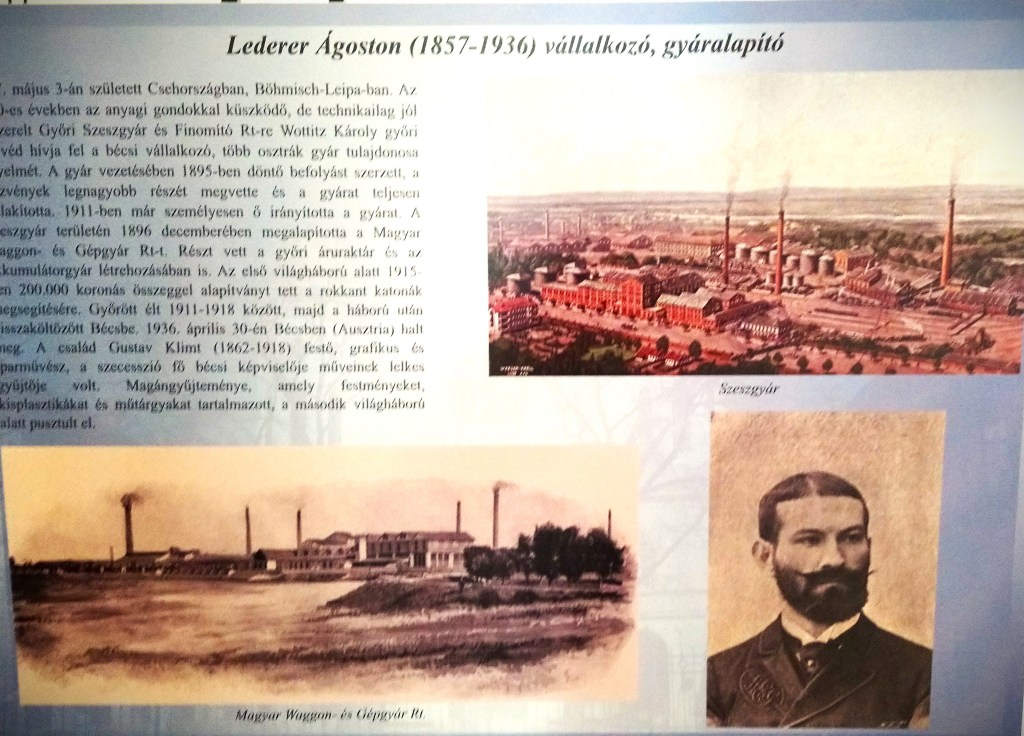
Győr Distillery on a postcard at the beginning of the 20th century. Lederer Ágoston managed and modernised the factory as owner between 1895 and 1936. He also founded the Győr Wagon and Machine Works. – Collection of János Honvári, gyorplusz.hu
The struggle between the entrepreneurial elite groups in Győr was evenly matched and in more than one case it was the Jewish entrepreneurs who had to cling to their Christian counterparts. If you look at the dozen or so bourgeois families that were considered the richest in the eyes of the public (tax lists confirmed this exactly), Christians were certainly predominant. There was no status envy, not even jealousy. In many cases of the change from a merchant town to an industrial model, we found a very high degree of cooperation between elite groups of different religions. The reason for this is to be found not only in the receptiveness, flexibility and Westernised civic values of the bourgeoisie of Győr, but also in the mentality of the local Jewish population. From very early on they lived together with local citizens, and if we look at the geography of immigration, they came from Western countries or from neighbouring settlements. According to the data in the local sematisms – and this was obviously also the case nationally – they very often, but by no means exclusively, performed commercial and other service functions in the surrounding villages.
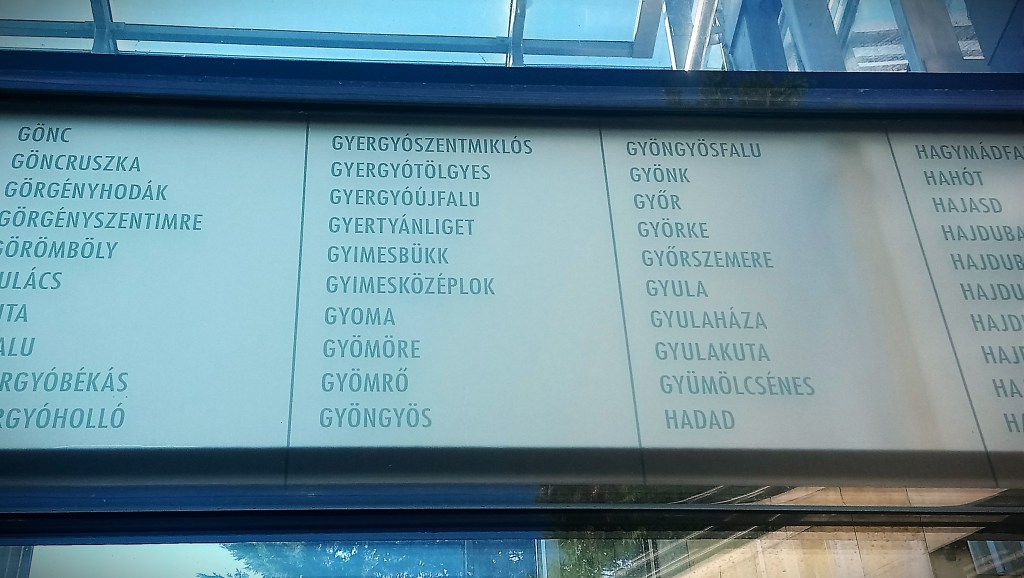
In a nearby settlement, Gyömöre (about 25 km from Győr), a small Jewish colony with a Yeshiva was established by mid-19th century. … We have scarce data to show that many people came from the surrounding settlements to Győr, which offered greater opportunities. The Jews of Győr belonged almost exclusively to the Neologue movement, in appearance and behaviour not unlike the bourgeoisie or even middle-class groups of the Christian faith as understood locally. According to an oral recollection, it was almost a unique opportunity to see Jews with sideburns and in kaftans in Győr, who did not move much from the Sziget district. Simply put, a Jewish entrepreneur in Győr is first an entrepreneur, then a Győr citizen and only then a Jew. Religiousness, as an identity-forming, group-forming, and thus bonding and excluding aspect in Győr, had been thoroughly weakened by the end of the 19th century. The pragmatic values of the bourgeoisie always overrode religious rifts.
Károly Zechmeister (1852-1910), Győr’s mayor – infovilag.hu
The most prominent mayor of the town, Károly Zechmeister (1888-1906), was of Lutheran origin, while the town’s chief medical officer, Fülöp Pfeiffer, and the town’s fire chief, Ernő Erdély, were of Jewish origin.
The Napoleon House, owned by Dr Fülöp Pfeiffer (1845-1930), which he rented in 1892 for a girls’ school – regigyor.hu
Estate inventories show that the general practitioners of active Catholic public figures were very often Jewish. It is therefore not surprising that the Masonic lodge(s) of Károly Kisfaludy, which was very strong and active at the turn of the century and had many members of Jewish origin, … included also many Christian members.
Ernő Erdély (1881-1944), Győr fire brigade commander, who was deported to Auschwitz and murdered despite his unheard-of merits – gyoriszalon.hu
Spatial framework of coexistence
The integration of Jewish entrepreneurs into Christian society can be considered seamless. There was no question of occupational or even territorial segregation. Computer processing of historical housing and address directories and of the census ordered by the second law on Jews (“Law IV, 1939, on the Restriction of the Participation of Jews in Public and Economic Life” – ed.) proves this. The latter list contains 506 items (names, occupations, streets). [4] Of these, 67 were deleted, who had died or moved away, and were included in the processing, since we were carrying out a social history analysis and these citizens had lived and worked in Győr for a long time.
We were mainly interested in occupations and their spatial location. In our case, the names were only important in terms of the proportion of families that were considered to be truly wealthy locally (among the richest). After all, there is always a family behind the names. Our estimate may be subject to subjective errors, but a maximum of 20 families could be considered truly wealthy. The list therefore ranges from the local Jewish upper middle class to the lower middle class. It excludes doctors, lawyers, and business as well as technical intellectuals. In Győr in the 1930s, the latter was a group of considerable size and power. Also missing were the poorer group who worked as workers or employees.
If we take the entrepreneurs in the list as a family of four, this represents 40% of the local Jewish population, but if we think of a family of six, it represents 60%. It is likely that the latter figure is similar to the real proportion. 63% of the entrepreneurs on the list were engaged in trade. We were able to sort the trading occupations (the same occupation was described in more than one way) into 36 major groups. The distribution of occupations shows the trend towards industrialisation and urbanisation. Food, general merchandise, textiles and clothing retailers accounted for nearly 60% of the 235 traders. They were essentially found in all trade sectors. It is rather interesting where they were few in number, even though stereotypes would have led one to expect their presence there. Only 24 entrepreneurs were involved in the second-hand clothing trade, the rawhide trade and the feather trade, which represented 5% of the whole group. Only 15 inn/pubkeepers were recorded (3.3%), although there were many more inns and pubs at the time. As a mere curiosity, 8 pig traders and one loan librarian were also recorded.
Iron Rod House with a seed shop on Széchenyi Square – photo by József Glück around 1910, Dr Kovács Pál Library
We were able to organise the 271 craftsmen into 38 major categories. Almost every profession of the time was represented. Nearly a third of the craftsmen were tailors, hatmakers, embroiderers and other clothing-related businesses. We also found 30 shoemakers (15% of Jewish craftsmen), 12 hairdressers (4.4%), 10 photographers and 6 dental technicians. We can assume that the majority of the photographers and dental technicians of the period were of Jewish origin. It is merely of interest to note that one goldsmith, one shipwright, one thresher, one window dresser and one cleaner were also recorded.
Perhaps more important than the occupational structure is the spatial location of businesses. According to contemporary records, there is at least one Jewish entrepreneur in 121 streets (squares) of Győr. It could be said that by the early 1930s they had already settled in the entire city. Of course, we know that the place of residence and the place of business did not always coincide, but for us it was the presence in the urban space that was important. Their home in the Sziget district of the time almost emptied between the two world wars. We could link at most 13-15% of the businesses recorded in the inventory to this area. In the immediately adjacent Újváros, their share could be a maximum of 10%. Obviously, the poorest layer still remained in their old location, but these are not recorded in the source.
Rozália House on Kazinczy Street, one shop next to the other – photo by József Glück around 1910, Dr Kovács Pál Library
Three quarters of businesses are concentrated on city centre streets. It should also be noted that doctors and lawyers of Jewish origin also lived in this area. (The downtown area occupies a circle with a maximum radius of 400 metres, which takes 15-20 minutes to walk around.) We found 53% of entrepreneurs in this area. However, one observation needs to be made. On Baross Street, which was the most representative shopping street in Győr at the time, their presence can be estimated at perhaps 30%. It would be good to know the religious distribution of the traders and craftsmen operating in each street. We can only estimate the 1938 data, as the closest accurate street list of businesses we have is from 1915.
Deák Ferenc Street, the second most important shopping street in Győr between the two World Wars – photo by József Glück around 1910, Dr Kovács Pál Library
It is also likely that the number of businesses could not have increased substantially from 1915 to the 1930s, as the geographical space of the street did not allow for this. We also assessed that in 1904, a business on Baross Street was a mere 5 m away, which had decreased to 4 m by 1915. The space of businesses could not have shrunk any more than this, or more precisely, their number could not have increased any more. The same proportion on the adjacent and equally long Deák Street fell from 9 to 7 m between the dates indicated. Thus, the proportion of Jewish businesses on the most important downtown streets can be put at less than 50%. More importantly, the premises of the leading businesses on Baross Street were quite large. This was the case with Ferenc Sándori’s hardware store, Jenő Kocsis’ department store, Gusztáv Kőnisgberg’s and Géza Alexy’s shops. They were Christian entrepreneurs.
The Kreszta House in Apáca Street – photo by József Glück around 1910, Dr Kovács Pál Library
There is a surviving photograph of the Salzer brothers’ shop, which was very modest in size and we know that they had great difficulty in finding a place on Baross Street. The largest merchant’s house in the downtown area, which had two floors, was owned by the Catholic Kreszta family. On Kossuth Street, the longest street in Győr, which separates Sziget from Újváros and connects directly with the city centre, there were 170-180 businesses, of which we can estimate the proportion of Jewish businesses at 20% at most. Only one “Jewish Street” was found, Híd Street, where the proportion of Jewish entrepreneurs can be estimated at 90%. This was both a connecting and a dividing street between the three districts. They catered specifically to the needs of the poorer layers of the urban population, with their very modest-looking shops.
END OF THE FIRST PART
Be sure to read the Second Part to find out how the Győr elite reacted to the political crisis and human tragedy of 1944.
[1] Borovszky 1910: 363.; [2] Quoted by Kemény 1930: 18.; [3] Kemény 1930: 67.; [4] Győr City Archives: separate lists
The list of the literature and sources used is provided in the Second Part.
This study was published in the journal Műhely (Vol. 36, No. 2, 2013). Republishing rights were granted by Dr Gyula Szakál.
The pictures published here are not included in the study, they are for illustration purposes only.
Edited and translated into English by Péter Krausz.
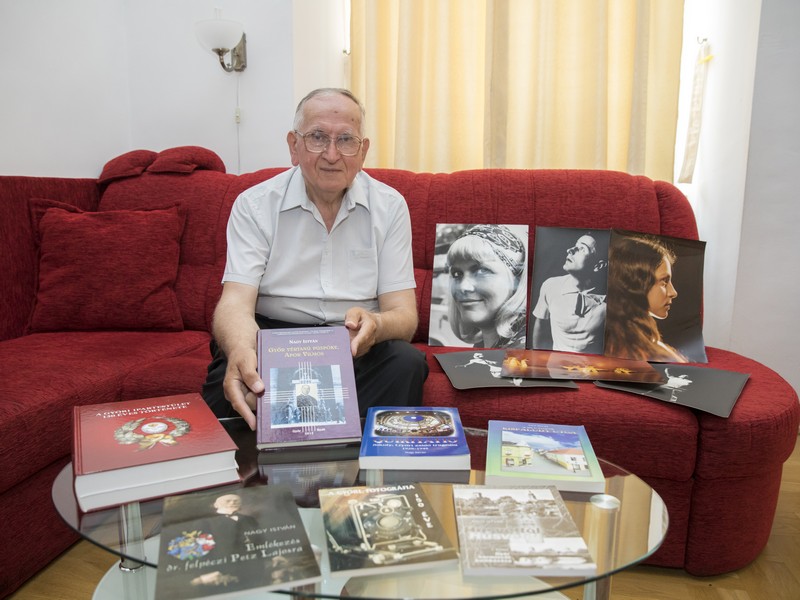
Many people in Győr got to know him during his sixty years as a photographer. With tireless diligence, he researches and takes photographs of the history of Győr and its surroundings, its prominent personalities and landmarks. Many popular books illustrated with his great shots have been published on his research. István Nagy, 75 years old this year, a non-Jewish master photographer and amateur local historian, amateur in the noblest sense of the word, has also made a lasting contribution to the local Jewish community. He is the author of Quiritatio (Scream), a book about the tragedy of Győr’s Jews 79 years ago, which has become one of the founding works on the drama in recent years. He created the material for the exhibition of local Jewish history in the former Menház (former Jewish Hostel for the Poor and Elderly), which every year enables hundreds of visitors from Győr, the whole country and abroad, to learn about the daily life, the great figures and the tragedy of the community of once 5,000.
We talk to him.
When and where were you born? Tell us about your parents, siblings, childhood and schools.
I was born in Csorna, in Erzsébet Street, in 1948. My father worked as a “soda-man” serving shops and restaurants in Csorna and the surrounding area. There were four of us brothers and sisters, two of them are now dead, and my third brother lives in a social home for the elderly.
Anyone who knows Csorna knows that it was not an easy place to live in. In 19 (1919, the year of a short-lived communist takeover – note of the translator), the citizens of the town were so shocked that the effects are still being felt. My grandmother had to watch seven people hanged in the Main Square with her two-year-old twin boys in her arms.
As a curious child, my friends and I used to go on great exploratory tours of the city. As Roman Catholics in the late 50s and early 60s, we were also intrigued by what was happening beyond the high fence of the Jewish cemetery. We leaned our bicycles against the wall and, standing on the saddle and handlebars, peered into the mystical cemetery.
Holocaust monument, Csorna – by P. Krausz
Where I was born, the Rehberger family lived next door in a one-storey house. They were Hungarian citizens of the Jewish religion, who lived according to the rules of the Orthodox tradition. They strictly observed Jewish holidays and the Sabbath. My grandmother and mother helped them with their work on these days. They cut the goose’s neck and bled the animal, then helped with the processing and daily chores. Mr Rehberger had a thriving clothing trade thus compensation for their help they received not in money but in bedding and other clothing. Over the years this amounted to a fair stock of cloth, which my father buried in three large crates in 1945. When the Russian army invaded the country, including Csorna, the soldiers poked the area around the house with long metal rods, found the crates and took everything with them. (I heard this so many times as a child that I remember the story almost verbatim.)
I was not an excellent student, I usually got just Bs. I had two Jewish classmates, Gyuszi Deutsch and Toni Viola. Papa Deutsch worked in a wood turning and horn carving shop next to the synagogue. Looking through the window I often saw him producing small objects with his skilful hands. Perhaps they emigrated in 1957. Toni went through boys’ school with me, I don’t remember his fate.
As a child with an interest in technology, I wanted to continue my studies at the Jedlik Ányos Mechanical Engineering Technical College in Győr. Two of us from Csorna applied, my friend was accepted. The boy’s mum’s deliveries of eggs and smoked meats meant a few points extra in his grade. The Győr Photographic School also had a branch in Csorna. There was once a sign in its shopwindow saying “boy student wanted”. I have been to the master several times to have my pictures shot with the miracluous machine called “Pajtás” developed. He also gave me advice, so when I applied in 1962, he supported my admission. I passed my apprenticeship exams in 1965. After my years as an industrial apprentice in Csorna, I got a job in Győr. Cooperatives were formed by the not quite ‘voluntary’ mergers of old craftsmen’s businesses throughout the country, and this is how it happened also in Győr.
“Pajtás” (Buddy) camera (The 6×6 camera was manufactured by Gamma Optical Works between 1955 and 1962) – soosfoto.hu; wikipedia.org
In 1965 I moved to Győr, my colleagues helped me in everything. From here I joined the army. I spent twenty-seven months in Sopron, and apart from the three months of training, I also did photography and a course in cinematography there, and then projected films. (In those years, the movies “The Golden Man” and “A Hungarian Nabob” were very popular /films based on the novels of the Hungarian writer Mór Jókai (1825-1904) – note of the translator/. It was also the beginning of Ilona Medveczky’s career (Hungarian movie and revue star in the years 1960-1970 – note of the translator). I had to screen her erotic scenes many times.) I had a lot of free time, I read all the books of the library of the border police and then continued in the city library. I took lots of pictures of the town and events. When I was discharged, unfortunately, I had to leave everything behind.
Révai High School today – revai.hu
(I graduated from the Révai High School in Győr. At the beginning of the 1970s, workers were supported by a government programme to continue their studies, so for four years I spent three afternoons and evenings a week at the high school. We graduated in the same way as full-time students. I met great teachers with great personality; my Hungarian literature, history and biology teacher with a ’56 prius (reference to the participation in the 1956 revolution – note of the translator) could not teach in the public high school, but yes, he was allowed to educate workers at evening courses. I maintained a very good human relationship with them for decades after graduation. For example: when I published my first book in 1994, my teacher Károly Lády of Hungarian literature visited me in my workshop. He was an old-fashioned, respected teacher. He congratulated me and then shook my hand, “Hi Pista, from now on you can call me ‘Karcsi, my brother’.” /Pista = nickname of István (Nagy); Károly = Charles, Karcsi = Charlie – note of the translator/).
When did you decide on your career choice and how did you become a photographer?
In fact, my fate was decided on the eighth of August 1962. That was the day I signed a contract with the Győr Photographic Production Cooperative. I have never been unemployed for a single day and have been working as a photographer for 61 years.
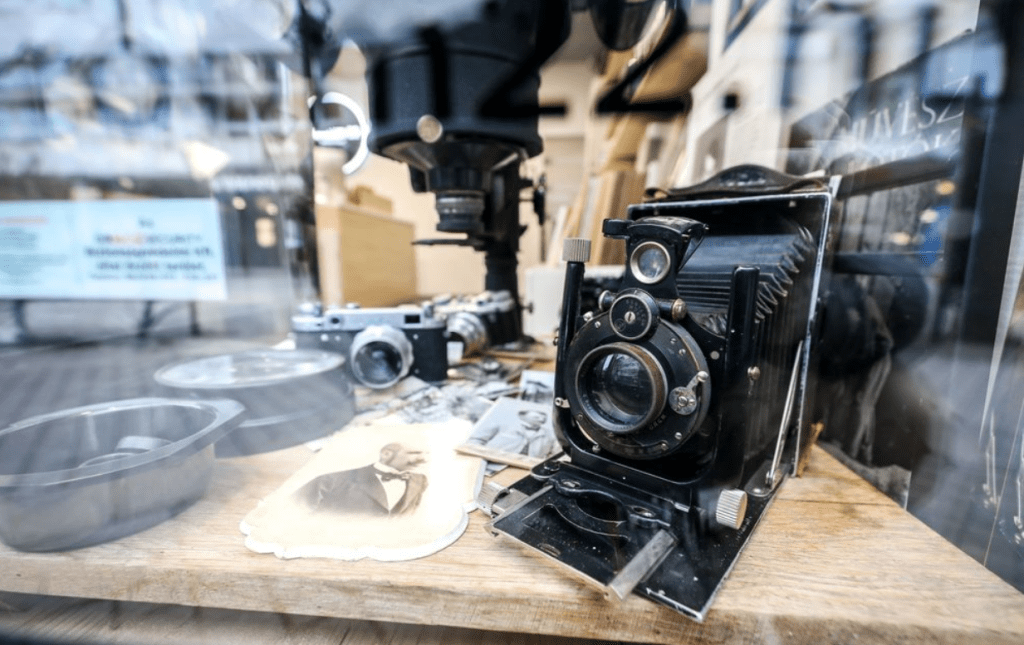
Old cameras of the 72-year-old Photographers’ Cooperative, maybe István used them, too – kisalfold.hu
I was a follower of the classic branch of the profession. I have taken a sea of passport and identity card photos, wedding photos, school-class photos, business photos and countless photos of children. Underwater photography was not my business. I have developed my own style by drawing on the experience of my senior colleagues. Today, I am classified as working in the service industry.
I always tried to be a disciplined person. (If the wedding started at 4 p.m., I couldn’t get there at a quarter to 5 p.m.). On one occasion, on June 1, 2001, I missed a civil wedding at 6 p.m. because an irresponsible motorist hit me on the highway. With a bleeding head and bleeding arm, I had already photographed the church wedding. I met some wonderful people then too; the firemen got me out alive of the car totally destroyed. I left the ambulance saying: I have to be at the wedding. As I was not to blame, the police officers took me to the wedding venue and waited outside the church while I photographed the ceremony.)
In 1982, I became self-employed and worked as an independent craftsman for 35 years. I retired on August 8th 2010 but continued working for seven more years just as before. I have not been unfaithful to the profession; I produce local history books and albums. Soon I will publish my fifteenth book and I have co-authored ten more.
How did you start your career, did you have any difficulties, how did you become a successful photographer?
During the first decades of my career, I was able to witness and be part of the golden age of photography. The emergence and rapid spread of colour photography was a huge change, which brought with it the automation of processing. Traditional black and white photographs were developed at room temperature, learned and practiced by a professional photographer. Colour technology could only be run at 37,2 degrees Celsius by processing machines.
There has also been a huge technological shift in cameras. The previous experience-based setting has been replaced by automatic setting, and focusing by autofocus. Then, at the turn of the 2000s, digital technology conquered photography.
Within a few years, this made traditional photography and its practitioners almost impossible. The clever cameras put into practice the slogan of early photography: “push the button and we’ll do the rest”. In recent years, the few people who make a living from photography have still been using cameras, while smartphones produce ever better quality.
Modern, digital camera – muszakiblog.hu
I had good masters and mostly helpful colleagues to learn from and to rely on. I have photographed on land, water and from the air, the latter being a special genre that I have had the pleasure of experiencing several times. During the first twenty years of working for the cooperative, whenever I had the opportunity, I attended professional training courses, where lectures were given by renowned representatives of the profession.
Another way of learning and gaining experience was to attend exhibitions. Between 1969 and 1982, national and international trade fairs were organised every year, where everyone could show their skills in a wide variety of categories. At these gatherings, a great deal of experience was gained and passed on. The first prize I won in ’69 was accompanied by a slender vase, which I cherish with great affection. Four times my pictures were selected for international exhibitions. My photographs have been shown in Budapest, Bucharest, Warsaw and East Berlin.
The moral recognition was nice, but in the circumstances of the time it brought little financial reward. I wanted to provide better than average conditions for my children born in ’71 and ’74, so I became self-employed in ’82. The small-scale, self-employed lifestyle “gave me the opportunity” to work 14-16 hours a day.
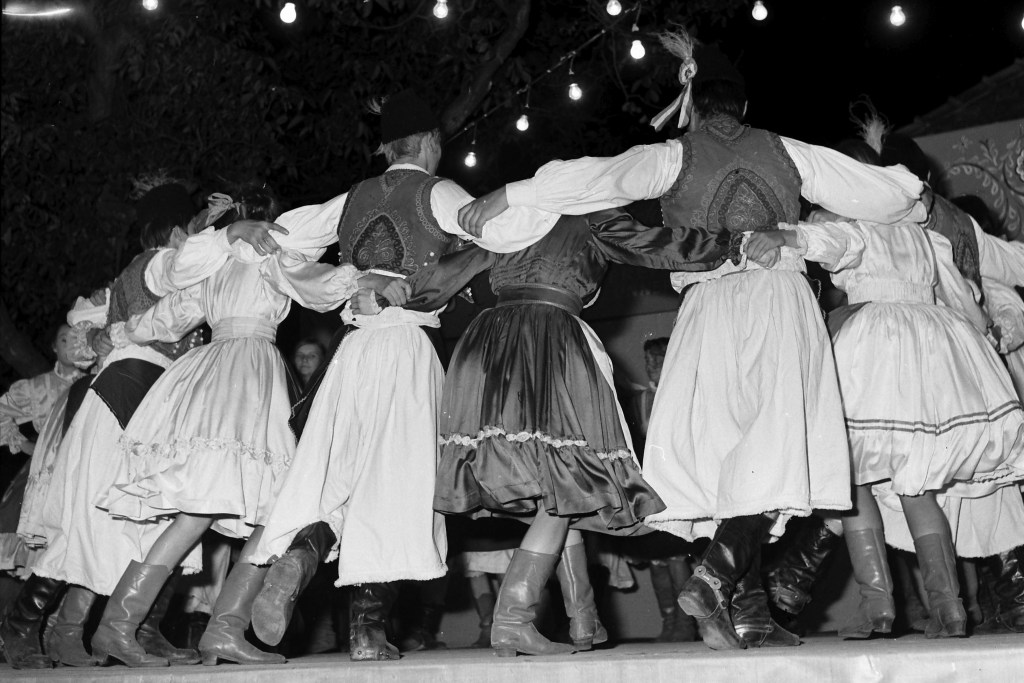
Folk dance 1 – by István Nagy
I considered it a success in my work that from the 1970s onwards, the managers of a number of institutions were keen to work with me. Factories and companies regularly commissioned me to photograph events. One morning I photographed 100-120 kindergarten children individually, with the head of the institution sitting behind me, trying to learn from me how to establish a good rapport with the little patients in a few seconds. Not with mime and mimicry, but with a few kind words, the results were much quicker. Even today, I am still delighted to be approached by people I don’t know, telling me how they enjoyed the experience of being photographed.
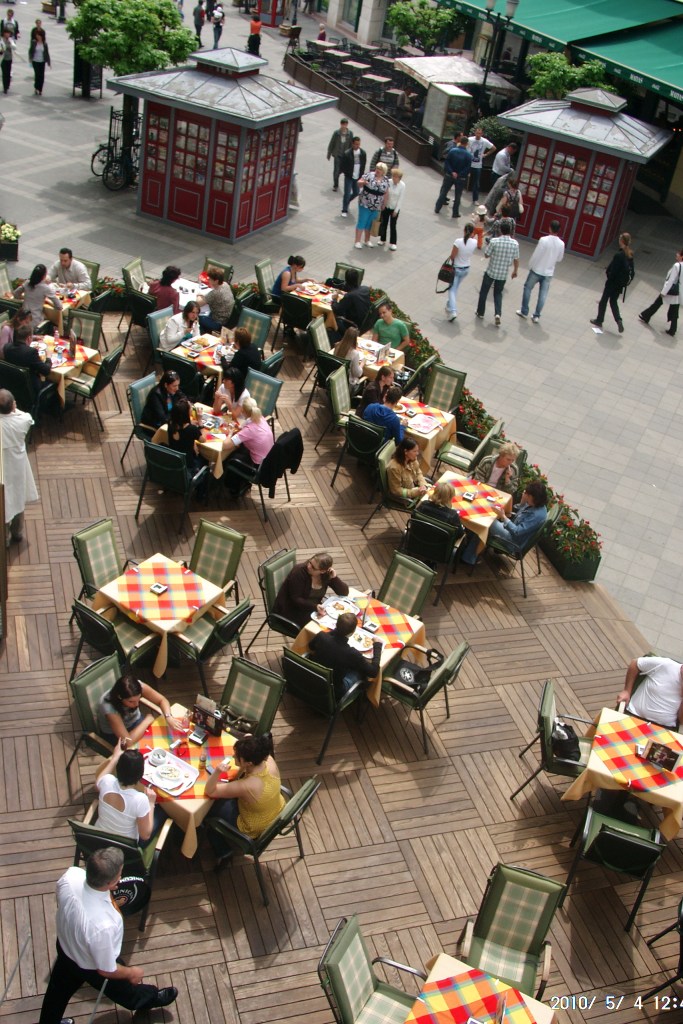
Baross Street terrace in Győr – by István Nagy
I’ve been asked to do an exhibition on a particular theme in many places. Over a long career I have put together just over two hundred exhibitions in a wide variety of genres. From aerial photographs to logos, from Christmas themes to the ruins of the Jewish synagogue, I have produced a wide range of subjects. My shots were also shown at village festivals in community centres or at schools.
Publicity 2 – by István Nagy
Your interests are very wide-ranging, and you are particularly passionate about the great questions of history, culture and faith. You have written several books on these subjects, what are they and what is their main message?
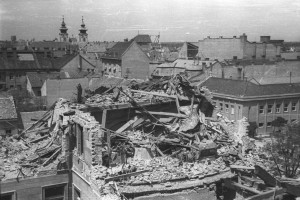
After I became an independent craftsman, I published a few photo compilations. I was involved in producing photographs for yearbooks. On several occasions it was suggested that the material from exhibitions should be edited into a book. Most of the good suggestions and ideas fail because of the printing costs. I have not been a partner for a cheap solution printed on simple newsprint. In the early 2000s, I put together several exhibitions on the first bombing of Győr on 13 April 1944. I was able to buy original photographs of the terrible events of a colleague of the time. I supplemented these photos with research in archives and newspaper cuts from the time.
Bombs also fell on the city centre of Győr – romer.hu
My local historian and archivist friends and I concluded that the Second World War was also a turning point in the life of the city of Győr.
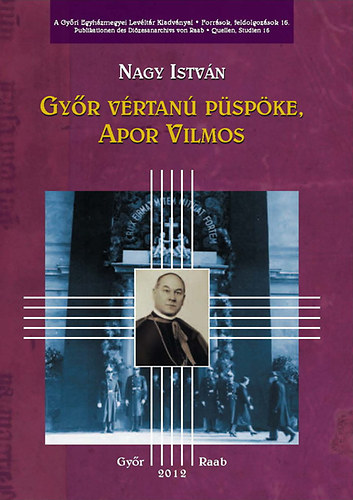
Cover of the book about Bishop Vimos Apor – bookline.hu
I have identified three important turning points, mainly those for which I have had enough material to start with. The first was the 35 air raids on Győr, the second was the deportation of Jewish Hungarians, and the third was the murder of Bishop Vilmos Apor of Győr.
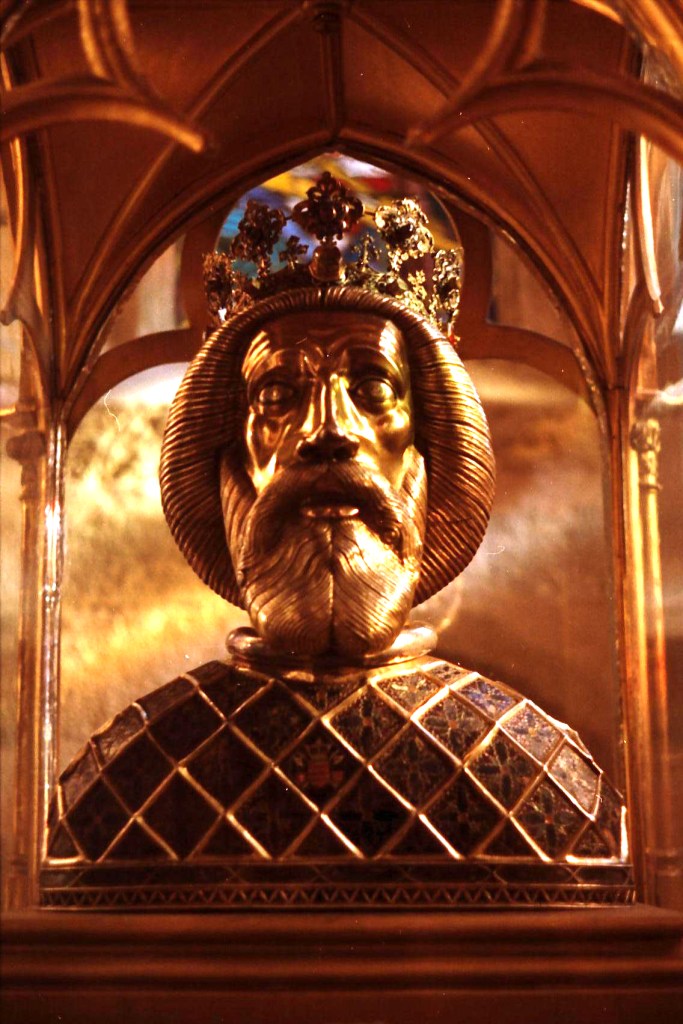
The herm of St. László in the Cathedral of Győr – by István Nagy
In the meantime, I wrote the history of Kisfaludy Street, and then 600 pages of material for the 1005-page book of the Federation of Industries. The result of many exhibitions in the past is the three volumes of the Rábaköz Monuments. I have prepared a book for a doctor friend for his round anniversary. I managed to make a particularly beautiful publication of Dr. Lajos Petz, the builder of the hospital in Győr.
Cover of the book on Dr. Lajos Petz – antikvarium.hu
For decades, you have captured in your pictures the historical sites and permanent changes of Győr and its surroundings. What is the main focus of your pictures and how did you manage to combine your photographic profession with your researcher-writer’s vein?
In writing the books, I wanted the reader to experience that they were the work of a photographer. The archivist would obviously have focused on the documents. A librarian would have focused on literature or publications. Archival research provides a wealth of experience that will give ideas and inspiration for the next publication.
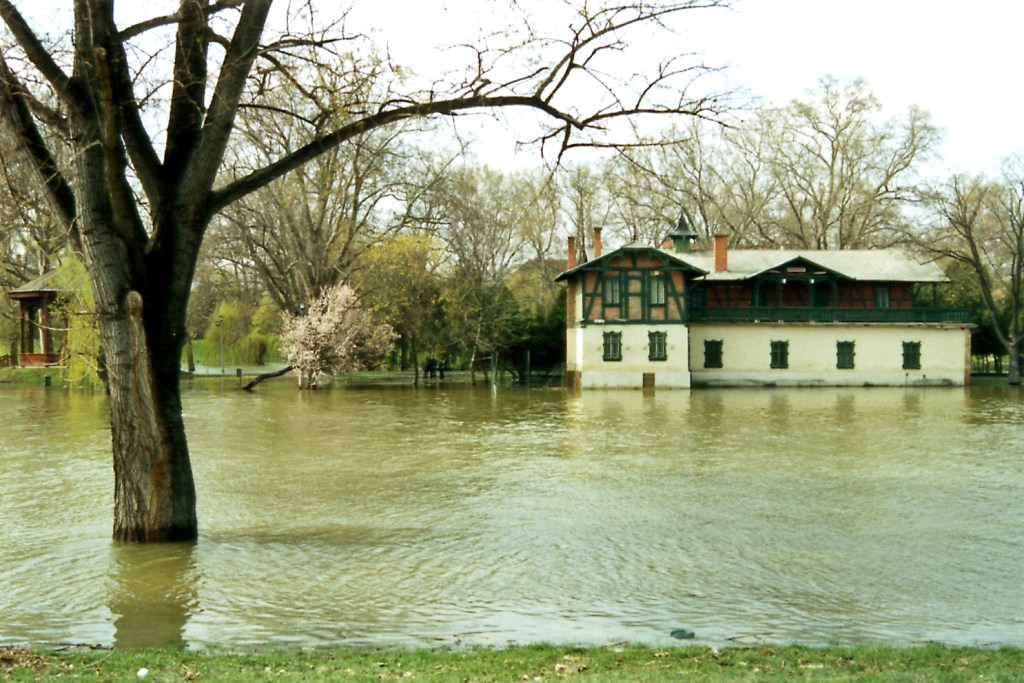
Flooding in Győr – by István Nagy
Your great interest in the history of the Jewish community in Győr is of oustanding importance to us. We refer to your extensive work Quiritatio (Sikoly), which deals with the Jewish tragedy in Győr between 1938 and 1945. But we can also talk about the exhibition you have created on the history of the Győr Jewish community in the former Hostel for the Poor and the Elderly in Győr. You also did an outstanding job in the production of a photo album to be published on the occasion of the 2024 Jewish Roots in Győr World Reunion. May I ask where you derive your affinity for Judaism from?
A high school teacher made me aware of the fate of the Jews. What happened to the Jews was simply not a topic, not in the public discourse. They were our fellow human beings, citizens just like Catholics, Reformed or Evangelicals. They had simply Jewish religion. Incredible as it may seem, there were thousands of laws, ministerial orders, government decrees and local restrictions on Jewish Hungarian citizens, while they were never deprived of their Hungarian citizenship. I am deeply outraged by this inhuman treatment, which is why I am so careful to say that Jews are Hungarian citizens of the Jewish religion.
I have never boasted of my Catholicism, I was baptised as such at the time. With my Jewish friend, we served in the army together and this topic never came up. In the late 1980s, I was already dealing with Jewish topics, when this subject came up once during a “librarians’ day meeting”. (For years we had an after-work open table from 5 to 6 p.m. We called it the “library”.)
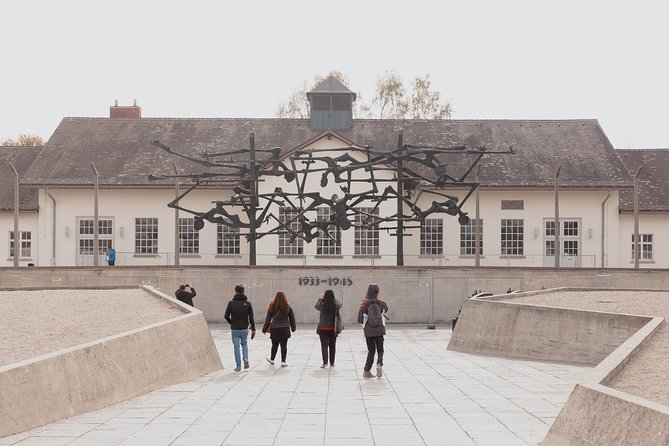
Memorial in Dachau – viator.hu
As a matter of historical fidelity, in 1982 I had the opportunity to travel to West Germany by car. Munich and the surrounding area were included in the one-week trip. I already knew the history of the death and labour camps. I travelled to Dachau, which is perhaps 20 kilometres from Munich. My photographs taken there are displayed on one of the panels in the Holocaust Memory Room of the Hostel for the Poor and the Elderly.
In the course of collecting the material for Quiritatio, I met a lot of people, including several Holocaust survivors I was able to talk to in person. Some people refused to share their memories. They locked themselves up in their apartment, in the physical sense of the word, and would not let anyone but their doctor in. But others were happy to tell me about what had happened to them.
Auschwitz 3 – by István Nagy
Thanks to the world of the Internet, I met Éva Quittner Klein, a painter from Győr who lived in Australia. We corresponded for almost fifteen years. Her story, entitled “The youngest survivor of the Holocaust in Győr”, is included in the book. She has had a successful career as a visual artist and, as a Holocaust survivor, she has written a book entitled “Pebbles of Remembrance”, which should be widely distributed. I asked her to prepare sketches of the places where she had suffered the terrible events. Despite repeated requests, she refused to do so, saying she was incapable of drawing them. I understood and took note of her decision. Her letters contained vague references to what had really happened, but she had no courage to recall the details. She died in Sydney on 10 July 2022, aged 91.
My historian friend Prof Dr Miklós Schubert was of great help in the preparation of the book. He translated several excerpts from English into Hungarian, including the wonderful life of his parents.
Not only did I collect memoirs, but I spent a week in Poland in 2009 researching the history of Judaism with my wife. The centre was Krakow, from where we made two trips to Auschwitz and Birkenau. Both days were spent in detailed photography. I researched in various national collections and took shots of big totals and small details according to my traditional method. This is how I found paintings of former prisoners. French or Italian deportations were sound-demonstrated by rattling trains and creaking rails. Even after so many years, the sound effects still ring in my ears.
It was a touching moment when I met an Israeli military unit paying a military tribute to all the victims at the gallows. I have compiled a series of tableaux from the many photographs taken at the two sites, which can be seen in the exhibition rooms of the Hostel for the Poor and the Elderly in Győr.
Auschwitz 11 – by István Nagy
The apt name, Quiritatio, is owed to István Gábor Benedek (Hungarian journalist, writer (1937-2022) – note by the translator). The book can be found in Israel, at the Yad Vashem Museum and the Holocaust Museum in Washington, D.C., as well as at the Library of Congress in Washington, D.C. I believe that no greater recognition can be given to a master photographer and local historian from the countryside.
Auschwitz 6 – by István Nagy
After the publication of Quiritatio, I received several enquiries. Of particular value to me are the letters I have received from people living in Israel. I am proud of the letter received from Károly Neuwirth, who emigrated to Israel after returning from labour service and fought for the birth of the Jewish State.
I am very sorry that I was unable to meet Eva Quittner Klein in person. I have kept two of her beautiful albums and many of her photographs. But I am happy that her grandparents’ gravestone has been restored and that in 2019, after two years of research, we were able to place a stumbling stone in front of her former home in memory of her parents and her brother. For the short and touching ceremony, her daughter and doctor son travelled from Australia to Győr together with their partner. At the street memorial service, the county government commissioner attended and spoke.
I often shudder to think that joyful excitement may have contributed to her death. However, I am reassured that Eva did her best to honour her ancestors during her lifetime.
The cover of Quiritatio – bookline.hu
Finally, what are your latest plans? How do you balance your tireless work, a genuine hobby, with your family life?
To begin the answer at the end: unfortunately, we have no grandchildren. My daughter and son are both single. We are helping to raise the 9-year-old son of a couple friends of ours. I used to say: the books are my grandchildren. I trust they will last for decades and bring joy to those who turn their pages. I know that a number of them have been used by other authors in their work. The perhaps four hundred copies of Quiritatio published at the time sold out very quickly.
Have you ever thought about making your immense and particularly valuable collection of photographs available to the public, and commissioning someone or some organisation to manage it?
I’ve thought about this a lot. If I were to die suddenly, my family would go crazy with all the collections.
I have already donated a large collection to the County Library. I have made many of the photographs of old colleagues from Győr available to Fortepan (Fortepan is a community photo archive – note by the translator), based in Budapest. I have already handed over the material relating to Judaism to Mr Villányi, the president of the local Jewish community. My collection on the War of Independence is being liquidated. The collection material of Dr. Lajos Petz, the founder of the Győr hospital, is waiting to be donated.
My largest collection is related to St. László (king of Hungary, 1077 – 1095 – note by the translator), I have had 23 exhibitions of it in different cities of the country. I do not want to part with it yet. The Rábaköz photographs (photos ofmonuments of a region close to Győr- note by the translator) occupy a large space, I have not yet decided on their fate.
I have an unimaginable number of shots, pictures and negatives from my work over sixty years. Processing an 18 square metre garage is no easy task. I only have 2x2x4 metres of space in my apartment for this purpose and I am always getting new commissions. The greatest problem is that it is difficult to be systematic in organising life, as there are only 24 hours in a day.
I know you weren’t expecting this answer, but I don’t want to use big words about the fate of my collections.
István Nagy – gyorplusz.hu
Dear István, thank you for talking to me, I wish you very good health and strength for your future work.
Photo report by István Nagy and Memorial Addresses
The commemoration ceremony in the funeral parlour of the Győr-sziget cemetery took place on a beautiful sunny summer day, 18 June 2023, with an increased attendance compared to previous years.
Tibor Villányi, President of the Győr Jewish Community, welcomed the guests and greeted the attendees.
Tibor Villányi Tibor, Photo by István Nagy, 18 June 2023
The first speaker was Prof. Andor Grósz, recently elected MAZSIHISZ President. It is of particular significance that Andor Grósz is a native of Győr, which he referred to in his speech (his address is available on the Hungarian post only in Hungarian).
Dr Prof Andor Grósz, Photo by István Nagy, 18 June 2023
Here you can also see an interview with the President of MAZSIHISZ, published in the daily Kisalföld on 24 June 2023. (Only in Hungarian)
Afterwards, László Rózsavölgyi, Győr Municipal Assembly Member, addressed the audience on behalf of Dr. Csaba András Dézsi, Mayor of Győr. (His address is available on the Hungarian post only in Hungarian.)
László Rózsavölgyi (first row left) with representatives of sister churches, Photo by István Nagy, 18 June 2023
Péter Joel Totha, Chief Rabbi of Győr and the Hungarian Defence Forces, recalled in his speech the events of 79 years ago in Győr and Hungary. Following a song of mourning by Cantor István Gara, the participants recited the ancient Kadesh in memory of those murdered in the Holocaust. (His address is available on the Hungarian post only in Hungarian.)
Péter Joel Totha, Photo by István Nagy, 18 June 2023
István Gara, Photo by István Nagy, 18 June 2023
Finally, Dr. Péter Krausz, Chairman of the Board of Trustees of the Jewish Roots in Győr Foundation, spoke about the World Reunion planned for next year’s 80th anniversary and the student competition already underway. He invited participants to these events. (His contribution is available on the Hungarian post only in Hungarian)
Dr Peter Krausz, Photo by István Nagy, 18 June 2023
The cemetery funeral parlour, Photo by István Nagy, 2022
Vilma Popper is a little-known individual in the Hungarian literary history of the 19th and 20th centuries. Unfortunately, only fragments of her life are known, and even less about her relationship to Judaism.
The productive novelist was born on May 11, 1857, in Győr. Her father, Armin Popper, served in the so-called Vienna Legion of Austrian Volunteers, fighting on the side of the Hungarian revolution in the War of Independence against the Habsburgs in 1848-49. Following the overthrow of the uprising, he settled in Újváros, a district of Győr, as a medical practitioner. Her mother, Josephine Leon, was also Austrian. She had one sister, Helén Lujza. She graduated from a Győr secondary school. She wanted to become a doctor like her father, but it was impossible for a woman in those times. Vilma’s mother tongue was German, but she spoke excellent Hungarian, English, and French. Her upbringing was influenced by the ideas of the War of Independence, reflected in several of her works.
They lived close to the synagogue at today’s 14 Kossuth Lajos Street.
Popper worked as an English and German language teacher at the Royal High School for Girls in Győr (Ferenc Kazinczy Grammar School today) and often assisted in her father’s practice. In WW1 – already 57 years old – she volunteered as a nurse and served in the military hospital set up in her school. She was a member of the Győr Women’s Benevolent Association. Also, she established a foundation to support students in need, irrespective of their religion.
Vilma Popper never married. In the last decades of her life, she lived quietly and alone in her parent’s house, taking care of her sister’s children and grandchildren.
In 1944, following the coup d’état by the Hungarian nazis, the Arrow Cross Party, she found brief refuge in the Csillag Sanatarium, but the institution was soon forced to shut down. Together with all the other Jews from the city and the region, she was forced into the Győrsziget ghetto and subsequently deported to Auschwitz. The 87-year-old woman survived the horrors of the journey only to die in the gas chambers.
Vilma Popper’s works were all written in German. Only three of her sixteen volumes were published in Hungarian. So far, no one has made an effort to translate the rest of her oeuvre, probably explaining why she is little known. Some of her books have been published in English, though. Also, she has translated several Hungarian authors, including Kálmán Mikszáth, into German. For this reason, she was considered an ambassador of Hungarian literature in Austria and Germany.
Vilma Popper was a versatile storyteller writing tales, essays, sketches, and short stories on historical and other subjects. She maintained contacts with several well-known Hungarian contemporary writers, including Kálmán Mikszáth, Frigyes Karinthy, and Ferenc Molnár. She also was a close friend of the celebrated actress of the time, Mari Jászai, whom she met when Jászai still worked as a maid in Popper’s neighborhood. The memory of encountering the renowned artist is told in her short story ‘Mari Jászai and the Green Bench.’
Her first success as a writer came in 1891 with ‘Märchen und Geschichten für große und kleine Kinder’ (Tales and Stories for Children, Big and Small), published in Leipzig. From then on, she was constantly present in German literary life. This work was published in Hungarian in 1894 under the title ‘Tales and Stories by Aunt Vilma.’ It was not her, but Adolf Ágai, the founder of the legendary satirical magazine, ‘Borsszem Jankó’, who translated it into Hungarian and wrote a foreword using the pseudonym ‘Uncle Forgó.’ “I consider this storybook is suitable for developing a child’s independent thinking, as it will guide his developing soul to what is beautiful and true without moralizing,” Ágai wrote.
Interestingly, none of these stories reflect that Popper was Jewish. Instead, the traditions of the country’s Christian majority are displayed in titles, such as: ‘The First Christmas Tree’ or ‘Santa Claus,’ perhaps because she came from an assimilated Jewish family.
Her second work, ‘Altmodische Leute’ (Old-fashioned People), was published in Dresden in the same year. Its Hungarian version hit the bookshelves five years later. The third volume, ‘Neue Märchen und Geschichten’ (New Tales and Stories), was the last to reach booklovers in Hungarian in 1900.
Books published in Hungarian, Hungarian National Library – Photo: György Polgár
Popper was a founding member of the Kisfaludy Literary Society of Győr, established in 1909, aimed at “promoting, developing and spreading Hungarian literature, cultivating fine arts, organizing readings and celebrations, and publishing the most significant literary works.” Starting then, her works were regularly published in Győr newspapers and recited at literary evenings. Between 1894 and 1920, she was also a member of the Verein der Schriftstellerinnen und Künstlerinnen Wien (Association of Women Writers and Artists, Vienna), where her works were regularly read. Her histories appeared in leading German literary magazines. Max Geißler, a well-known German literary scholar of the time, praised Popper’s talent as a short story writer in 1913 but also stressed that Popper had recognized the limits of her talent.
She celebrated the Kossuth1 centenary in 1902 by releasing a youth novel about the War of Independence, ‘Die Fahne hoch!’ (Raise the Flag High!), and subsequently wrote a biographical book about Richárd Forstmayer, a renowned organist and cellist in Győr. Until 1926, her short stories, translated into Hungarian, were frequently published in Győr newspapers. These were primarily short, concise narratives or fables written in the style of Aesopus.
Animal fables – Source: Győri Hírlap April 7, 1912 (Easter insert)
One of her most powerful short stories, Ahasuerus’ Sons, was published in the newspaper ‘Győri Hírlap’. (Ahasuerus, or the Legend of the Wandering Jew, is a medieval story about a Jewish man who Jesus Christ cursed on his way to Golgotha to eternal life until the Last Judgement.) Dr. Erzsébet Nagy, a local historian and secondary school teacher of history in Győr, describes this in her monograph on Popper. The characters in the story are outsiders: a sick Gypsy musician and a Jewish doctor. The dying man complains to his doctor of a lifetime of pain:
“You see, doctor”, said the gypsy, when the bow fell from his feeble hand, “I am relieved now. My brothers will sing these tunes as I am being buried, as the blessed soil will welcome her son. The dead will finally be granted the land denied to the living. We, Gypsies, bear the curse of Ahasuerus. We must wander, always wander, without rest. No one loves his homeland more than we do, no one sings about the motherland in a way we do, of which not a single lump is ours, because we are not Hungarians – only Gypsies.” “Old man, I can say the same about myself,” the doctor said, “I, too, bear the curse of Ahasuerus because I am a Jew. We are free to fight, bleed and die for the homeland, but we are still strangers; we will always remain the children of the Ahasuerus.”
She also worked as a translator.
Translation of a short story by Jerome Klapka Jerome, a British writer – Source: Győri Hírlap, June 2, 1912
With the rise of the nazis, no more works of hers were allowed to be published. The Győri Hírlap remained loyal to her, and some of her animal stories, characterized by witty mockery and tormenting the spread of fascism, were printed under a pseudonym.
Limited memories
Vilma Popper’s legacy is all but forgotten.
Vilma Popper’s birthplace today – Photo: György Polgár
At the end of the war, in 1945, her nephew, Dr. Sándor Korein, a doctor at the Csillag Sanatarium, who had survived the Shoah, placed a white marble memorial plaque in the inner doorway of Vilma Popper’s former residence. The students at the Kossuth Lajos Technical College of Győr used to pay tribute to the writer every year by laying a wreath and doing a small performance at the plaque. Access has become impossible in recent years, and the custom has faded away.
Students at Vilma Popper’s memorial plaque – Source: Új Élet magazine, 15 December 2013
As the house, about 150 years old and in poor condition is currently under renovation, the commemoration will be in a little while possible again. The memorial plaque has been temporarily removed but will be reinstalled when the works are completed.
The memorial plaque today – Photo: György Polgár
Miklós Petőcz, a literary historian and poet, commemorates the Győr author with a poem created in 1997.
(The poem was not translated)
In 2006, Dr. Erzsébet Nagy compiled a gap-filling monograph titled ‘Vilma Popper, the Gentle-voiced Author’ that is a valuable tribute to the almost forgotten Jewish writer. According to Nagy: “The real way to maintain her memory, however, would be publishing her works so that her thoughts and gentle humanity would be present among literature lovers and readers.”
Translated by Viktor and György Polgár
1 Lajos Kossuth (1802–1894) was the political leader of the Revolution and War of Independence in 1848–1849.
Sources:
A magyar irodalom győri nagykövete (The Ambassador of Győr’s Literature), Kisalföld, December 2, 2013
Max Geißler: Führer durch die deutsche Literatur des 20. Jahrhunderts. Dunker, Weimar 1913
Győri Legendák (Győr Legends) – The poems of Miklós Petőcz, Palatia Printing House, Győr 1997
Roots and early years in the life of Rabbi Dr Emil (Joel Zvi) Róth
By Amir Livnat
Hebrew version below
Introduction
Rabbi Dr Róth Emil (Joel Zvi), the last Rabbi of Győr’s Neologue community before 1944, is a well-known figure in the city’s Jewish history. His Zionist approach convinced many of the city’s youth, including members of the Orthodox community, to immigrate to Palestine, the Land of Israel, in the years before the outbreak of World War II, and as a result saving their lives. Rabbi Róth stayed with his congregation throughout the war, even though he was given the opportunity to save himself and his family. As a teacher and spiritual leader loyal to his community, Rabbi Róth is often referred to as “Korczak of Győr”. He is also remembered for his joint sermon with the Orthodox Rabbi Benzion Snyders on the last Sabbath of the Jewish community, in the barracks camp in Budai Street before the deportation to Auschwitz-Birkenau.
It is not surprising, then, that Rabbi Róth is remembered by Győr’s Jews and their descendants as a leader and a role model, almost a mythic figure. Accordingly, much has been written about his years serving as Rabbi in Győr, from 1935 until the last days of the community in June 1944. On the other hand, the period before Rabbi Róth assumed his position in Győr is less known and documented. In the following paragraphs we will fill in these gaps and trace the roots and early years of Rabbi Róth.
Childhood
Emil Róth was born on September 21, 1907. Apart from his Hungarian, he was given the Jewish name Joel Zvi (יואל צבי), reasons for that will be discussed later on. His last name, Róth, is written in modern Hebrew as “רוט”, but in Jewish traditional Hebrew it was usually written as “ראָטה”.
Emil Róth’s birth record, 1907 (source: FamilySearch)
Civil records preserved in the Hungarian Archives in Budapest shed light on Emil’s family. His parents are Izsak Róth and Irén Kohn, who married on July 28, 1904. Emil is the third of Izsak and Irén’s five sons. His elder brother Dezső (David) was born on June 10, 1905. Andor (Mordechai) was born second, on August 29, 1906, and after them, as mentioned, followed Emil. Emil’s younger brothers are Sándor, born on October 6, 1909, and László, who was born about a year later, on October 21, 1910.
Marriage Record of Isaac and Irén Róth, 1904 (Source: FamilySearch)
Emil was born in the town of Kunszentmárton, where his parents Izsak and Irén lived, and where all their children were born. Kunszentmárton is located in the eastern part of today’s Hungary, in the Great Hungarian Plain, about 130 km southeast of the capital Budapest. It lies on the eastern bank of the Körös River: a tributary of the Tisza River, and is considered an important crossroad due to the bridge that crosses the river within its boundaries. Kunszentmárton was recognized as a city as early as 1807.
In 1910, shortly after the birth of Emil Róth, 10,921 inhabitants lived there, of which 222 were Jews. In 1912, a new synagogue was built in the town, which still exists today. Most of Kunszentmárton’s Jews made a living from agriculture, trade and various crafts. Jews in the town also owned a flour mill, a wood factory and a printing house. Emil’s family made a living as grain merchants. They would send grain on cargo ships that sailed across the Tisza River.
Kunszentmárton in the old days (Source: Képeslaptár)
Emil’s childhood family life can be visualized based on the memoirs of his brother, Sándor Róth, who in later years took the Hebrew name Israel Goren, a member of Kibbutz Ma’abarot in Israel. A booklet called “From the River Tisza to Hefer Stream” collects stories of Kibbutz members of Hungarian origin, among them Israel Goren. Some of his memories will be shared here:
“The village had a small Jewish community of 25 families. My parents maintained a Kosher kitchen, closed their shop on Shabbat, etc., they also celebrated the Jewish holidays – Passover, Rosh Hashanah, Yom Kippur and more. They would often quote the verse “Le’Shana Haba’a Bi’Yerushalim” – “Next year in Jerusalem!”. Our family was very warm and there were good relations between the family members. In my parents’ home, I absorbed the Jewish tradition, which was common for all of us: my parents, grandparents and us, the five sons… On vacations, father would bring a student from the Rabbinic Seminary, who would teach us some Torah. During the school year we had religion studies for only an hour a week, which was a very poor study. Our vacations were wonderful: before noontime we would play in the synagogue yard, then we spent one or two hours learning with the student, and in the afternoons – like all the other children and boys – we would swim until nightfall in the stream near our house. This is how we grew up, and we enjoyed ourselves in the village. My father was in the grain tradesman. We were an affluent family”.
Emil Róth (possibly in the middle) and his brothers, from the booklet “From the River Tisza to Hefer Stream”, p. 53 (source: Yad Yaari archive)
Upon completion of the elementary school in the village of Kunszentmárton, the children of the Róth family, including Emil, were sent to high school in the nearby city of Szeged. In 1920, close to the beginning of Emil Róth’s studies there, the Jewish community in Szeged consisted of 6,958 people, which made about 6% of all the city’s population. Most of them belonged to the Neologue community.
Family History
We will now go back several years, to follow Emil’s extended family and their origins. We will start with his parents, and continue to follow the family tree to previous generations. Emil’s father, Izsak Róth, was born on April 3, 1878 in the town of Komádi, which is located about 120 km east of Kunszentmárton, near the present-day Hungary-Ukraine border. Previous generations of the Róth family lived in this town as well.
Izsak Róth’s father, and Emil’s grandfather, is Lajos/Leopold Róth, who bears the Jewish name Yehuda Aryeh. Izsak’s mother is Aranka Porgesz. Apart from Izsak, the couple had 4 daughters: Hermina who married Béla Fisch, Rosa who married Josef Baron, Ethel who married Izsak Schwarz, and another daughter. After the death of his wife Aranka, Lajos married Sara-Szerena Sussman. The two were married on September 15, 1891 and had one son and 3 daughters.
Emil’s mother, Irén Kohn, was born on June 4, 1877. Her parents were János Kohn and Regina Kohn. Apart from Irén, we know of another son named Ödön Kohn. Irén was born in the town of Csongrád, and grew up in the nearby town of Kunszentmárton, the birthplace of Emil Róth. Like the Róth family, János Kohn was also involved in the grain trade business. In a relatively small town, it is likely that the Róth and Kohn families were connected by business ties, which ultimately resulted in a match between Izsak and Irén, Emil’s parents.
Families of Izsak Róth and Irén Kohn, prepared by A. Livnat
Next, we will continue our journey further back in time to trace even more distant origins of the Róth family. Lajos, Emil’s grandfather, is the son of David Róth and his wife Frumet Klein. Apart from Lajos, they had three boys, Ignatz-Yitzchak, Isidore-Israel, Simon and a daughter, Memet (Engel). As mentioned, this generation of the family lived in Komádi already.
One generation before, David Róth is the son of Simon Róth and his wife Roza-Reisel Reich. Apart from David, they had two more children Josua and Sara, the wife of Jakob Feldman. Simon’s father, who is the earliest ancestor known in this family, is Joel Róth. Emil Róth carries, therefore, the Hebrew name of his ancestor from the fifth generation: his great-great-great grandfather. But as it turns out, this is not the person he was named after.
Early generations in the Róth dynasty, prepared by A. Livnat
The previously mentioned Simon Róth, Emil’s ancestor, had a first wife before Roza Reich: Zipora, born Gotlib. Their only son was Joel Zvi Róth, who was named after his grandfather, and later became the most famous figure in this dynasty. Emil Róth was, therefore, named after Joel Zvi Róth: his great-grandfather’s half-brother. Joel Zvi Róth was born in Komádi in 1820. He served as a Rabbi in several towns in western Hungary. In 1854 he began serving as Rabbi in the city of Huszt, established a large yeshiva there and gradually became one of the most important Rabbis in Hungary. After his death in 1892, several books containing his legacy were published, the most prominent one is Beit HaYozer (בית היוצ”ר, a name that refers to the acronym of his name in Hebrew).
Cover page of the book Beit HaYozer (source: HebrewBooks)
Education
After reviewing the history of his family, we will now return our focus back to Emil Róth. In June 1926, Emil Róth started studying at the Jewish Theological Seminary and University of Jewish Studies, also known as the Rabbinical Seminary in Budapest (Országos Rabbiképző – Zsidó Egyetem). This institution, related to the Neologue community, was established back in 1877, and is still active today. The Seminary’s graduates were leading key figures of the Neologue Judaism in Hungary. At the time of Emil’s studies, Rabbi Lajos (Yehuda Aryeh) Blau was the head of the Rabbinical Seminary.
The Rabbinical Seminary in Budapest in early years (Source: Seminary website)
Emil Róth’s Seminar summary report, Courtesy of the Library of the Jewish Theological Seminary – University of Jewish Studies, Hungary
Emil Róth studied at the Rabbinical Seminary for five years. During their studies, the students at the Seminary completed studies with a Doctor of Philosophy degree at the University of Budapest. As part of his studies, Emil Róth’s work focused on Rabbi Obadiah of Bertinoro: a 15th-century Rabbi and commentator who was born in Italy, moved to the land of Israel and served as one of the leaders of the Jewish community in Jerusalem. In 1930, Róth published his thesis under the title “Obadjah Bertinoro Palesztinai utazása” (The journey of Obadiah of Bertinoro to Palestine). He presented a copy to the Hebrew University in Jerusalem. This copy, which includes a handwritten dedication, is currently held by the National Library of Israel.
During the course of his studies, Emil Róth spent certain time in Jerusalem as a guest student at the Hebrew University. The university was then in its early years, and consisted of a few buildings distant from the rest of the city, on top of Mount Scopus. Emil arrived in the British Mandatory Palestine on October 28, 1930, on the ship “Zelio”. He stayed in Jerusalem for about a year. In addition to his studies at the Hebrew University, Emil studied at the Rabbi Kook Central Yeshiva, headed by Rabbi Abraham Isaac Kook, Chief Rabbi of the Land of Israel. During his studies, the yeshiva was located in Rabbi Kook’s house, in the street that is now named after him, in the center of Jerusalem. During Emil’s stay in Jerusalem, his younger brother Sándor Róth came to visit him, and ended up staying in Israel for about six months.
List of passengers on the ship Zelio (source: MyHeritage)
After his return to Hungary, on February 24, 1932, Róth took the Rabbinical ordination exam at the Jewish Theological Seminary in Budapest. He passed the exam successfully and was ordained as a Rabbi. A notification of this appears in the Seminary yearbook for the Academic Year 1931/2.
Notice of Rabbi Róth’s ordination, Courtesy of the Library of the Jewish Theological Seminary – University of Jewish Studies, Hungary
Rabbi in the city of Eger
Soon after Emil Róth was ordinated, he was appointed Rabbi in the city of Eger. Reports about his links to this city appear already from the beginning of June 1931, even before his ordination as a Rabbi. Eger is located in the north of Hungary, about 120 km northeast of the capital Budapest.
Among Jews, the city was called Erlau or Erloi, deriving from its German name. Rabbi Róth was appointed as Rabbi of the Status Quo Ante community – an independent portion of Hungarian Jewry, which did not belong either to the Neologue or Orthodox communities. Status Quo Ante was a small portion of the Jewry of Hungary, however in Eger it was the dominant community, which most of the city’s Jews, numbering 2,100 these years, belonged to. At the same period, Rabbi Shimon Sofer, grandson of the famous Chatam Sofer, served as the Rabbi of the small Orthodox community in Eger. Rabbi Sofer served in Eger from 1881 until being murdered in Auschwitz in 1944.
The Great Synagogue, a magnificent building located in the center of the city, served as the center of the Status Quo Ante community in Eger. The building was inaugurated on September 13, 1913, and no longer exists today.
The Erloi Yizkor book (memorial book for the Jews of Eger), which was published in Jerusalem in 1975, sheds light on the work of Rabbi Róth during his time in Eger: “Dr Emil Róth, the young Rabbi, a graduate of the Rabbinic Seminary in Budapest, who spent two years in the Land of Israel at the Hebrew University in Jerusalem and in [Rabbi Kook’s] Haro’e Yeshiva, came to the city in 1932. He was invited to the position of Chief Rabbi after Dr Eliezer Schweiger moved to Nitra.
During his short term of office, Dr Emil Róth introduced a revolution in youth education. Among all the Rabbis of Hungary, he was the most active and consistent in preaching for Zionism and the study of the Hebrew language… Dr Emil Róth brought new energy to the Zionist activities in Eger. In the Ohel Shem school classrooms, Rabbi Róth divided the youth into age groups, so that at least 4-5 educational groups, about 100 school students, could be educated in a Zionist Jewish atmosphere after their regular daily studies. They learned Hebrew songs, studied the Hebrew language, obtained knowledge about the Land of Israel and the history of the people of Israel. The many trips and summer camps that were organized and managed by the young and talented Rabbi himself, were particularly successful among the youth”.
Also in this book, we find the memories of Meir Zeira (Tibor Klein), who was born in Eger: “After Rabbi Emil Róth started his function, a significant turning point occurred: the Jewish holidays were celebrated by children as part of a connection with the Land of Israel, while learning about symbols of the holiday, beautiful songs in Hebrew and overwhelming stories told by the Rabbi. All of this happened after school, in the Ohel Shem hall, and there were often discords between the school management and the Rabbi and his young assistants.”
In 1935, Rabbi Róth was appointed Rabbi of the Neologue community in Győr, therefore he left Eger. After his departure, he was replaced by Rabbi Dr Zoltán Récz, also a graduate of the Rabbinical Seminary in Budapest. Like Rabbi Róth, he was also taken to Auschwitz together with his congregation, but he remained alive.
During his time in Eger and Győr, Emil started a family. He married Erzsébet (Elisheva Baneth), who was born in Budapest in 1910. Around 1934, their eldest son György (Yehuda Aryeh) was born followed in about 1937 by their daughter Eszter Judit.
Emil Róth continued to serve as the Rabbi of Győr, his divers work in this city until the last days will not be detailed here. In June 1944, the Jews of Győr were sent in two transports to the Auschwitz-Birkenau extermination camp. Among them were Emil Róth, his wife and children. None of them survived. During the years of the Holocaust, Izsak, Emil’s father, also perished. His mother Irén had passed away a short time before that. In addition, his brother Andor (Mordechai) Rot, his wife Ágnes and their daughter Hanna also perished.
Three of Emil’s brothers, Dezső, Sándor and László, were the last survivors of his family. All the three immigrated to Israel, and made their home there. His older brother Dezső married Klára Klein while still in Hungary. The two lived in Kunszentmárton, where their son Pál was born in 1932. Klára and Pál were deported to Auschwitz-Birkenau in June 1944, and killed there. Dezső survived the years of the Holocaust. After the war he married Sara Parcel Neiman, who also lost her husband in the Holocaust. They immigrated to Israel in 1951, and lived in Kiryat Bialik, a town close to Haifa. László Róth, the youngest of the brothers, also lived in Kiryat Bialik.
One of Emil’s brothers arrived in Israel at an earlier stage: Sándor Róth, who was mentioned above when discussing Emil Róth’s childhood and studies. Sándor studied law in Hungary, and simultaneously agriculture, which he hoped would be useful in the Land of Israel. He joined various Zionist groups, and after several attempts, immigrated to Israel in 1935. In Israel, he adopted the Hebrew name Israel Goren. He joined Kibbutz Ma’abarot, located in the Sharon area, not far from Netanya. He married Klara Kliger, and they had two children, Yitzhak and Igal.
Emil Róth’s siblings, prepared by A. Livnat
There is no better way to conclude this review about Rabbi Dr Emil Róth, than citing the words of his brother Israel Yanai: “My older brother, who studied at the Rabbinical Seminary, brought home the Zionist idea that ignited in my heart the desire to follow the path of practical Zionism. Under his influence, I joined the Zionist student union ‘Maccabiah’… thanks to him I came to Israel – while his own fate was very bitter… these things will serve as a monument to the memory of my brother, who perished in the Holocaust and was not buried according to the Jewish tradition”.
On May 5, 2023, another fourteen stumbling stones were placed in Győr in the framework of a project started years ago by the Hungarian Jewish Cultural Association (Mazsike).
Dr Csaba András Dézsi, Mayor of Győr, was also present at the stone-laying ceremony and made a short statement. Péter Kirschner, President of MAZSIKE, also spoke. A TV report was made of the commemoration.
Stones were laid in front of the former residence of the Hacker family. How devastating that one of the Hacker stones was damaged a day or two after it had been laid. A metal thief looking for a copper block instead of the thin copper plate covering in reality the concrete block? Or an anti-Semitic manifestation? Shocking.
April 16, the day of remembrance for the victims of the Holocaust in Hungary, is approaching. By the end of March, the renewed “Walk in the Jewish Quarter of Győr” will be available to help commemorate the event. On this occasion, I would like to introduce you to the IWalk educational programme.
The IWalk program is a digital education program of the University of Southern California (USC) Shoa Foundation, implemented in Hungary by the Zachor Foundation. The program offers local history walks through a free phone app. The phone application allows you to learn about the history of the Jewish community of a given settlement, either independently or with a guide, through a local history walk.
The information is supported by site-specific digital/multimedia resources; these are short (a few minutes) excerpts of video interviews from the USC Shoa Foundation’s Visual History Archive. During the walk through Győr, we will learn about the personal recollections of Lenke Askergren, Leslie Borsa, Ibolya Keller Krausz, Gabriella Polgár and Edith Tupy. In addition to the interview extracts, there are also resources to help the learning process related to each stop of the walk. The Győr walk includes maps, photos, posters and newspaper clippings.
The Győr IWalk brings the history of Győr’s Jews closer to us through active learning by visiting parts of Győr-Sziget and Újváros. The walk takes us through the peaceful and tranquil 1920s, and then through the period of exclusion, looting and deportation.
The walk takes us through ten stations in five locations.
Híd utca, the entrance to Bercsényi Park – the settlement of the Jewish community, a period of peaceful coexistence between Jews and non-Jews
the park behind the synagogue – the time of settlement of the Jewish community, the period of assimilation
Synagogue courtyard – building of the synagogue and the school
Emil Róth memorial plaque – the role of the Rabbi and the concept of Zionism
The Memorial to Child Victims – disenfranchisement, discrimination
Home for old and poor Jews (Menház) – the power of the community, the German occupation
Kohn’s Oil Factory Industrial Memorial – the role of the Jews in the industrialisation of the city, the period of looting
Bishop János Simor Square – ghettoisation, exclusion
Former Catholic girls’ school and convent – relocation to the barracks camp, silent bystanders
Győr-Sziget Israelite Cemetery – Vilmos Apor, Memorial to the Martyrs
The walk is a guided discovery and reflection. The process is prepared by providing the necessary background information about the place and then students gather information from a variety of sources. Knowledge construction is done collectively through discussions, so it is very important to ask questions related to the sites and video interviews, and to give students the opportunity to reflect on what they have heard. Reflection can take place during or after the walk in a classroom setting. The phone app also allows us as teachers to monitor individual student responses. In this case, we need to be familiar with the IWitness interface, which I will write about in more detail next time.
The IWalk app is free for anyone to use, and walks can even be done virtually.
The process to download the app is as follows:
IWalk is available under the name USC Shoah Foundation and can be downloaded for free on Google Play and the App Store. Look for this logo:
Once downloaded, the interface will display the available countries.
In our case, we have to look for Hungary, then Győr.
In the footsteps of the Jews of Győr, you can find a walk through Győr, with the dome of the Neolog synagogue in the picture. (In Hungarian only.)
The walk can be downloaded and will be offered by the app. The reason to download is that you don’t need an internet connection on the spot.
The interface asks if the answers should be sent to the teacher. You should tick no here, in which case the download will start.
The walk can be viewed virtually from home, giving you the opportunity to learn about the life and history of the community through personal stories.
Jewish scouts at Révai High School – MEMOIRES NEVER PUBLISHED BEFORE
To the best of our knowledge, this document has never been published in any form, either on the World Wide Web or in print. It has been hidden in manuscript for over 20 years. We owe this little sensation to Margit Erdély, whose compilation about her grandfather, Dr. Ernő Erdély, the former Chief Commander of the Győr Fire Brigade, was published earlier on this site (https://jewishgyor.org/2022/07/11/dr-erdely-erno/). Ernő Erdély’s son Miklós, Margit’s father, was a member of this scout troop as a student at Révai and significantly contributed with his memories to writing this story.
This post is longer than average, but I didn’t see any reason to shorten or split the original manuscript. I have selected the photographs from various sources for illustrative purposes.
Thanks go to Margit Erdély for preserving this treasure and contributing to its publication, to Daniel Jaquet for putting the manuscript on the computer and to Judit Somló for the most indispensable corrections to the text.
Peter Krausz
The story of the László Szőgyi Scout Troop 479 in Győr, 1932-1940
Compiled by László Székely, Scout Officer, using the Yearbooks of the Royal Hungarian Révai Miklós High School (later Révai Miklós High School) of Győr and the recollections of László Szende and Miklós Erdély, 2001
Born in England at the beginning of the century and having arrived in Hungary before the First World War, scouting developed in the 1920s into a significant movement of youth, and especially of schoolchildren. This was demonstrated, among other things, by the 1926 County Scout Camp in Megyer, which was attended by 6 000 scouts representing the country’s scout troops. With its uniforms, excursions and camps, the scout movement became very attractive for the students of the Révai Miklós High School. The school’s scout troop Turul, which was formed before the First World War, had 60-70 scout members out of 340-350 students around 1930.
At that time, Győr, with a population of around 50 000, had a significant Jewish population almost 6 000. A considerable number of these citizens were merchants and intellectuals, and their sons were sent to the Révai Miklós High School (they had little choice: apart from the Benedictine Gymnasium, this was the only option for boys in the city to go into trade or higher education). These Jewish students also wanted to become scouts, but partly the Christian nature of a scout troop as such (and with it the majority of Hungarian scouting) and partly their different religious requirements (the Sabbath and the meal regulations) did not allow this. Thus, the need to form a separate Jewish scout troop arose in the early 1930s.
In 1931, there had been already 8 Jewish scout troops among the 589 scout troops in the country, and by 1934 (including the Győr troop!) their number increased to 12, meaning that elsewhere the same thinking was being followed as in Győr.
After such a precedent, in the first half of 1932 the (neologue) Israelite religion teacher of the school, József Ullmann, started to organise the scout troop. The Győr Israelite Community became the supporting body, while the troop recruited its members exclusively from the Jewish students of the Révai High School.
The Royal Hungarian Révai Miklós High School in the1920s, gyoriszalon.hu
The troop was officially formed in the autumn of 1932, at the beginning of the school year, with 33 members, who prepared for the recruit probation with great zeal under the leadership of Scoutmaster József Ullmann and Assistant Officer István Klein.
The Yearbook of the Catholic High School of the Order of St. Benedict in Győr, with the name of József Ullmann, Israelite religion teacher, Győr, 1934, adt.arcanum.com
József Ullmann was primarily a religion teacher, he taught religion to students of the Israelite faith in several secondary schools in Győr. His profession, coupled with his purist personality, had a great impact on his work as a Scoutmaster. Parents were happy to allow their high school boys to become scouts because they knew their adolescent children were in good hands as a supplement to parental and school education. As a result, within two years, 70-80% of the school’s Jewish students were members of the troop.
The troop took the name of László Szőgyi, a teacher of the high school who died as a war hero in the WW1, and received the number 479 from the Hungarian Scout Association: thus the full name of the troop became László Szőgyi Scout Troop No. 479.
László Szőgyi’s name in the list of former teachers of the High School (Révai), revai.hu
László Szőgyi joined the Győr Main Real School in 1910 and was a teacher at the school until 1915, after a one-year break (1911-12). He also enjoyed engaging with his students outside the classroom, for example, in the summer of 1914 he and three of his students rowed on the Danube from Ulm to Győr. In 1915 he was called up as a soldier and died at the front. His name is on a memorial plaque in the school lobby, unveiled in 1925, along with that of four of his colleagues and 55 former students.
In respect of the number 479, the scouts of the troop had a battle cry that went like this
“479! (whispered) – 479!!! (in the middle voice) – 479!!!!! (at full voice)”.
The debut of the team took place on March 8, 1933, whereby Pál Seller, national Scout Inspector, Gergely Bencsik, the Co-president of the Székesfehérvár Scout District (also a teacher of the school and the commander of the Turul team) and Dr János Erdős, the Chairman of the team’s organizing committee, were really impressed by the good work the team had done so far. As a result of the inspection, the troop was certified by the Hungarian Scout Association on 14 June 1933 and was inaugurated by District Co-President Gergely Bencsik on 19 June at a nice ceremony.
The troop held its first camp in Balatonlído (sic!) from 16 July to 30 July 1933. It was attended by 34 scouts. The camping was made possible by the generous support and dedication of Dr Ernő Erdély, School Board President.
The participating 34 scouts represent practically the whole troop – even in the following years the whole troop always camped together. This is remarkable, because e.g. in the Turul troop only 50-60% of the members were also campers. Obviously, this was only possible thanks to the parents, as well as wealthy (merchant) members of the community, who also provided substantial support to the troop, e.g. by paying for the camping costs of poorer scouts. The city of Győr also contributed to the costs with a 50 Pengo camping grant (at that time the cost of a scout camping was around 5-10 Pengo).
Dr Ernő Erdély, School Board President, was the Chief Commander of the Győr fire brigade. His son attended the second grade in this school year and he was of course a member of the scout troop.
This summer, the 4th Jamboree, the great meeting of the world’s scouts, was held in Gödöllő, Hungary. The recently formed, novice troop could not, of course, attend, but it nevertheless went on a one-day trip to the huge event, which attracted 30 000 Scouts, at the beginning of August.
Cover of the meeting’s photo album, nemzetikonyvtar.blog.hu
This visit was a wonderful experience for the Scouts of the newly formed troop, and the boys’ reports of their impressions gave a great boost to the recruitment of new members.
Scout fever, Gödöllő, 1933, Múlt-kor történelmi magazin
From the autumn of 1933, the Jewish Community of Győr, supported by generous external financial contributions, provided the troop with a scout “home” and equipment ideally tailored to the scouting goals.
Boy scouts on the train, Gödöllő, 1933, archivnet.hu, Fortepan
The Israelite Women’s Association also bought scout uniforms for the needy scouts, contributing to the uniform image of the troop.
In the school year 1933-34, the troop continued to grow and by the end of the year the troop had 50 scouts and 9 recruits under the leadership of two officers (Commander József Ullman and Frigyes Ullmann) and three assistant officers (István Klein, Imre Herzberger, Ervin Freiberger).
On September 10, 1933, the troop unveiled the troop flag donated by Dr Jánosné Erdős (wife of the chairman of the organizing committee) in the presence of a large distinguished audience. The inaugural speech was given by Dr János Erdős, President of the Organising Committee. A speech was delivered also by Dr Henrik Kallós, President of the Jewish Community, about the team’s namesake, László Szőgyi, who died a hero’s death (in WW1). The scout flag of the troop with the inscription “Ancient faith and integrity for the homeland” was blessed by Chief Rabbi Dr Mór Schwarz.
The good performance of the troop was recognised by letting it send six patrols to the national competition of the Hungarian Scout Association. The best result was achieved by the patrol “Hawks”. Three patrol leaders (Tibor Holzer, Zoltán Kállai, Pál Weiler) could participate in the 13th (national) training camp for patrol leaders in Hárshegyi Scout Park (Budapest).
Girl scouts, Gödöllő 1933, archivnet.hu, Fortepan
The 1934 Big Camp was held from 9 to 24 July in Fonyód-Béla-telep with the participation of 51 scouts.
65 years later, László Szende, who was in the second year of high school at the time, remembers the camp as follows:
It was a real pleasure to camp on the shores of Lake Balaton. The murmur of the water almost echoed in the tents and accompanied our dreams.
Of course, this great experience also had its drawbacks, because when a storm raced across the lake, it didn’t spare the camp. The tent canvas was stretched to the point of being torn to pieces, and some of the more fragile parts of the tent fell on the occupants. It had to be rebuilt with the help of the most storm-resistant members of the team.
A great event was the flag-raising ceremony with a horn call at the opening of the camp, and the ceremonial lowering of the flag to music at the closing. Between these two occasions, the flag was flying in an imposing way.
In the mornings, a line-up and the issuing of orders in front of the flag followed a horn call, and in the evenings, the retreat to the tents was accompanied by music. All this made the sunrise and sunset more colourful.
Of course, those who were reprimanded in any way by the commanding officer during the morning call – for their objectionable behaviour the previous day – were not taken in by the cheerful colours, but rather by ‘other’ feelings and thoughts.
In general, a mischievous cheerfulness ruled the camp. Just to give a few examples …
… our friend N., who was fast asleep and disturbed his tent-mates with his snoring, was ‘rewarded’ by the others by having black shoe-paste smeared on his nose, forehead, face and many other parts of his body. On awakening, the tent dwellers were greatly amused at the spectacle. The most amusing thing was that, at first, our friend N., unaware of what had happened to him, laughed with the others. Then, when he realised what had been done to him, he withdrew, blushing and embarrassed, to “wash away the shame of what the centuries had smeared on him”.
… another nice experience was that when we found out that our friend J. was sleeping the sleep of the righteous in the night watch. A not quite appropriate piece of rubber was found somewhere and stuck in his open mouth until he woke up. He saw the joke and removed the “piece”, i.e. spat it out.
… the boat trip to Badacsony with a crew of about 3 men happened to be a nice adventure. First, we walked around the mountain and thereafter we “climbed” it (a low mountain). The route led up past some very spectacular press houses and vineyards, with the Kisfaludy house visible at the end. There was an amazing view down to Lake Balaton, walking down to the harbour and then crossing the water to the campsite was of course much easier. It was a really romantic day out.
An old photo of the Kisfaludy House in Badacsony, Magyar Nemzeti Digitális Archívum
In the school year 1934/35, the enrolment ceremony was held on 25 March 1935 in the presence of a large and distinguished audience. The inaugural address was given by Dr Károly Barna, Chief Government Councillor and President of the National Grand Committee of the Hungarian Jewish Scouts. The Hungarian Scout Association awarded the troop with two commemorative medals (for the raids and the obstacle race) acknowledging their good work this year. The 14th National Patrol Leader Training Camp, held in the spring in Hárshegyi Scout Park, was attended by Patrol Leaders Pál Kőnig and Miklós Erdély. The troop consisted of 6 officers (Scoutmaster József Ullmann, Commander, Officer Frigyes Ullmann, Assistant Officers István Klein, Imre Herzberger, Ervin Freiberger and István Silbermann) and 58 Scouts at the end of the school year.
From 8 to 20 July 1935 the troop camped in Sopron at the Tómalom. The generous support of the Jewish Community, the Women’s Association and the Holy Association made it possible for all the scouts to take part in the camping, which was refreshing for body and soul. After 65 years, little was known about the camp. Recalling his memories, Miklós Erdély, a former camper, said that …
… the boys had visited Vienna under the guidance of Scoutmaster Frigyes Ullmann, where the scouts had been warmly welcomed. They visited the most important sights of the city, but he also recalled that they saw soldiers in helmets everywhere. Federal Chancellor Engelbert Dollfuss, who had introduced a fascist-style dictatorship, was assassinated by Austrian National Socialists in a failed coup in June 1934. A year later, in his opinion, there were riots because of the anniversary.
On 1 September, a boat launching ceremony was held. The 5 new boats of the troop were inaugurated by Dr Pál Vidor, Scoutmaster. This was a great opportunity for the troop to make adventures on the water, which, in Győr, given the rivers in and around the city, was a great opportunity. The scout troops operating here were able to take advantage of this situation very easily, as there was a separate scout boathouse on the banks of the Rába river.
The troop commander was pleased to note in his report in the yearbook of the Révai High School that the young scout troop was making progress year-by-year. He also wrote that they were striving to achieve the goal that scouting would help the boys in developing their spiritual and intellectual gifts and talents, which God had instilled in them.
On February 9, 1936, a scout enrolment ceremony was held again, at which Chief Rabbi Dr Emil Róth delivered the enrolment address. On this occasion, 5 new recruits took their vows and 32 Scouts made their pledges.
Dr Emil Róth, Rabbi, 1930s, Gyor Jewish Website
During the “good deed week”, the team collected two cartloads of in-kind donations and P100.15 cash for the needy. The donations were delivered to the city’s Social Welfare Department for distribution.
The Hungarian Scout Association rewarded the troop with a commemorative plaque of 500 good points rating for their good work during the year.
The size of the troop also continued to grow: this year, 52 Scouts and 32 Cub Scouts led by 6 officers were actively involved.
In 1936, the summer camp for the scouts was held in Kőszeg, but there was also a separate camp for the Cub Scouts in Vaspuszta, on the estate of Ignác Bruck, the Community President. In addition to the two camps, the troop’s rover patrol also attended a three-week boating camp at Lake Balaton.
Unfortunately, nothing more has been found out about these camps, even their exact dates, duration and number of participants have been forgotten over the decades. In any case, the fact that they were able to organise three camps in one summer reflects very favourably on the zeal of the leaders and the financial situation of the team.
A successful summer was followed by a very good year of scouting. According to the report the scouts participated in all national scouting events of the Hungarian Scout Association. During the “good deed week”, the usual 2 cartloads of donations was collected again this year, but the amount of financial donations almost doubled reaching 185.09 Pengo. The Hungarian Scout Association honoured the troop with an even greater award, 600 good points on the usual commemorative plaque.
László Szende (then in 5th grade) recalled that he was a member of the Seagull Patrol at that time. The leader of the patrol – son of the above-mentioned Dr. Ernő Erdély, Chief Commander of the Győr Fire Brigade and Chairman of the School Board – was Miklós Erdély. Dönci (this was his scout nickname), as a firefighter offspring, was extremely attracted to the fire brigade (he became a fire brigade officer after the war). From the point of view of the Seagull Patrol, this was interesting because …
… the patrol had a “fire discipline”,
… several times, its members would participate in a light drill of the firefighters in the yard of the fire fighter station (e.g. rolling out hoses, assembling, etc.),
… the scouts went often skating on the rink of the Skating Club next to the fire fighter station, managed by the fire brigade,
… in the spring and autumn, they played football and did athletics on the skating rink, which had been converted for the purpose.
Such programmes were accessible not only the Seagull patrol but other patrols could also participate in similar sports activities.
In his memoirs, László Szende also writes that besides the practical work, they also received theoretical training in the patrol (troop), talked in detail about the 10 Scout Laws (after 65 years he still remembered five of them verbatim!) and other requirements of the scout trials. But they also did special tests, he recalled, for example, taking the cook’s special test and the observation special test – and the badge related to these tests to wear on his arm.
In the summer of 1937, the camp was held at Síkfőkút, near Eger.
László Szende was also at this camp (he didn’t go to many camps because he had to help in his father’s grocery store in the summer), and this is how he recalled it long after the event:
Síkfőkőkút is located in the western part of the Bükk Mountains, an extremely beautiful area, an almost wilderness setting.
The hilly, mountainous woodland with its hills was perfect for a game of a ‘war’ with numbers fixed on our hats. We threw ourselves into this game with great passion. The numbers “shouted off” by the warriors in their hiding places were resounding. The number of survivors grew thinner and thinner and the number of “corpses” gradually increased, and at the end the winners returned to the camp site with a triumphant battle cry. I’m not boasting, but the game I remember was won by our patrol – the Seagulls.
Síkfőkút today, kirandulastippek.hu
The night watch was an exciting moment of the camping experience. The sound of the horn woke the boys at midnight. They woke up from their sleep, dressed as quickly as possible and lined up around the troop flag at the command of their patrol leader. The commander informed us that our posted observers had reported that an enemy formation was preparing to attack our camp.
The patrols surrounded the camp and waited for the enemy. However, after about half an hour on watch, the commander called off the alert because the observers reported that the enemy, having learned of our vigilance, had abandoned the attack. It was disappointing not to be able to fight and defend our camp, but comforting not to have to spend more than an hour of the night without sleep.
Among my experiences was an unpleasant one, namely the following:
There was a very beautiful meadow below our camp, which was often used as a football pitch. We used to play football matches there in free time. During one of these games, I got into a big fight with one of the assistant officers, whom I called an idiot in the heat of the game. Naturally, I got the short end of the stick. The affair turned into an interrogation and detention. The most painful thing for me, however, was that during the previous days of the camp I had been hoping to compete for the proud title of “best camper”, but this “malheur” put an end to that beautiful hope.
On one occasion, a small part of the campers went on a trip from Síkfőkőkút to Eger. Eger is situated between the Mátra and the Bükk mountains and is the capital of Heves county. It is very rich in monuments and historical sights. We visited the ruins of the fortress, famous for the heroic battle of Captain István Dobó against the Turks. We also visited the minaret from whose balcony the muezzin called the Turks to prayer in the name of Allah. The high tower offers a beautiful view of the city.
The view of Eger, 1940, egriugyek.hu
We saw the house of Géza Gárdonyi, the great writer of Eger, where he wrote his famous work “The Stars of Eger”, and we visited his grave. In addition, we also passed by several other historical sights and monuments. We returned to the camp tired, but with very nice experiences.
As the years went by, the Révai yearbook became thinner and thinner, and the reports in it about the scouts became shorter and shorter. This was particularly true of the report of the Jewish scout troop, which in 1937-38 was only a few lines long and contained hardly any meaningful information. From the following year onwards, any search for the report is futile; even about the Turul scout troop only a few lines could be included in these wartime yearbooks…).
In the 1937-38 school year, the troop participated in all the federal rallies and this year again it collected donations in kind for 2 carts and 152,90 Pengo in cash. In the spring and fall – every year, including this year – several day trips were organized to excursion sites near Győr.
László Szende remembered these trips in this way:
In addition to the big summer camps, we organised short trips in spring and autumn.
Our favourite and most frequent excursion target was Kiskút by the Iparcsatorna (an Industry Canal built for the factories around). This was mainly a patrol trip, but there were also troop trips, which were usually organised in conjunction with the summer outing of Révai in June. One of the favourite programmes at the camp show was ‘Mufti, the Wonder Spider’. Mufti, member of our troop, had the special ability to recite every text from the National Anthem to Toldi backwards and forwards. We had great fun with the improvised backwards recitation of texts invented by our mates from other patrols, that he was doing as if he were reading from a book. That’s why we called him “Mufti, the Wonder Spider”. Another friend of ours was a “counting wonder” who did similar tricks with numbers as Mufti did with words. He divided and multiplied everything and anything. It was a great experience for us.
The Industry Canal in Győr, 2017, Photo: dr. Honvári János, ipartortenet.hu
Another of our favourite excursion spots was „Püspök erdő” (the “Bishop’s Forest”), up the banks of the Moson Danube, which was the scene of exciting number wars and obstacle races.
Püspökerdő beyond the Moson Danube, 2018, wikimedia.org
Several times during our scouting period, we visited Kismegyer, the scene of the Battle of Napoleon. Here we saw the monument erected to commemorate the battle.
Memorial in Kismegyeri in the 1950s, regigyor.hu
The team also made boat trips north and south on the Moson Danube, as well as on the Rába and other rivers in the area.
Once (we have not been able to find out which year) a major undertaking was undertaken: it was our participation in the North-East Hungary Cycling Tour.
Months in advance, preparations were underway. The girls embroidered flags on the bikes and the parents – especially the mothers – were worried sick about their touring sons. The route was Budapest-Eger-Miskolc-Debrecen and back, with lots of fun and some not so fun.
The trip started with excitement, because one of our mates had such an unfortunate fall in the horseshoe bend in Gödöllő that he was injured and his bike was badly damaged. But we helped to fix everything and continued on our way.
We arrived at the camp of the Jewish team in Miskolc late on Friday evening (which was already part of Sabbath), so we were stigmatized by the camp rabbi as “blaspheming God”.
Well, in the end everything went very well and nicely. Lillafüred and later the Nagyerdő in Debrecen, but also many other beautiful places we saw on the way, were a great experience for the participants. It is true that we had originally planned the tour to be even longer, but we did not have enough time and energy for more.
The mothers were the happiest that we shortened the trip, still an unforgettable experience.
As the Jewish question in Hungary became more acute, the Scouts withdrew from the more “fashionable” campsites of the previous years (Balaton, Sopron, Kőszeg, Eger) to “modest” camping facilities. This meant summer camping on the estates of Jewish landowners or landlords in the Győr area, who, understanding the changing times, were willing to provide the troop with a campsite.
Thus, in the summer of 1938, the group was given a campsite on their property in Fúd near Nagyszentjános by the Vajda brothers, who were farmers there.
I have a photograph of the gate of this camp in the background with the inscription “479th Szőgyi László Scout Troop Győr” that I received from László Szende with the following lines of recollections:
I had been courting the little girl at the front of the picture for only a year; she has been my wife since 1946 for 53 years. When she came to visit me in the camp, neither of us had expected our lives to take such a turn. Unfortunately, this turn of life has been full of sad events. The deportation of our parents, family members, many of our fellow scouts and ourselves. After our return home, severely shattered but fortunately alive, we did what we were wisest to do: we got married.
It is interesting that our brother scout, Pali Grüngold – later Gábor – who is in the background of the picture, my best friend and my assistant patrol leader in the Seagulls, and the little girl he loved, were in a similar situation and acted in the same way as we did. Another of our teammates – the aforementioned Dönci Erdély – followed the same path. I think we were good examples of the perseverance and persistence of the Scouts. Examples that are rare in life.
I remember one nicer “story” from the puszta of Fúd: we had a fellow scout, Pollák, whom, who knows why, everyone liked to poke and prod. One day, we thought he was in the tent and someone shouted “let’s punch Pollák!” That’s all we needed, we rushed into the tent: pulling and pulling until the tent collapsed. We waited to see Pollák’s terrified face as he climbed out.
But our face became terrified, because on climbing out it turned out that someone had mixed up the person entering the tent who was not Pollák, but our extremely strict assistant officer: Uncle Gyuri Klausz. The trouble broke out, of course, followed by an order for questioning, and severe reprisals. Well, that too is one of the fond memories of the camp. In later years, when we met Gyuri Klausz, who had become a good friend, we would recollect old times and have a good time.
Sadly, neither Gyuri nor Pali Pollák are alive anymore.
As Hungary became more and more entangled in the fascist world, the Jewish troops’ options had narrowed to the point where they could only camp on one of the nearby Jewish estates. The last camp of the group was held in the summer of 1939, at Hodálypuszta near Ménfőcsanak. János Krausz, a tenant farmer on the estate, was kind enough to approve the camp.
The following letter is addressed to István Vértes, a former scout member of the troop, who understood the times, sensed the coming storm and was the first, or at least among the first, to emigrate to Israel.
Hodálypuszta Camp, 29 June 1939
SZŐGYI LÁSZLÓ SCOUT TROOP GYŐR NO 479
Dear Brother Scout,
We think of you with great affection in our Hodálypuszta Grand Camp where we have just held our cosy campfire in memory of you, in your honour. At the beautiful melody of Hatika Oath, every brother scout remembered you.
Our Scout regards to you, Commander József Ullmann (+ 17 signatures)
The letter is typical of the situation which, in the late 1930s and the first half of the 1940s, brought tragedy to Jewry, and of course to the Scout movement.
It is probable that the songs sung at the campfire mentioned in the letter were the ones learnt by those who stayed behind from their brother scouts who had emigrated to Israel, and which were often sung in difficult times. Here are two of them (which László Szende recalled, who unfortunately did not tell us the tune):
(Only in Hungarian)
A Jordánon suttog a szél A Jordán regéket mesél. És sejtelmes hangját Oly messzire viszi a szél. Elviszi messzire, távoli földekre, A zsidó szívekbe.
xxx
A Kineret tó partján Egy kicsinyke kis sziklán Ül egy fekete bachur És magában így beszél: Tízet szerettem És kilencet feledtem, De azt az egyet elfeledni Nem tudom soha.
Little is known about the years 1939-40. László Szekeres, a scout leader who graduated from the high school in 1939 took his scouts on several excursions even in the spring of 1940. But there was no camp in 1940 anymore.
The impact of the laws on Jews and the parallel state pressure was growing in general as well as on the Hungarian Scout Association. There was the choice: either to dissolve the whole association (all 600 scout troops) or to expel the 2,000 Jewish scouts, who were then grouped in 14 troops. In the interest of the others, the latter was decided upon and, according to the decision of the General Assembly held in December 1940, Jewish Scouting in Hungary was dissolved. This, of course, also meant the end of Scout Troop László Szőgyi No. 479.
But what happened to the scouts?
Many scouts followed Pista Vértes – together with his parents, of course. They emigrated to the most diverse countries of the world, from Israel, through North and South America, to Australia and even other places.
Some – like László Szende, Miklós Erdély and many others – stayed at home and were put into forced labour camps and were later deported. Those who were lucky managed to escape alive, but these were just a few. The majority, however, like their parents, and most of their families, were victims of the concentration camps.
Those who survived started a new life after the war and remembered for the rest of their lives that …
… “once there was a Jewish scout troop in Győr, which helped many boys to have a beautiful childhood, a character-building and an eventful youth.” (Words by László Szende)
Finally, here-below some of scout songs (recollections of László Szende):
(Only in Hungarian)
Megjött már a fecskemadár, fészket rakott nálunk. Hívogat már a napsugár, nagytáborba vágyunk. Virág nyílik a hegyoldalon, nincs szebb annál semmi: Harsog a kürtszó, cserkész pajtás, táborba kell menni.
xxx
Este van, este, szép csendes este, ragyognak ránk a csillagok. Nem zúg a szellő a sátrak mellett, jó anyám csak Rád gondolok. Aggódó, könnyes két szemedre, mosolygó szép tekintetedre. Te jársz eszembe jó anyám, téged szeretlek igazán.
xxx
Száraz tónak nedves partján döglött béka kuruttyol. Hallgatja egy süket ember, ki a vízben lubickol. Sej, haj, denevér, bennünk van a kutyavér. Sej, haj, denevér, bennünk van a kutyavér.
Epilogue
I have finished writing and I am sad to say that this collection of memories is shorter than I would have liked. The sources I have found have really been very limited and there are hardly any witnesses to remember 50 years later. Here, I would like to thank the generous accounts of two former scouts who were still alive when the data collection began. Without them this story could not have been written.
The question may arise: why did I, as a Catholic by religion, write the history of the Jewish scout troop in Győr?
I was a scout only after the war – for less than two years – and in 1990, as a teacher at the Révai High School, I reorganised the school’s Turul Scout Troop No. 42. In these two capacities, I come across the László Szőgyi Scout Troop. It caught my interest, because from my pre-war childhood years I remember with fondness the Jews who lived in our town: our doctor, our dentist, as well as my father’s friends, business partners and employees. I felt that, even though this story is not dedicated to them, I owed this piece of writing also to their memory.
It was a great pleasure for me to be able to commemorate the László Szőgyi Scout Troop in Győr.
Written by Ildikó Mesterházi, Ambassador of the Zachor Foundation and the USC Shoah Foundation in Győr
If you are lucky enough to talk to your parents or grandparents about your childhood, it can be a life-changing experience. It is important for all of us to learn as much as possible about our ancestors through personal stories. This is no different when we are dealing with history. In school education, too, oral history, personal storytelling, which gives an individual perspective on a historical event, is becoming increasingly important. I myself often use this tool when teaching 20th century history.
I am a teacher at the János Richter Music Secondary School and its affiliated school, the Béla Bartók Singing and Music Primary School. The primary school is located in Győr-Sziget. When we deal with city history as a part of Hungarian history and then more narrowly with the history of the place where we live in, it is inevitable to learn about the history of the Jews of Győr, whether it is the construction of the factories in Győr-Sziget, the prosperous peaceful times (editor’s note: the end of the 19th and the beginning of the 20th centuries), or the time of the Great Disaster. This is also the case for secondary school students, who visit the synagogue on numerous occasions for school events. For them, too, it is essential to learn about the life and history of the community that built and used this wonderful building.
My graduation in 2015 from the training course for professors called “Video Interviews for the 21st Century Education” run by the Zachor Foundation for Social Remembrance and the Southern California University (USC) Shoah Foundation was a tremendous boost in my educational work, as it opened up a whole new perspective for me on the use of personal life stories in classroom teaching.
The Zachor Foundation, a partner of the Shoah Foundation, is a non-governmental educational organisation that develops teaching materials, educational programmes and teacher training based on the life stories of Holocaust survivors.
In recent years, I have participated in several training courses, developed and tested teaching materials, and created IWalk, a local history walk combined with video-interviews on the history of Győr’s Jewish community. Based on video interviews, my students and I created artworks for an art competition. Two classes of secondary school students have also been prepared for a visit to Auschwitz using interviews and teaching materials from the IWitness online educational platform.
The Rescuerby András Kleininger, a former student of the Bartók Primary School, prepared in 2017, when András was in 7th grade, for the Zachor Foundation’s competition “Art as an Interpreter of the Unutterable”; photo received from Ildikó Mesterházi
It was a great honour for me to join, as Ambassador of Győr, the Ambassador Programme of the Zachor Foundation and the USC Shoah Foundation, which started in September 2022.
As an Ambassador, I see it as my task to promote the activities of the two foundations as widely as possible, by organising programmes that bring the personal stories revealed in the video interviews closer to teachers, students and in many cases “ordinary people”, thus helping to combat racism, intolerance, anti-Semitism and prejudice, and to overcome the trauma of the Holocaust.
Among the programmes being organised, I would like to bring to your attention an art exhibition visiting Győr in April 2023 and the Győr Walk, renewed in the IWalk app, which will pay tribute to the victims of the Holocaust in Hungary on the occasion of Holocaust Remembrance Day. I will write about both programmes in more detail and with more precise dates next time.
Győr, 24 February 2023
You can read more about the work of the Foundations:
“Useful courses for teachers’ continuous training” by Mónika Mezei can be found here
The misadventures of a Medical Doctor from Győr in the final days of World War 2
In Part I you learnt why and how the diary was written, and that the roads were constantly under attack by Russian planes and the German army, especially supply columns and mechanised units, were pouring back, with many tanks, some of them damaged.
Let us continue. The year is now 1944.
Saturday, 23 December
“The farm and the highway are so congested that it almost offers the opportunity for a plane attack, and it won’t be missed. Russian planes are attacking in low flying with terrible machine gunning, impacts in our immediate vicinity. We get some machine gun fire, but no major hits in the village. Some houses burnt and set on fire, the room in the farm …, the cow shed in Vázsony – the cows have been let out and are now wandering in the
Óbarok, Mohos, Google maps
I move off, but I only get as far as Mohos, another attack, I am forced to retreat and then go back. … By the afternoon the air activity has quietened down, it is true that there are only occasional vehicles on the highway and I decide to go back up, bring down all the bandages and petrol so that we have lighting, because the electricity had gone out days before, so unfortunately, we can’t use the radio.
The way up wasn’t very pleasant either, but I got everything fixed. In the barracks I met one man, Leon, who was at home as a telephone operator. He had aged at least 10 years in 2 days – company commander and guards are nowhere. I gave Leon 2 blankets at least to keep him warm and recommended him to go to the shelter, where I was soon forced to follow him as a terrible cannon thunder began.
Red Army units in action, Source: Origo
The pre-dinner duel between the German long barrels and the Russian batteries. In the shelter, 2-3 women prayed in Hungarian and German, while grenades flew overhead with wild whistling. Fortunately, nothing lasts forever, so this too was quietened… On the road, to complete my happiness, as I passed the cornfield, planes came, and I thought it better to lie low in the trenches… By the time I reached the middle of the lucerne, they were coming back, but it was already very dark and fortunately they were not firing … But I … when I heard the roar of the machines, I made a run in the wide-open country that would have done any champion credit, until I reached the big pit, where I recovered a little. I then pushed on at a strong pace to reach the Friedreichs’ cellar, where it is much safer after all, or so we think. When I got to them I am told I looked a bit shaken! … By nightfall we settled back in the post office room, but at 11 o’clock there was such a wild shoot-out that we hurried back to the cellar. By the time we got downstairs it was quiet, with only occasional shots from the enemy to signal their wakefulness …
Sunday, December 24
At 5 o’clock in the morning we are woken up by the news that the Russians are already in Vázsony. This news proved to be a fake, but we didn’t go to bed again and waited for what was to come. We saw Hungarian soldiers partly unarmed and un-equipped on the road beside the house going towards Zsámbék, then some German tanks passed by, and by half past eight there were no more Hungarian or German soldiers on the road or in the village.
A strange, frozen silence has replaced the constant noise of the previous days, there is little sound of cannon fire, the people of Vázsony say that the Germans had loaded up during the night, and had taken their long-barrelled guns and towed away their damaged tanks.
Considering that it is morning and I am hungry, it is also quiet, I advocate some food, but I see that the appetite of the cellar people is very weak and only Charap is with me … In the meantime, we are trying to put some order in the cellar, so that at least we can move around. The idiots are ejected, but they only give in to violence, despite the total silence. In the noise of battle, they are so afraid that they cannot be lured out.
Around half past ten the first Russian troops appear, but they only pass through and do not stay with us. More and more Russian troops are pouring in, some of them marching towards Zsámbék and some towards Németháza, but the village and the Friedriechs are getting some of them. In Friedriech’s apartment there are also 10 or so Russian soldiers, while in the post office building there are 4 officers … and they ask for lunch at 2 p.m., so we start to prepare it.
In between, more Russian soldiers come, eat what they can find, but they don’t hurt anybody. A Russian lieutenant likes my wristwatch, so I have to exchange it, I get a woman’s wristwatch instead, which doesn’t work … It seems that this exchange, which took place in the kitchen, was surprised by a Russian soldier who relieved me of my money and the wristwatch I had received. This is war!
Then a man runs barefoot out of the barn, his boots pulled off, and Charap is equally freed from his watch. Despite all the protestations that we are doctors and need the watch, nothing works. “Davaj, davaj” says the Russian, and it must be given to him.
They left around 3 p.m. Leaving a terrible mess behind them, they took nothing but food, and the cupboard doors, although open, were damaged by the visit. Then a detachment of Russian soldiers took Jancsi Freiberger’s medical bag from the post room…
The sound of battle is getting further and further away, and we are calmly picking up the things scattered around the flat, thank God, we have got over that too. The joy proved to be very premature, for by evening the German batteries in the distance began to fire on the village, and it was shot in and shot out. One shell hit the church tower, which caught fire and fell down the next morning when the wooden structure was burnt out. …
Monday, December 25
Christmas Monday, the first day of Christmas.
We almost completely forgot it was a holiday and only remembered it in the quieter hours of the morning. … after 10 o’clock the air activity started again and we received air raids to the south, this time for a change the Germans were machine gunning the village. I was bandaging a wounded Hungarian soldier in the house near the highway, … the poor fellow must have been dead since then – he had a nasty big gap wound on the left side and his right elbow was shot away too. We tried to keep to the corner of the room to avoid any trouble. … I started towards our safer-looking basement apartment. On the way, of course, there was another wave, and I ran into the cellar, flattening myself against the wall.
Meanwhile, the noise of fighting can be heard nearer or further away, but the arriving news is not very encouraging. The Germans are very close and we are trying to think what to do. …
We decide that as soon as the situation is clear, we will move on and leave the Friedreichs to their fate. So far, we have represented the family and we have negotiated with the Russians if necessary. By 3 p.m. there was a lull in the firing and no cannonading, but small arms fire could be heard in the immediate vicinity. The incoming news was that the Germans were back in Vázsony, Russians were hardly to be seen, and the Russians who had appeared here and there were all moving towards Bicske. The situation is very uncomfortable, we don’t want to fall into German hands again under any circumstances, so we have to go.
We take only a side bag, but the Russians at the mine office laugh at us for our concerns, … so we decide to go back for the rest of our belongings. Just in time, as a woman with a broken leg has been brought in, we put it in a splint and after another emotional goodbye, we set off. We head for Székesfehérvár. First stop Felcsút, where we intend to spend the night at the Tessényi’s. We set off well packed and tried to get over the railway embankment as quickly as possible, … in the meantime Freiberg’s Red Cross badge was torn off by a Russian, but no other trouble happened.
Near the oil depot we were joined by a young Russian soldier who took a great fancy to my boots and I was forced to part with them, but again in exchange. The only fault was that the boots I received were too tight and I could not walk in them. With great difficulty we got to nearby Felcsút, where a guard checked on us. While we waited there, I exchanged the tight boots for Jancsi Freiberger’s half-boots, which were slightly too large but wearable. After the exchange, the guard led us to the headquarters, where we left all our belongings and were driven off to roll petrol drums.
Óbarok – Felcsút – Alcsút, Google maps
When we were done, we were let go without further ado, told to move on. Of course, they did not give us any papers. On arriving in Felcsút, we found out that we could not sleep at Dr Tessényi’s because the Tessényi family were not at home and their flat and surgery had been completely looted. Since we couldn’t find a place to sleep in Felcsút, because there were so many Russian soldiers everywhere, we continued on to Alcsút, where we arrived in the dark. We had no special adventures on the way, except exchanging gloves with a Russian soldier, but at least here I got gloves that were usable, even if worse than mine. In Alcsút we managed to find accommodation with a retired printer who welcomed us and even protected us at night from the Russians who were trying to enter.
The end of the second part.
Don’t miss the third part, which will tell you that medical supplies, medicine and good shoes are a great treasure at the front. Who cares about dry gunpowder!
I reproduce these few lines from the Hungarian version of Wikipedia.
Why is that? Because Vilmos Apor was the only Hungarian Catholic prelate who, not without risk, openly stood up for the Jews in the most difficult times of the 1940s.
He was born in Segesvár in 1892 and died in Győr in 1945 as Bishop of Győr.
Scion of a prominent Transylvanian aristocratic family. He studied at the Jesuits. Enrolled in the seminary of the diocese of Győr, graduated from the University of Innsbruck. He was ordained a priest in 1915.
He began his ministry in Gyula as an assistant pastor and teacher, then as a parish priest. At the age of 26, he gained great prestige when, after a hostage-taking operation by Romanian soldiers, he and several others negotiated the release of the captured citizens of Gyula with the Romanian queen.
He focused on the social responsibility of the Church and ran a children’s charity kitchen. He set up several communities, visited prisoners, helped the poor and the sick, renovated churches and founded a Catholic newspaper. In 1919, when the Hungarian Council Republic abolished religious education in state schools, he succeeded in getting this measure revoked by mobilising parents in Gyula.
In 1941, at the age of 49, he was consecrated Bishop of Győr. At the beginning of 1941, the Cardinal appointed him president of the Hungarian Holy Cross Association, a body which was concerned with the cause of Jewish converts to Christianity throughout the country.
On 26 August 1943, Catholic public figures of the time gathered in the Bishop’s Palace in Győr to discuss the possibilities of Christian politics, in opposition to the cursus politics of the time.
„And whoever denies Christianity’s fundamental law of love and claims that there are people and groups and races to be hated and proclaims that people should be tortured, whether they be Negroes or Jews, no matter how much he may boast that he is a Christian, is like a pagan and a public sinner.” – Bishop Vilmos Apor’s sermon on Pentecost Sunday 1944 (excerpt)
After the German occupation and the takeover by the Arrow Cross, he stood up for the persecuted, regardless of their denomination or ethnicity. He strongly criticised and scourged the established order, personally defending the vulnerable against the German and Arrow Cross leaders (1945).
However, his protests, petitions and telegrams on behalf of the Jews remained ineffective. Some of those who approached him were hidden or sent on to Nuncio Angelo Rotta, who issued thousands of letters of protection, or to his sister, Gizella Apor, head of the Hungarian Red Cross. He also helped the civilian population of the city, working with the monastery leaders to house many refugees, especially after the bombing of Győr in April 1944.
On 28 March 1945, the siege of Győr began. The city was also shelled by the retreating Germans and the cathedral was hit. The Bishop took in all the refugees, and hundreds of people found shelter in the cellars of the Bishop’s Castle.
On 30 March, after refusing to extradite the women who had fled to his residence, a Soviet soldier mortally wounded him in a scuffle, and on 2 April, he died of his wounds.
He was temporarily buried in the Carmelite church in Győr. His reburial took place in 1986, when he was laid to rest in the Héderváry Chapel of the Győr Cathedral.
In 1997 he was beatified by Pope John Paul II.
Vilmos Apor’s lifesaving activities in 1944-45 and his actions to save the Hungarian Jewish community in Győr and nationwide are well known. In the 1980s, he was nominated for the title of Righteous Among the Nations, an honor awarded by the Israeli Yad Vashem Institute.
Several serious Hungarian sources mention that Vilmos Aport was honoured with this title. Reading these materials, I myself was under the same misapprehension. However, I recently learned from the Yad Vashem Institute that the title has not been awarded. The Institute informs me that they are of course aware of the bishop’s activities in saving human lives, but since no testimonies or authentic documents have been submitted so far, they have not been able to award him the title of Righteous Among the Nations.
The Yad Vashem Holocaust History Museum at night, architect: Moshe Safdie, yadvashem.org
Our readers are invited to contact us if anyone knows any specific details about Bishop Vilmos Apor’s concrete steps to save Jewish lives. If there were any testimony or irrefutable documentation that the Bishop provided concrete protection or assistance to even one Jewish person during the Holocaust, it would be a great step forward in the matter of granting him the title of Righteous Among the Nations.
„He who saves one life saves the whole world.” – the Talmud
The misadventures of a Medical Doctor from Győr in the final days of World War 2
The document, entitled ” Dad’s Diary “, was preserved by Hugi Bakonyi (real name Irén), the daughter of Dr. Bakonyi of Győr, who died recently. It came to me through Hugi’s daughter and friends. I subsequently discovered that the description had previously appeared on the World Wide Web under the care of Archivnet.
I publish the diary on our website in six parts, with only minor omissions, each marked with three dots. I do not change the text, except to correct minor punctuation errors and to break paragraphs and longer sentences for ease of reading.
The diary begins on 19 March 1945 in Penc, exactly one year after the German invasion. It was there that Dr Bakonyi decided to write his notes in a diary. This is made clear in the entry of 8 March 1945, towards the end of the diary. The whole story begins on 12 December 1944 (the date of his wife’s last visit). There is some inconsistency in the dating here and there, but it is really not disturbing.
The photographs shown here are not part of the diary, but are for illustrative purposes only. The Google maps presented in today’s format may help a little with geographic orientation.
While editing the diary on our website, I think of my father, Károly Krausz (1903-1983), who, like Dr Bakonyi, tried to break away from his company of forced labourers (muszosok) in the final days of the war, but unlike Dr. Bakonyi, unfortunately, he did not go in the right direction, fell into the hands of ill-willed Russian soldiers and ended up in a prisoner of war camp in Russia. After many long months only, his journey led him back to Győr, where he had ‘no home any more’.
Péter Krausz
So, the diary:
The first page of the diary, Source: archivnet.hu
“I write these lines, in which I record the story of my wanderings, with the purpose of recalling things years hence, so that my dear Wife, who is far from me, may, if fate would have it, be informed of my progress while the diary lasts. I therefore ask anyone who may have the diary in their hands to send it to my Wife at the following address: Irén Kőműves, Győr, Erzsébet liget u. 16.A.
Postcard from the labour camp, Source: HDKE
Penc, 19 March 1945
For a long time now, I have been thinking of putting down on paper the events that have happened to me since 12 December 1944, when my wife left Óbarok. Since that time, I have received no sign of her, I hope she has returned home safely. …
The situation is becoming more and more tense, distant flashes are seen in the evenings, the people of the neighbourhood are aware that some villages have already come under Russian authority. During the day, there is almost a constant air raid, but fortunately our barracks camp is not bombed, the company is assigned to road repairs.
… every day I go down to Óbarok and try to learn something new and positive. We three doctors decided that under no circumstances would we go any further, but that if our companies were ordered to move, we would quietly fall behind. In the meantime, events are developing rapidly, a lieutenant and his entourage are moving into our infirmary room, in charge of road repair work, and they are beginning to wagon the more valuable mechanical parts of the mine. … according to leaked reports, the German lieutenant, in view of the threatening proximity of the front, has been constantly urging the departure of the companies in the direction of Komárom since the 18th.
This is, of course, impossible, because on the one hand the roads are taken by the retreating units, and on the other hand our men are so poorly dressed that about ¼ of them are permanently in barracks and do not even go out to work. The roads are under constant attack by Russian planes and, I notice, the company commanders do not want to depart either. The roads are constantly being flooded by German troops, especially supply columns and mechanised units, with many tanks, some of them damaged. A good one pulls 2 or 3 bad ones.
Muszosok at rest, Surce: HDKE
Meanwhile, along the road to Óbarok, 4 German twin anti-aircraft guns had nestled in the fields and were firing at the passing Russian planes, which of course returned fire and now the machine-gunning was almost constant in our immediate vicinity and the shelling could be heard closer and closer.
On the 19th the squadron is no longer going out to repair the roads, because the workplace 6 km away from us is already under heavy threat, the Russians are in the immediate vicinity. The men are permanently in the mine shelters, they don’t even come home to eat properly.
I am normally in the nearby shelter, but we don’t get attacked. In the meantime, I go down to the post office every day and I think it happened on the 18th that I was in the middle of the lucerne when 2 Russian planes came and I came under machine gun fire. I vowed that in future I would cross that part of the field on the run.
The same planes dropped some bombs along the road through Újbarok, with no loss of life. The German Oberleutnant is increasingly urging us to leave and will accept no excuses, but it is impossible to leave for the reasons mentioned above, and it is also impossible to assemble the company, because they are hiding in fear of air raids, and they do not sleep at home at night, but hide in shelters and cellars.
… I slept at home until 20 December, but it was very uncomfortable, my things were falling off the shelf above the sink from the constant shaking, and so I decided to move in with the boys. On Thursday, I completely repacked and brought my belongings and instalments to Óbarok, where we stored them in the Friedreichs’ basement. … the kitchen was no longer working, as our cooks had also seen fit to seek a safer place, in view of the constant air activity. …
On the way to Óbarok, I was stopped twice by the camp gendarmes, but fortunately they did not ask for any writing and were satisfied with my saying that I was a doctor and going to a safer place. On Thursday night I slept at Freiberger and Charap’s, but the situation there was as threatening as at my place and we decided to follow the example of the Friedreichs and spend the time in the cellar. On Friday morning I went up to the company, but there I found complete confusion… Boriska was cooking something in the officers’ kitchen, I said goodbye to her too – I haven’t seen her since, and after picking up a few more odds and ends I went down to Óbarok.
Muszosok and Hungarian Watchdogs, Source: honvedelem.hu
We’ve been in the cellar almost all day, there’s an endless stream of people retreating down the highway, sometimes planes come and we don’t know what kind, but it’s good to take shelter because they can let go a few machine gun rounds very easily. The farm is also full of German and Hungarian cars, not a very pleasant proximity. The Russian planes are being fired at a great deal but to no effect, meanwhile German long-barrel cannons seem to have been set up around Vázsony puszta and are firing from there in the direction of Felcsút, from where the Russians return fire, the in and out shots are very similar and we are left to guess what the banging was all about.
Our cellar is not very safe, but it is better than nothing, the overcrowding is enormous. …
Óbarok, Vázsony puszta, Google maps
The meals are completely rhapsodic, the lunch is of course interrupted by a plane attack on the highway … The German tanks are firing heavily, one tank has positioned itself between the 2 houses and is firing from there, so at close range. The Russian pilot returns again, and he does not regret the shelling, which has an effect, because the windows of the servants’ house are all smashed.
SS in Transdanubia, Source: vilaghaborufegyverei.blog.hu
Another tank is parked in front of the church, but its operator seems to have had enough of the war, because he doesn’t fire a single shot and leaves on Friday. Also gone were the twin machine guns set up on the lucernes, … which we were very glad about because they were a constant nuisance. By nightfall, it had quietened down a bit, so Charap, Freiberger and I decided to sleep in the post office room, where we could feel comfortable and at least stretch out. …”
The end of the first part.
Don’t miss the second part, which will tell you that running is a shame but useful, and that the Russians are coming.
Oszkár Papp, president of Győri AC, recently told the online version of the Győr daily Kisalföld (1):
“I believe that without an appreciation of the past, sports cannot have a future. Rowers have always followed this ars poetica …
… rowing in Győr is now 145 years old, /our club/ is one of the oldest, if not the oldest, still active in the country …”
The monument of Győri AC in honour of the heroic dead of the First World War, with its president Oszkár Papp
“Few people know … that behind the swimming pool there is a stone memorial erected by our ancestors to the rowers who died heroically in the First World War. I don’t really know its history … In 2018 and this year … we commemorated the athletes who died more than a hundred years ago,” said Oszkár Papp, who would like to organise a meeting for the living family members of the rowers who died in the war.
Boaters and bathers on the open beach of the Moson branch of the Danube in Győr, photo by József Glück (2)
“We are probably talking about grandchildren and great-grandchildren who might like to get to know each other and the past of rowing in Győr, as this is what their families have in common. … a meeting like this … would be a decent way to remember those who have been part of our club’s glorious past,” said the club president.
The names on the sports club’s memorial are: foreman Dr. József Kellner, foreman László Szőgyi, secretary dr. Rezső Reichenfeld, Gyula Csillag, János Czigler, Gyula Gold, János Gunyhó, Antal Gyulai, Lajos Harmat, Dezső Haut, Lajos Holló, Elek Karsay, Imre Keszey, Lőrincz Meixner, Antal Németh, Nándor Rosenkrantz, Emil Róth, dr. Imre Sághy, Lipót Schnabel, József Szaltzer, Tádé Turcsek, Róbert Wottitz.
Relatives can contact the club on its Facebook page (Győri Atlétikai Club – Rowing Department) or by e-mail at info@gyac.hu.
So far, the news from Kisalföld newspaper.
I look at the sad memorial of the Győr Atlétikai Club and the names listed on it.
I am involuntarily reminded of the imposing memorial wall at the entrance to the Győr Synagogue, also erected to remember the First World War, and the list of the names engraved on it of the nearly ninety Jewish soldiers who died in the same war.
Since I think there is a similarity between the names engraved on one monument and the other, I have a more thorough look at the two lists.
First World War memorial in the Győr Synagogue
My intuition has been confirmed. Many of the names on the memorial of the sports club can also be found on the World War I memorial in the Győr synagogue: Dr. József Kellner, László Szőgyi, Gyula Csillag, Gyula Gold, Antal Gyulai, Lajos Harmat, Nándor Rosenkrantz and Róbert Wottitz. József Szaltzer, another heroic rower, probably corresponds to József Saltzer on the synagogue memorial.
Thus, among the 22 Győr AC soldiers killed, nine were of Jewish origin. Forty percent, almost every second victim.
Skiffs, tour boats, boats – rowing has always been popular in Győr, photo by József Glück (2)
Seeing this, I wrote to the president of Győri AC, indicating my “discovery” and mentioning the 2024 World Meeting in Győr of descendants of holocaust survivors, which could help to discover the family background of the former rowers, as initiated by the sports club.
I wrote to the club two weeks ago, still waiting for a reply… Should I write again? Or should I not embarrass anyone? I will be back with more news if ever I have the answer.
According to Wikipedia (1), Nof HaGalil (Hebrew: נוֹף הַגָּלִיל, lit. View of Galilee; Arabic: نوف هچليل), formerly called Nazareth Illit is a city in the Northern District of Israel with a population of more than 40 000. Founded in 1957, it was planned as a Jewish town overlooking the Arab city of Nazareth and the Jezreel Valley. Its name was changed to “Nof HaGalil” in 2019.
The establishment of Nazareth Illit was initiated in the early 1950s. There were economic and security reasons for developing a town in this region.
A parcel of 1 200 dunams of land, about half formerly within the municipal boundaries of Nazareth, was allocated to developments for public purposes in 1954, relying on a law permitting such expropriations. Protests against this action reached the Supreme Court of Israel, which in 1955 accepted (HCJ 30/55) the government’s word that the sole purpose of the land was to erect government facilities. However, only 109 dunams were used for that purpose and planning for residential areas continued. The first dwellings were completed in September 1956 and residents moved in later that year.
In 2014, the ethnic and religious composition of the city population was 64.4% Jewish and other non-Arabic, the rest Arabic. In the 1990s, Nazareth Illit was the fastest developing city in the country as to its population. Newcomers included immigrants from the former Soviet Union and South America including young couples.
The city’s population has been dwindling ever since, due to its deteriorating commercial and industrial basis. Thus, a large portion of the younger population has left altering the city’s demographic structure.
In 2010, the city had 12 elementary schools and two high schools, one for religious studies and another one for engineering.
Nof HaGalil municipality strives to maintain the city’s parks and the surrounding Churchill Forest donated by the UK Jewish community in memory of Winston Churchill.
Hapoel Nof HaGalil is the city’s major football club. Basketball and table tennis are also popular local sports.
Nof HaGalil is twinned with San Miguel de Tucumán, Argentina; Leverkusen, Germany; Klagenfurt, Austria; Győr, Hungary; Chernivtsi, Ukraine; Saint-Étienne, France; Alba Iulia, Romania and Kikinda, Serbia.
Meeting in Győr
A delegation from Nof HaGalil visited Győr in September 2022. Mayor Ronen Plot met Győr Mayor Dr. Csaba András Dézsi. (2) The Israeli delegation spent three days in Győr. The two Mayors discussed the functioning of the Győr city administration, the strengthening and development of their relationship as well as the refugee situation.
“We have similar problems and the solutions may also be similar. The aim of the visit was to build and revitalise cultural, sporting and other links” – said Dr. Csaba András Dézsi.
According to Mayor Plot “we can talk seriously about cooperation between the two cities and have agreed to prepare an operational plan for this purpose, that will include the intensification of exchanges in the area of sport and culture”.
The Israeli delegation met Tibor Villányi, President of the Győr Jewish Community.
In November this year, a new synagogue was inaugurated in Nof HaGalil, an Indian synagogue, as the Eliayahu-Hanavi shrine was built by a community of Jewish immigrants from the Bnei Menashe tribe in India. This community believes that its members are descendants from one of the ten lost Jewish tribes that were taken as slaves from the northern kingdom of Israel to the Assyrian Empire around 721 BC. However, it is highly likely that they are a group of tribes that adopted Judaism in the 1950s.
This article is a tribute to the photographer József Glück, who with great diligence and skill captured for posterity the many sites of Győr in the first third of the 20th century. His local patriotism has left an invaluable reminder of the rapidly industrialising city of 100 years ago, including the historic and contemporary buildings of the time. For those interested in the city of Győr at that time, the Glück images offer a unique glimpse of what the city looked like a century ago. His pictures are second to none.
József Glück (1887-1944)
The visual representation of the residents of the city of Győr was, however, of outstanding importance for the socially sensitive Glück, beyond the sight and the capture of the buildings: we can see the simple workers of the time, people walking in the streets, children who appear in many places, bathers in the Kis-Duna or the Cziráky open-air swimming pool, the rowing world, which was already inseparable from the cityscape, and so on. Glück has created a veritable pictorial sociography of Győr of a century ago.
City Hall, the symbol of the city even 100 years ago
The following paragraphs of this post are taken in their entirety and verbatim from the work of Maria Nagy (1).
Industrial Vocational Training Institute No 401, the former industrial apprentice school, with the dome of the Synagogue in the background
Dunakapu Square, sign on the right: Berger Pálinka
Glück was born on 11 November 1887 in Székesfehérvár, where he completed his schooling and learned photography. After years of practice he moved to Győr, where he continued his work. In 1898, he opened his studio at 13 Deák Ferenc Street (today Aradi Vértanúk útja).
In Munich he developed and enriched his photographic knowledge, and here he passed his master’s examination in 1909.
Danube section, great rowing life
Swimming pool,in the background the Cziráky obelisk, erected in memory of Count Béla Cziráky (1852-1911), the decades-old president of the Rába Regulating Society
With his camera, which was still very rudimentary and heavy at the time, he was constantly wandering around the city, capturing the life of the streets and squares. From the beginning of the century until the outbreak of the Second World War, he photographed almost without exception the construction works and monuments in the city.
Danube bridge, the predecessor of the riveted bridge in Révfalu, which is still standing. This wooden bridge was painted by Egon Schiele as a guest of Ágoston Léderer, the founder of the wagon factory, and entitled “Bridge of the Goat’s Feet”
Teleki utca, Glück’s signaturebottom right
It is thanks to chance and the saving efforts of a few enthusiastic citizens of Győr that most of József Glück’s photographs have been preserved for posterity. Today, the Rómer Flóris Museum of Art and History holds his 24×30 cm glass negatives and several positive enlargements, while the Dr. Kovács Pál Library and Community Space houses 145 of his photographs.
Rozália House, Kazinczy Street 21, built in 1703, named after Saint Rosalia of Palermo, patron saint of plague sufferers
Széchenyi Square, the main square of the baroque town
Virág-köz, opposite József Österreicher’s shop
He came home with honours from almost all the photography exhibitions of his time. From 1926 he was the chairman of the National Association of Hungarian Photographers, and from 1935 the chairman of the Economic Committee of the Győr Industrial Association, as a member of the board of the photography department.
Carmelite church and monastery, another fine example of Győr Baroque
He was an active and respected participant not only in the photographic profession but also in the public life of the city. He held positions in the Győr Singing and Music Society, the Firemen’s Association and the Ambulance Association, among others. He was also active in the School Committee of the Neolog Israelite Community of Győr.
He considered it particularly important that the students of the Israelite elementary school in Kossuth Street receive a modern education and enlightened upbringing.
The Synagogue
The area around the Synagogue, seen from the rear wing of the former Nádor boarding restaurant and café, where the Industrial Apprentice School was opened in 1932
Nádor courtyard, main facade of the Nádor boarding restaurantand café with atrium
Detail of Kossuth Lajos Street opposite the Synagogue
For decades, he was a member of the city’s Law Commission. He was expelled in 1939 because of his Jewish origins. In 1940, he was elected to the supervisory board of the city’s Chamber of Industry, and later, as anti-Semitism intensified, he was deprived of his citizen’s rights.
József Glück and Janka Singer, inscription: “To our dear good son, 1937 III. 3”
His studio was closed down on 1 May 1942. In May 1944, he was forced into the ghetto with his family, and on 11 or 14 June 1944, he and his wife (Janka Singer) were deported to Auschwitz. He never returned from there and probably died in Auschwitz in June 1944 – the exact date is not known. One of his descendants, his son, is known to have lived in Israel: he visited Győr in 1990 and attended the opening of his father’s exhibition.
The images shown are from the collection of the Dr. Kovács Pál Library and Community Space, Győr, with the permission of the institution. (2)
In August, the tragic story of Hanna Szenes was performed on an open-air stage in the courtyard of the Lajos Vajda Museum in Szentendre, created by Ágnes Réka Tóth and Kristóf Widder using the young poet’s verses, diary and memories, with music by Sándor Födő. The role of Hanna was played in a very convincing way by Eszter Bíró, who resembles her so much. (1)
Hanna and Eszter (2)
It was a real experience, despite the fact that the performance took place not on stage planks, which usually set the rhythm, but on the bare ground of the museum courtyard, which absorbed every step, almost without any echo or any noise. Can this be interpreted as meaning that Hanna’s fate and memory will one day be forgotten in such an echoless way?
We hope not. Eszter Bíró and her companions may also have undertaken to stage Hanna for this purpose. We also know that Hanna, who was brutally and senselessly murdered by the Arrow Cross, is revered in Israel as a national hero, which is a real guarantee that her memory will survive. This should be the case in Hungary too, and not only in Jewish circles.
In connection with the performance, I remembered that a public square in Győr bears the name of Hanna’s second cousin. Szenes Iván Park.
Szenes Iván Park in Győr (3)
How is it possible? For Iván was born in Budapest in 1924 and died there in 2010.
Searching the web, it didn’t take much effort to see how Iván Szenes, a very popular non Győr native, was connected to the city.
Let’s see the artist first. It is almost impossible to list the main spheres of Szenes’ artistic activity.
According to Wikipedia (3), Iván Szenes is a Hungarian writer, songwriter, playwright and composer. According to statistics from 2000, he is the most performed author in Hungary, with more than 400 theatre premieres to his credit. He was honoured with the Distinguished Artist Award.
Iván Szenes in 1973 (4)
His father, Andor Szenes (1899-1935), was also a writer.
After WW2, Iván worked as a journalist and as a dramaturg, as well as artistic director of theatres, while writing his songs one after the other.
And here comes the Győr connection: between 1961 and 1979, Iván Szenes was the dramaturg of the Kisfaludy Theatre in Győr.
He has an amazing list of hits. All well-known songs, performed by the most famous Hungarian pop singers and outstanding actors of the 20th century. People of my generation might be heartbroken at the memory of these songs. Just a few examples of the greatest hits, mentioning the original performer of each song:
Nehéz a boldogságtól búcsút venni – Group Apostol
Isten véled édes Piroskám, Nemcsak a húszéveseké a világ – László Aradszky
Jöjjön ki Óbudára – Tivadar Bilicsi
Az a jamaicai trombitás – Gyula Bodrogi with Ági Voith
Melletted nincsenek hétköznapok – Violetta Ferrari
Mindenkinek van egy álma – Teri Harangozó
Próbálj meg lazítani – Géza Hofi
Álltam a hídon – Katalin Karády
Annyi ember él a földön, Kislány a zongoránál, Nem vagyok teljesen őrült – János Koós
Bocsánat, hogyha kérdem – György Korda
Úgy szeretném meghálálni, A régi ház körül, Találkozás egy régi szerelemmel – Kati Kovács
Álltam a hídon – Olivér Lantos
Mások vittek rossz utakra engem – Imre Ráday
Szeretni bolondulásig – Pál Szécsi
Orchideák – Klári Tolnay and Antal Páger
Engem nem lehet elfelejteni – Hédi Váradi Tölcsért csinálok a kezemből – Sarolta Zalatnay
You can get emotional, you can hum the catchy tune and you can complain. Whatever the case, according to Wikipedia, Iván Szenes is the most prolific Hungarian hitmaker of all time. And probably one of the most successful too.
The old Master (5)
After the artist’s death, his daughter Andrea Szenes established the Iván Szenes Art Prize.
His popularity in Győr is unbroken. The park named after him bears witness to this. This July, the Iván Szenes Memorial Evening and Family Day was organised in Győr for the eighth time.
The poster of the Memorial Evening in 2022 (6)
Even in death, Ivan’s popularity may help to preserve Hanna’s memory.
Compiled by Krausz Péter
Sources:
(1) HANNA – szabadesés több szólamban, Szentendrei Teátrum The play will be shown in Budapest in the automn.
There will be an opportunity, among other things, to process and exhibit family histories from Győr. If you want to take advantage of this opportunity, please contact Tünde Csendes, a PhD student at the Jewish Theological Seminary – University of Jewish Studies (OR-ZSE), Budapest, whose extensive research on the history of Jewish Győr will be used by the HDKE. Please write to: cstundegyor@gyorjews
It is well known that for several years now the former Jewish Menház in Győr has been hosting an exhibition on the history of local Jewry, created by the Győr Jewish Community, which deals equally with Jewish customs and traditions.
The planned Budapest exhibition will also include new elements. For example, it will also touch upon the activities of Jewish landowners in the Győr area before the holocaust and it will present the everyday life of their families.
It is also planned to move the temporary exhibition of the Budapest Memorial Centre to Győr at a later date.
The Holocaust Memorial Centre is a public institution, which opened its doors on 16 April 2004 with its first exhibition, the Auschwitz Album, as a result of the renovation of the Páva Street Synagogue and the construction of a new building complex.
Featured image: With yellow star on the Révfalu bridge (1)
Since our childhood, people of my generation (70+) in Győr have known the story of the fateful swap of trains between Auschwitz and Strasshof, or some of its fragments. Even among friends of my parents, survivors met who had travelled on the trains they considered later ‘lucky’ or ‘unlucky’ as in the story told here.
People forced into the ghetto on the “Double” Bridge (Kettős híd) over the Rába, (2)
Yet again, I was shocked by László Zöldi’s recent article on the net entitled “The walking pawns” (3).
I quote from it the excerpt that so seriously affects the Győr deportees:
“In May 1984, the Washington correspondent of Magyar Nemzet, János Avar and I visited Professor Braham in his New York office. The renowned Holocaust scholar made up the name Randolph L. Braham from his Transylvanian name, Adolf Ábrahám, in America. He spent an hour with us. We had been chatting for about half an hour when I mentioned a documentary film made in Hungary, in which the inhabitants of the Győr ghetto are escorted by gendarmes to the cattle cars. I saw smiling faces in the procession and was wondering what they were happy about.
Randolph L. Braham (1922-2018) (4)
The professor became agitated and apologised for leaving us alone, but he would look into something. He returned an hour later. I summarise the results of the interview in Élet és Irodalom (a Hungarian weekly called Life and Literature) of 15 June 1984. Professor Braham linked the Győr waggon loading scene to the so-called Joel Brand action. He as one of the leaders of Hungarian Jewry visited SS-Obersturmbannführer Eichmann, who supervised the deportations from Budapest with a small unit and offered him 12,000 lorries for the life of the Hungarian Jews.
The German lieutenant-colonel took note of the unusual offer, and while Brand was trying to persuade the anti-Nazi Allied powers to make the exchange, he “blockaded” 30,000 Jews. The nearest ghetto to the Austrian province of the German Reich (where agricultural labour was needed – editor’s note) was the Győr ghetto. So ‘the walking pawns’ from here were meant to go to work in agriculture. The crowded train set off northwards in the direction of Érsekújvár, then turned eastwards instead of westwards. The train commander, SS-Scharführer (sergeant) Kassel, noticed the mistake and called his boss, who told him: `Once you’re there, take them on to Auschwitz, I’ll send other ones to Austria.’ (3)
Almost four decades have passed since the interview was published. Researchers have become more nuanced in their interpretation of the 1944 story, but the essence has hardly changed. As Professor Braham put it in 1984: ’It’s a tragic joke of fate that thousands of Jews from Szeged and Debrecen survived at the cost of the deaths of the Jews of Győr.’” (3)
So far, the quote.
News about the establishment of the Győr Ghetto in a local publication, May 1944, (5)
During our exchange of letters, László Zöldi authorised our website to republish his article, but also drew our attention to his last lines, which indicateed that researchers were lately divided on what had actually happened in 1944.
Looking at some of the sources, it seems to me that, despite the contradictions discovered, the story is true, or could very easily have been true, because in those terrible times anything and its contrary could happen, so fateful were the unpredictable, irrationally insane and evil decisions by murderers and oppressors of the time carrying in all circumstances very grave consequences.
Joel Brand (1906-1964) (6)
Of course, “from a more distant point of view”, considering the total number of victims, it „did not really count” in the tragedy of rural Jewry in Hungary as to deportees from a given gendarmerie district were sent to Auschwitz or to a “more lenient” concentration camp like Strasshof, while, of course, the train destination sealed individual fates.
Perhaps if some of the deportees from Győr had been sent to the Strasshof distribution camp in Austria, near Vienna to the north-east, they would have had a better chance of survival. But who knows: 21,000 Hungarian Jews were transported by Eichmann to Strasshof, often entire families. The ‘idyll’, however, did not last long. After the harvest of 1944, some of the slaves held here were sent to the notorious Bergen-Belsen, others to Mauthausen and Theresienstadt towards the end of the war. A total of 2,000 Hungarian Jews, i.e. 10 % of those deported, were liberated by the Red Army in Strasshof (7).
In the meeting with the Hungarian journalists, Professor Braham linked the Strasshof alternative to Joel Brand‘s action. Brand had indeed played a key role in the chaotic negotiations with Eichmann on the trucks-for-lives deal, and after Eichmann’s apparent approval, he tried unsuccessfully to convince the Allied representatives of this rescue operation. (6)
Braham, Randolph L.: The Politics of Genocide, cover page of the Hungarain edition (8)
Nevertheless, in his own work “The Politics of Genocide: the Holocaust in Hungary” (2nd expanded and revised edition – Budapest: Belvárosi Kvk., 1997), the Professor refers to the event, which he calls “‘Setting aside’ for Strasshof”, as a result of the negotiations between Eichmann and Rudolf Kasztner. It was in the framework of this agreement that some of the deportees from the Szeged district were transferred to Austria. Here we quote Professor Braham directly:
“Kasztner expected the first shipment of Jews to come from Győr and Komárom, areas where deportations of Jews were in full swing. Although this plan appears to have been approved by Eichmann, all transports from Gendarmerie District II and III, including of course those from Győr and Komárom, were routinely diverted to Auschwitz, probably due to the clumsiness of one of the SS-Scharführers in charge of the transports. The Scharführer in charge of the Győr transport only noticed that the train number was not in the register when the transport had already arrived at the Slovakian border; he called Eichmann and asked for instructions. Eichmann, who was more concerned with ‘completing the plan’ than with moral duty, apparently instructed the Scharführer that if the transport was already at the Slovakian border, it should go on to Auschwitz. He decided to ‘compensate’ Kasztner with a transport from another part of Hungary”. (10)
Same story, different names.
Rudolf Kasztner (1906-1957) during a radio broadcast in Israel (9)
Another twist: some researchers say the story is false, or even untrue, though in the upside-down world of 1944 it could have even been true.
Tímea Berkes, in her 1995 thesis (supervisor: László Karsai, a well-known historian), writes: “Braham adopts the story of the ‘train swap’ from Kasztner’s report; this is not tenable, since on the day of the agreement with the Germans the second deportation train had already left Győr.” (11)
So the train change never happened?
It did or it didn’t, as I said, it didn’t reduce the actual suffering, the number of victims and those subjected to persecution.
At this point, let me remind you of the Franco-Belgian-Dutch-Romanian film ‘The Life Train’, written and directed by Radu Mihaileanu from Romania.
Poster of the film “Life Train” (12)
“One night in 1941, Shlomo, the village fool, returns home with earth-shattering news: the Nazis are deporting all the Jews of the neighbouring villages to an unknown destination. Their village is next on the list. The council of elders, led by the rabbi, meets that evening to discuss how to save the community. After endless bickering, the best idea only pops out of Shlomo’s head at dawn: organise their own mock deportation. They pretend to be victims, train mechanics, Nazi officers and soldiers. The enthusiastic inhabitants tailor Nazi uniforms, buy a scrapped rusty locomotive, call their Swiss relative home to learn German from him, fabricate false documents and cobble together the train wagon by wagon. And one fine day, like Noah’s Ark, the train sets off with all the villagers on board.” (12)
And what is the end of the smile-inducing and yet terribly upsetting story told in the movie?
“… and there we see Shlomo in his striped cap and prison garb, standing behind barbed wire telling a story. How? What we have seen and heard of the miraculous rescue, could it be just a fairy tale?” (13)
In fact, to quote relevant words of János Arany, Hungarian poet of the 19th century, “no fairy tale is this, child”.
Dr. József Csillag, the founder and chief physician of the former Csillag Sanatorium, which has been almost forgotten, was born in Győr on 28 October 1887. His father was Géza Csillag (1850?-1944?) and his mother Gizella Goldberger (1859-1927). He attended the Jewish elementary school and graduated from the Hungarian Royal State High School in Győr in 1907.
The Csillag Sanatorium at 20 Árpád Street in Győr, from the collection of the Evangelical Deaconess Motherhouse in Győr
He graduated from the Royal Hungarian University of Budapest in 1912 then gained experience abroad, in Berlin and Vienna between 1913 and 1914.
In the First World War he served as a military doctor with the 10th Artillery Regiment for 39 months and was discharged with the rank of colonel. He was awarded the Knight’s Cross of the Order of Franz Joseph, the Gold Cross of the Crown, two Signum Laudis and the Charles Cross of the Order of the Garter.
From 1917 he worked in the surgical department of the Rókus Hospital in Budapest as a surgeon, gynaecologist, laryngologist and urologist.
From the beginning of 1920 he lived again in Győr where he married Józsa Korein (Jozefin) (1901-1944). They had four children.
News about the opening of the Sanatorium, Dunántúli Hírlap, 17 January 1924
Dr. József Csillag opened his Csillag Sanatorium in Győr, at 20 Árpád út, which he then run as the Director-General Chief Physician. The Sanatorium made it possible for patients from the counties and towns of Upper Transdanubia not to have to be taken to Budapest for continuous medical and nursing care, and to have access to complex health care in Győr more quickly and cheaply.
Opening speech by Dr. József Csillag Dunántúli Hírlap, 17 January 1924
At the time of opening, the sanatorium could accommodate 14 inpatients and had single and double rooms for accompanying persons. The operating theatre was equipped with roof lighting for surgical and gynaecological procedures and was equipped with the most sophisticated equipment and instruments of the time. The X-ray department and laboratory were also equipped to European standards. Even the doctors who visited the institute were surprised by the mechanical marvels of the body straightening room. Patients with all but contagious diseases were treated.
Advertising the Sanatorium, Pápai Hírlap, 2 June 1925
Initially, patients were cared for by Red Cross nurses led by a head nurse, later joined by Lutheran deaconesses. The working relationship between the Chief Physician and the deaconesses was characterised by mutual respect.
Nurses’ room in the Sanatorium, from the collection of the Evangelical Deaconess Motherhouse in Győr
Dr. József Csillag’s wife was in charge of catering in the Sanatorium. Their son Antal, who himself became a surgeon, also took part in the work (after the war he worked for decades at the János Hospital in Budapest).
The Csillag family lived in the Sanatorium. When treating a serious patient during the night required the expertise of the Chief Physician, deaconess Lenke Zsohár was obliged to wake the doctor.
Lenke Zsohár (1908-2011), for many years the diaconal operating nurse of the Sanatorium, from the collection of the Evangelical Diaconess Motherhouse in Győr
The Sanatorium employed excellent doctors. One of the medical staff was József Csillag’s brother-in-law, Dr. Sándor Korein (1899-1989), Senior Physician in internal medicine, who also served as the general consultant. He also acted as a volunteer doctor at the Home for the Poor and the Elderly Singles.
Bedside care in the Csillag Sanatorium, from the collection of the Evangelical Deaconess Motherhouse in Győr
According to recollections, Dr Gyula Corradi (1905-1980), a specialist in infant and paediatrics, was also involved in the work of the Sanatorium.
Dr. József Csillag (fourth from left) before surgery, from the collection of the Evangelical Deaconess Motherhouse in Győr
Dr. Csillag’s statement, made at the opening of the Sanatorium, that his institution was not only available to a narrow group of people, but to the whole of Győr society, is confirmed by newspaper cuts of the time.
Treatment of accident victims in the Csillag Sanatorium, Győri Hírlap, 2 May 1934, detail
Dr. József Csillag also worked as a doctor for the rowing team of the Győr Gymnastics Club. He was a member of the German Surgical Society and was invited to their events until 1942.
An article by Dr. József Csillag, published in the Medical Weekly, 14 March 1926, detail
He also actively participated in international meetings of sanatoria, Budapesti Hírlap, 18 September 1936, detail
He was a member of the School Board of the Győr Jewish Community in the 1930s, and of the Győr Committee of Judicial Affairs as a virilist until 8 January 1942. His membership ended by order of the Minister of the Interior.
Dr. Csillag’s declaration following the discriminatory orders of the Hungarian authorities, from the collection of documents entitled The History of the Jews of Győr with special reference to the Holocaust
The work of the Sanatorium continued, and in 1943 the cellar was declared an air-raid shelter. During the first bombing raid on Győr, the doctors and nurses of the Sanatorium worked almost non-stop.
At the end of May 1944, the Csillag Sanatorium closed its doors and Dr. Csillag together with his family was forced to the ghetto of Győrsziget. On Sunday, 11 June, they were herded into a cattle car with the first group of Győr Jews (except for his eldest son, who was then serving as a forced labourer). After a few days the train arrived with them at Auschwitz-Birkenau.
The closed Sanatorium was officially declared “Jew-free” by the Councillor of the Mayor’s Office, István Horváth.
A “proposal” for the confiscation of the building “to benefit the Hungarian race”, published in the Győr Nemzeti Hírlap in the month following Dr. Csillag’s deportation, 9 July 1944, excerpt
The building of the Csillag Sanatorium has also been claimed by the Evangelical Diaconal Motherhouse for further health work, and a petition for this purpose has been submitted to the Ministry of the Interior. The Government Commissioner for Medical Workers allocated the Sanatorium’s medical equipment and facilities to the Motherhouse.
The Sanatorium was hit by a bomb (first damaged on 2 July 1944), the roof was smashed and the windows were broken. The building now attracted the attention of thieves. After a while, the loss of equipment was noticed by the Treasury, which sold off the remaining items without delay. In two days, everything was dismantled.
A few months later, at the end of March 1945, the city of Győr was liberated, and the first Jewish forced labourers and some of the Auschwitz deportees returned in April. Former Sanatorium owner , Dr. József Csillag, also survived the concentration camp and returned to his hometown. He found refuge in Győrsziget (!).
Three of the older children in his family survived the Holocaust, his youngest son and his wife were however killed in Auschwitz.
Dr. József Csillag’s weakened body was unable to overcome the lung disease he developed in the concentration camp, and he died a year after deportation on 11 June 1945, aged 58.
Our website (www.jewishgyor.org) invites readers to write to us if they know any descendants of Dr. József Csillag who are probably living in Budapest today (email, phone number requested), because we would like to contact them.
In 1930, József Kemény wrote his book “Sketches from the History of the Jews of Győr”, which is a kind of a chronicle of the Győr Jewish citizens’ philantrophy in favour of their city and the local Jewish community. In his work, he also covers the history of the Menház (Home for children and elderly). The following is based on Kemény’s description up to the date of publication of his book.
In 1889, Dr Fülöp Pfeiffer, a physician, citizen of Győr who loved and supported his town being simultaneously the president of the Jewish community, made a foundation of 4,000 crowns with the noble aim of establishing a charity home for poor pupils of the Jewish elementary school located in the two wings of the nearby Synagogue. Several wealthy donors contributed substantial sums to the foundation much later, such as Ignác Schreiber 130 000; Ignác Meller, Jakab Hatschek and Dezső Kürschner 20 000 – 20 000, Károly Wolf 13 600, Márton Fürst 12 400; Samu Winkler, Mór Scheiber and Sándor Hacker 12 000 – 12 000; Lipót Eisenstaedter, Hermann Back and Lipót Redlich 11 000 – 11 000; Albert Fuchs and Miksa Wolf 10 000 – 10 000 crowns, to mention only the most prominent contributors.
Besides the problem of properly feeding the children, the care of the elderly was also unresolved. The funds raised from donations to build a separate children’s institution, a ritual kitchen for public catering and a house for the elderly were insufficient. So, the community leaders combined all the goals.
The Menház and charity home in 1913 Photo: József Glück
In 1913, the Menház was completed, based on the plans of architects Károly Mocsányi from Budapest and Dezső Stadler from Győr. The new building became one of the architecturally successful public buildings in Győr-Újváros, its proportions and slightly neo-classical style becoming the ornament of the district in the immediate vicinity of the Synagogue, on the corner of Kossuth Lajos Street and Palatinus (today Erkel Ferenc and Dr. Róth Emil Streets).
“In the basement, there is a large kitchen with a serving area and a pantry, meat and spice room, and the central heating room with a wood and coal fireplace. On the ground floor, to the left, there was the dining room with the servery, and next to it the caretaker’s apartment. To the right there were the old people’s rooms and rooms for the sick and the staff. On the upper floor, the most beautiful part was the prayer hall of about 110 m2, next to which there were also the maternity rooms and rooms for the sick as well as other service space. There was also a laundry in the attic. In keeping with the requirements of the times, the building was designed to provide a pleasant home for the abandoned old people, soothing their old age. But it was also intended to be a focal point for the care provided to our schoolchildren.” (See József Kemény)
The Menház prayer room Photo: Kemény Pál
The Institute’s operations were shaken to the core by the 1st WW. The rooms were used for housing, and some of them housed soldiers. Food for the children was cut off. Dr Pfeiffer then again donated a substantial sum of 30 000 crowns to the Menház refurbishment, and many other donors followed his example. A change of those responsible took place, the building was renovated and the Menház resumed its old functions, which were even extended (to the Girls Association’s kitchen).
However, history soon intervened once again, and the life of a thriving and growing community was blighted, first by the discriminating laws on Jewish citizens and then by the tragedy of the Holocaust. The Hungarian state abandoned five thousand patriotic citizens of Győr, entire families, including women and children, without whom the city might never have developed as dynamically as it did.
After the 2nd WW, less than nine hundred survivors, who had been through hell and stripped of their possessions, were forced to sell the Menház to the city because they simply could not care for its maintenance. The Menház became a kindergarten, but later it was no longer functioning as such, and the abandoned building deteriorated step-by-step.
2012 saw a positive turnaround. The Jewish Community agreed with the municipality to buy the building back in five annual instalments to prevent it from collapsing and eventual demolition. It was obliged to do so out of respect for tradition and in memory of the builders…
The complete renovation of the building has started, for which the Community has won funds through tenders and it intends to finance further improvements in a similar way. As a first step, the Community has provided space for a kindergarten on the first floor of the building. These premises are now rented by the kindergarten of the Hungarian Pentecostal Church. Later on, the entire building was saved from dilapidation. An exhibition space and a theatre hall were built on the ground floor.
Afterwards, in these spaces, a Jewish religious and local history exhibition was organized by the Community, which gives a broad outline of the history, holidays and customs of Jews in general and in Hungary, as well as the outstanding representatives of the Győr Jews and their contribution to the economic and social development of the city. A number of charts give an account of the life of ‘everyday’ Jewish families, with the help of photographs which are now of historical value. The exhibition aims to inform, remember and recall. History teachers from some of Győr’s secondary schools regularly bring students here to introduce them to the missing chapters in their history textbooks. There are also many visitors from abroad. Entries in the exhibition’s guestbook testify to the positive experiences of visitors.
For several years, the theatre has been home to a successful micro theatre featuring reputable artists. The series of nationally renowned small stage performances has unfortunately been discontinued and the space is now rented out.
The Holocaust Documentation Center and Memorial Collection (HDKE, Budapest, Páva Street) plans to open a new exhibition in the basement of the Menház in the spring of 2026, which will showcase the diversity, past, and present of the Jewish community in Győr.
As I sit down to write a brief history of my family, I am horrified by the current daily news reports. It has been over 6 weeks since the Russians invaded Ukraine. The destruction and devastation is overwhelming! It brings back so many memories of the Hungarian uprising of 1956. I remember my seven-year-old self, looking out of our second story window on Aradi Vértanuk street in Győr, as the Russian tanks rolled by. My Mom shouting at me to get away from the window because the soldiers had guns.
Until the geopolitical events beginning in the late 1930s, my parents were proud of their Hungarian heritage. Their Jewish ancestry, as far as we can trace it, lived in the land of the Magyars for ages.
Mom, born Perl Zsuzsanna, in August 1921, was raised in Győrsövényháza. She came from a loving family consisting of her parents, two sisters and two brothers. Her father was an inn-keeper, butcher shop owner, and wheat farmer of 100 acres. He managed dozens of employees. Mom described having had a very happy childhood. Her parents were strict and had high expectations. Her family was one of only two Jewish families in their village. She attended Catholic primary school (the only school in the village) where she liked to tell us she was a top student in Catechism. Mom’s parents had to hire a Hebrew teacher from a nearby town to teach her and her siblings to read Hebrew and learn the prayers and Bible stories. Likewise, the family had to walk to another nearby village to attend High Holiday services and other religious affairs.
Mom (r) with siblings, Miklós, Gyöngyi and Sári (their half-sister), around 1926-27
Mom and her siblings had to travel even farther, to Győr, to obtain a higher education. This was an expensive project made more-so because they had to take a carriage and then a train daily. The value of education was drilled into the Perl children. But by the time Mom graduated from business college at age 19, she, (like the other 5 Jewish girls in her class) couldn’t find work. She eventually lucked out and was able to work in a laboratory and support herself in Budapest.
When the Nazis invaded Hungary in 1944, Jews were compelled to wear the bright yellow star on their clothing to identify them, harass them, spit on them and loot their businesses. Within months, my mother’s family was rounded up and taken to concentration camps. Mom and her younger sister, Gyöngyi, were rounded up in Budapest and initially marched in near freezing temperatures to Lichtenwörth camp in Austria. They were held there for six miserable months. Mom described the conditions, the inhumanity, the hunger, the cruelty of those months. She also shared that they encountered some kindhearted folks from nearby villages who sneaked bits of food to the captives when they were able.
With luck, determination and spirit, Mom was able survive the Holocaust. The rest of her family was not so fortunate. She, her sister Gyöngyi and her brother, Miklós were the only ones in her family to survive. Both of her parents, her older sister and younger brother-were murdered in the gas chambers in Auschwitz, along with numerous aunts, uncles, cousins and friends. Incidentally, Mom’s Mom was taken to her death on her 46th birthday.
Liberation came to Lichtenwörth on April 2, 1944, Easter Sunday. Russians arrived at the camp with truckloads of bread and canned food. The people cheered and hugged and kissed the soldiers. The soldiers were repulsed by the starving filthy masses. Once fortified, they eventually returned to their childhood home and joyfully reunited with the other family members who survived. Their joy was tempered by their sorrow upon learning how the others had perished.
Little by little they began to rebuild their lives. Mom and her sister eventually rented a small apartment and found jobs in Győr. Some of the belongings of the Perl home were saved for them by friends after their deportation. Among the items were a watch that had become rusty in its moist hiding place. Mom asked around if anyone knew of a Jewish watchmaker who might be able to repair the watch. This is where my personal history begins.
Mom took her watch to be repaired by Egri Jenő, also a Holocaust survivor. At that time, money was scarce, so he asked for a home cooked meal as payment for the repair. He was lonely and started visiting Mom and her sister quite frequently. Their ease with each other resulted in a very short courtship and culminated in a proposal of marriage. At a Christmas gathering with Mom’s brother (who married his high school sweetheart and converted to Catholicism) Jenő (my father to be) reached into his pocket and held forth five wedding bands. “Pick one” he said to Mom, and the rest is history. On December 31, 1945, they wed under a Huppah officiated by a local Rabbi in a simple ceremony attended by very few family members and friends.
Mom and Pop in 1946
My father’s history, of which I know a lot less than Mom’s’, is in some ways even more tragic.
Born in Győr on September 2, 1908, “Pop”, as I used to call him, learned the trade of watchmaking because Jewish boys were prohibited from entering many professions. His father, a furniture craftsman, was the only family member who died a natural death of a heart attack, at the age of 57. The rest of his family—his Mother and his only sister, perished in the concentration camps.
Pop’s (2nd from r.) parents and sister
Mom was my father’s second wife. He had been married before and they had two little girls named Eva and Marika. Together with their mother, all three were victims of the gas chambers. When most of the Jews of Hungary were deported to various concentration camps, my future father was sent to Labor camps.
Pop’s little daughters, Éva and Marika, murdered in Auschwitz
He rarely talked about those times. I can think of no greater horror than to lose one’s entire family so tragically. The ‘conventional wisdom’ at that time was not to talk about painful parts of their lives; that talking about it would only make it worse. Now we know just the opposite is true. By nature, my Pop was very congenial. As a young man, he traveled all over Europe with friends on his motor bike. He was an avid reader, liked to sing and to play cards. He was a hard worker.
After the Russians liberated Hungary at the end of the war, they sent their proxies to occupy seats of government. They urged the Hungarians to join the Party. Shortly after my parents were married, they moved into a lovely large condominium above my dad’s watch store. My father was thought by the Communists to be a wealthy man who hid jewels and gold prior to the war. Since private wealth was not permitted, the Communist Police began to harass them. They banged on our door at all hours of the day and night, searching every inch of our home for their imagined loot.
Other than the political situation, Mom described pleasant social life filled with friends, strolls in parks, birthday celebrations. We lived relatively comfortably for 11 years, but my parents did not want to raise their children under that regime.
By ‘their children’, I mean my brother and me. Misi, who later became Michael, had been born in September 1947, and I arrived 15 months later. I am named Eva, after my father’s first daughter. Mike and I were very much loved, and raised with all the opportunities available.
The only thing my parents lacked was their freedom. When the Hungarian patriots revolted against the Soviets in October 1956, after careful consideration my parents decided to flee. They said goodbye to some friends and relatives, and joined another Jewish family in a rented truck and headed toward the Austrian border. That was on November 10, 1956. When the truck was allowed to go no further, together with the other family, we had to cross the border on foot—in muddy terrain, pocked with holes from excavated landmines. Exhausted, with only two pieces of luggage, having left everything else behind, we crossed into Austria. What a relief!
We were welcomed by local villagers who helped us get to the first refugee camps, where my parents joined others and tried to figure out what to do next. They knew what they were leaving but not where they were going. We eventually got to Vienna, where my father completed applications to go to Australia. As luck would have it, we met an American lady who was Hungarian by birth. The conversation my parents had with her altered their vision and their plans. The following day, my Father obtained the necessary forms to go to America!
A few days later, we were aboard the second military airplane chartered by then president Eisenhower, bound for the United States and were among the first 5,000 refugees who arrived with a permanent permit of residency. What amazing luck!
Newspaper cuts, 1956 and later
When we touched down in San Francisco on December 5, 1956, we were the first Hungarian refugees to arrive there. I still recall the amazing reception we received there—newspaper reporters, photographers, radio interviewers. Through an interpreter, our parents told the press how grateful we were to come to this land and my father, showing off his three newly learned English words pronounced “God Bless America” to their applause.
For a while we were front-page news. Thanks to the publicity, both parents found jobs, and an apartment was found for us. Mom was able to work in a children’s clothing factory and Pop was employed (temporarily) by a reputable watch and jewelry company. Michael and I were enrolled in grammar school, and treated like celebrities (mostly). We learned English quickly, and totally lost our accents. Our parents attended night school. Their progress was slower, but they could get by with Mom’s fluency in German. My parents also changed their surname from Engel to Angel, per a friend’s recommendation—more American. After a while, they bought their first car: a 1948 Packard for $50.00 (!). With the help of social workers, they were introduced to other Hungarians who had come to San Francisco years before.
After a couple of years, when Pop was laid off from his job, we moved to Los Angeles. They got new jobs and once again they developed friendships and a new community. We became American citizens in 1962. They worked hard, saving as much as they could so Mom was able to fly to Israel to see her sister for the first time after 14 years of separation.
The job in Los Angeles was a heavy burden for our father. He had to travel to downtown daily. He had heart problems. Then, he saw an ad in a trade newsletter for a Jewelry store for sale in Ontario CA. A suburban town with a population of 50 thousand, offered an opportunity for our family to lead a more relaxed lifestyle. Our parents were able to purchase the store and adjacent home. Michael and I went to High School in Ontario. We all made new friends, but kept the old. We were thriving. Life was good.
Michael and I both went to Universities (UCLA). He got a Law degree and I obtained a Master of Social Work degree. Our parents were proud, they achieved a lot in a short time.
Mom and Pop dancing their 25th wedding anniversary, 1974
Michael and I both married and each have two children, now adults and parents themselves. I worked as a medical social worker most of my adult life, but only part time when my girls were young. I retired when I was 65 years old. My daughters, now 44 and 46 years old, were wonderful children and are wonderful adults and parents. Parenting them has been my greatest joy.
Now at age 75, Michael still enjoys working. In his spare time, he rides his horses. He claims that his love of horses and riding began in his early childhood years when we spent summers in our uncle’s ‘falu’ (village) Sövényháza.
My brother, Misi, the “cowboy”, around 2010
Sadly, my father died of a heart attack in 1976 at the age of 67. I have no doubt that his life experiences contributed to his early demise. He was able to be a part of both Mike’s and my weddings, but he died just 6 weeks before his first grandchildren were born. It saddens me to this day that he missed out on that joy!
A friend of mine introduced me to my would-be husband, a doctor from Argentina. After we married in Los Angeles, we moved to Laguna Hills CA, and lived in a lovely community called Nellie Gail Ranch—where we raised our daughters, Nicole (1976) and Danielle (1978). Mom moved from Ontario to a retirement community called Casta del Sol in Mission Viejo, a town just a few miles from ours. Recently widowed, Mom was a major part of our lives as our family grew. We had an active family life which included membership in our large Reform Jewish Congregation. Both daughters went on to get their Master’s degrees, both in the San Francisco Bay area.
Mom and grandchildren, around 1990
Mom was always a very important part of our family! As a widow, she made new friends and traveled extensively, often visiting friends and relatives in all corners of the world, including Győr. She loved to cook and entertain. She had a fantastic relationship with our children and they admired her, respected her and loved her very much! At the age of 74, Mom joined our father in death in 1995. She is missed every single day. We have our precious memories and that is a blessing!
Mom’s last birthday with Michael and me, 1995
My daughters are both married and each of them have blessed me with two wonderful grandchildren. Now I am able to have a close relationship with my 4 grands, just as my Mom had with hers…
Zoe’s (my eldest granddaughter) Bat Mitzvah, August 2021
The Raoul Wallenberg Association in Hungary has been organising Holocaust-related quizzes for secondary school students in Hungary for several decades. It had run under the title “It was a long time ago, how was it?” some ten years, but about five years ago this was changed to the more specific name “In the footsteps of Wallenberg”.
For a long time, I myself did not know about the existence of this competition, although as a history teacher I always motivated my students to take part in competitions. I once accompanied a team from my school to the regional round in Győr, which I had not been in charge yet, but the teacher who had been coaching the team could not make it and asked me to take his place. Thus began “my story”.
In the mid-2010s, I was teaching history to a very dedicated, hard-working class. Towards the end of Year 10, I told the students that there had been an announcement for a competition called ” In the footsteps of Wallenberg”, which would be exciting and require a lot of creativity. Three students entered: Luca Felhalmi, Norbert Mester and Marcell Pollreisz. They called themselves “Time Travellers”. In June 2017, some preliminary tasks were already known. For example, they had to visit local Jewish memorial sites, take photos, or post about anything related to Jewish culture and events on Facebook popular among the students. My students didn’t delay, they threw themselves into the task with great enthusiasm. They photographed synagogues, memorial plaques and visited Jewish cemeteries, not only in Győr, but also in the city’s surroundings. They also visited Budapest several times, and searched for Jewish memories during their family holidays, although, as far as I know, none of them belonged to the Israelite community.
One of the important tasks was to interview a Holocaust survivor or someone who had been a rescuer. We did all of them. A relative of mine recommended Mrs. Kati Sági Pálné from Celldömölk, who was over 90-years old but had a vivid spirit. We went to her and did the interview. At the same time, we asked for help from Mr. Tibor Villányi, the President of the Jewish Community of Győr. This led to another thread of the story. Mr. Villányi took us to the nearby village Kimle, where we met the Láber family, whose ancestors hid Jewish youth during the Holocaust. Each story made a deep impression on us. The young people were impressed by Mrs. Kati Sági’s will to live and the heroism of the family in Kimle. We produced some excellent interviews, which were presented at the Wallenberg competition and at school commemorations.
The team prepared diligently for the regional round, which it won in November 2017 in Nagymegyer (Slovakia), the first regional final to be held outside our borders. Two months later, there was the national final in Budapest, for which we were given a special task. Our students had to present a concept in collaboration with two other teams. I can’t remember the concept itself, but it was great to work with the team from Vojvodina (Serbia) and the team from Nagyszalonta (Romania). We even did a shadow play; the youngsters were indeed very clever!
The “Time Travellers”: Marcell Pollreisz, Norbert Mester, Luca Felhalmi and Dr Attila Tar, teacher (lr), 2017-18
In the Ministry of Foreign Affairs building on Bem Square in Budapest, the team took the obstacles one after the other and finally finished in a tie for the third place! We were very happy, especially when we found out that our prize was a trip to the Felvidék (Slovakia). (This trip took place in June 2018).
A year later, the “Time Travellers” team wanted to compete again and I didn’t say no. Now a year more mature and learned, they were up to the task. We confidently won the regional final in Veszprém in autumn 2018. As a preliminary task, we again had to make a film on someone who had rescued lives. This time it was a short film about Bishop Vilmos Apor of Győr. We visited the Saint László Visitor Centre in Győr, where Mr. Renátó Kovács guided us through the exhibition of Vilmos Apor.
As usual, the finals took place at the Ministry of Foreign Affairs. Before the finals in the afternoon, the organisers made it possible to visit the Dohány Street Synagogue, just as in the previous year. I would like to mention here that my students used the opportunity of the competitions to visit the largest synagogue in Europe (Dohány Street) or the Holocaust Memorial Centre in Páva Street. Our second attempt did not do so well in the competition, this time we came sixth, but it was not about the ranking, but about the participation, the programmes and the team.
In 2019, I had to say goodbye to my “winning” team because its members graduated from school. I had planned to take a year or two off anyway, but due to the coronavirus epidemic, it ended up being a 3-year break. But for the 2021/2022 “In the footsteps of Wallenberg” contest, I managed to get three determined and experienced team members back on stage again. Blanka Erdős, Tünde Pálfi and Virág Vida from class 10.K of our school agreed to participate. They chose the name “Győr Triumvirate”.
Again, we asked Mr Tibor Villányi for help. He recommended visiting the Jewish cemeteries in Győr and its surroundings. He said that there were hardly any Holocaust survivors left. So, on a stormy afternoon in late January, we set out and toured several sites. We visited the memorial to the child victims in the courtyard of the Győr synagogue, the cemetery in Győr-Siget, the synagogue in Pannonhalma, the Jewish cemetery in Győrasszonyfa and the memorial to Miklós Radnóti, the poet, in Abda. The girls made a great film of what they saw, which we presented at the regional round in Veszprém on 21 February 2022. Many other tasks followed that day, and by the evening it turned out that we had come second, which meant qualifying for the final.
The “Győr Triumvirate” team: Virág Vida, Blanka Erdős, Dr Attila Tar, teacher, and Tünde Pálfi (lr), 2022
The finals took place in Budapest, on the border of Terézváros and Erzsébetváros, in the parish of the church St Teresa the Great of Avila. Ten teams competed against each other, and the competition consisted of several rounds. My students were very much prepared for the “live” production: a dramatised portrayal of a period in the life of Hanna Szenes (one of the heroes of the Holocaust). In addition, there were several worksheets, a walk through the city centre and a visit to the Jewish Historical Museum in Erzsébetváros. All very interesting and thought-provoking, and of course we were most excited about the live performance.
There was not much to be nervous about, the dramatic production was well done, but the performances of the others were also impressive. So, the competition was very tight indeed. In the end, there was only 1-2 points between the top teams. We finished in 4th place. Overall, we were happy, this is a very good result. We missed out on the trip abroad this time, but we won a valuable book prize.
We didn’t really do it for the prizes, and that’s not why I do it. The students got into these contests to gain extra knowledge and experience. Before they knew little about Hungarian Jewry and the Holocaust, now they know a lot more. They have become much more sensitive to the subject and are willing to share their knowledge with their peers and classmates. As a teacher, I am happy that my students are gaining knowledge and experience, as well as life-changing experiences. In the meantime, I meet my fellow teachers and the dedicated organisers of the competition, and we agree that, barring another pandemic, we will meet again next year.
Communicated by Dr. Attila Szilárd Tar, teacher, Baksa Kálmán Bilingual Highschool, Győr
The competition “In the footsteps of Wallenberg”, The short movie “How I survived”, Exhibitions
We were pleased to read in a recent information material we received from the Pattantyús-Ábrahám Géza Technical Highschool in Győr that young people, at least some of them, are striving not to forget.
Tell it to your sons, tell it to everyone’s sons.
Young generations growing up should know the historical traumas, failures and sins of this country and the world, as well as its great deeds and outstanding successes.
Among many other things, they need to remember what happened in 1944, how the terrible tragedy of the Jews, the Holocaust took place, and how, in the midst of inhumanity, some saviours of humanity bravely acted to save lives in Győr, Hungary and the world at large.
This is the theme of an annual, national competition for secondary schools named “In the footsteps of Raul Wallenberg”.
It is gratifying to see that schools from Győr also participate successfully in this contest, in which students from the Pattantyús-Ábrahám Géza Technical Highschool among others, have been active participants for years.
In 2017, the school’s 3-member student team led by history teacher Melinda Kazóné Kardos reached the regional finals in Veszprém. In addition to the Holocaust and examples of rescuing designated victims, the students dealt with issues of anti-Semitism, tolerance, racism and xenophobia. Before the competition, they had to create a profile on a social network site, where they posted pictures and entries about Imre Pattantyús-Ábrahám, one of the leaders of the Győr-based Waggon and Machine Factory who is considered by Yad Vashem to be one of the “Righteous Among the Nations”. The team of Bence Haász, Tamás Horváth, Márk Jakus achieved great success with, among other things, a five-minute film about the 85-year-old Holocaust survivor, Mrs. Joli Stern, entitled “How I survived”.
The team: Bence Haász, Tamás Horváth and Márk Jakus, 2017 and 2018
In 2018, this time the team named after Imre Pattantyús-Ábrahám, the rescuer, reached the final in Budapest with an unchanged line-up. The 86 teams included ones from neighbouring countries such as Slovakia, Romania and Serbia. They had to create a Facebook profile where they had to post pictures and entries until the final of the competition. The team from Győr also solved tasks on the Győr aspects of the Roma Holocaust. The final competition took place at the Holocaust Documentation Centre and Memorial Site in Páva Street, where they completed a test on the centre’s exhibition, followed by a quiz on the Holocaust and the rescue of people. Afterwards, the participants visited the Dohány Street Synagogue.
The Pattantyús-Ábrahám Géza Technical Highschool has also organised a number of exhibitions on the subject.
In 2017, an exhibition entitled “Explorers, Scientists, Magicians – Hungarian Inventions” was presented at the school with the help of the Budapest Holocaust Documentation Centre and Memorial Site as well as private collections of the school’s teachers. The exhibition presented Hungarian inventors and scientists of Jewish origin who made significant contribution to the development of a particular field of science. Visitors were able to learn about Gedeon Richter’s role in the pharmaceutical industry, the important contribution to the development of physics by Leó Szilárd and Ede Teller, and the work of many other renowned scientists, as well as gaining insight into the world of art through the work of the photographer Robert Capa, and even learning about the escape artist Harry Houdini and the magician Rezső Gross (Rodolfo). The exhibition was complemented by archive film footage. Over two weeks, nearly 500 students from Győr visited the exhibition.
In 2018, 600 students took part in a historical journey through time in the framework of an exhibition entitled “The State of Deception: the power of Nazi propaganda”, which was again compiled using materials from the Holocaust Documentation Centre and Memorial Site, also under the guidance of Melinda Kazóné Kardos, history teacher. This time, the pupils were given an unconventional history lesson and looked at former Nazi propaganda posters. Then they filled in worksheets and “experimented with mass manipulation” to “prove” the absurd thesis that people should be afraid of the – non-existent – Martians.
In addition to the Highschool’s own students, the extraordinary history lesson was attended by pupils from the Győr Krúdy Gyula Technical Highschool, the Gárdonyi Géza and Kölcsey Ferenc primary schools, as well as from Győrújbarát and Ikrény. Ten history teachers from schools in and around Győr also visited the exhibition.
Pictures from the exhibition “The State of Deception: the power of Nazi propaganda”, 2018
How did the students like this special lesson? They told the Győr daily Kisalföld: “It was like turning the pages of a giant history book.”
In 2019, the Pattantyús-Ábrahám Géza Technical Highschool organised an Anne Frank Memorial Exhibition called “If I can be who I am”. The exhibition material was provided by the Anne Frank House in Amsterdam. Over a three-week period, nearly 900 students and 27 teachers from Győr and the surrounding area visited the exhibition, which aimed to help young people to better understand the dangers of discrimination and exclusion, to learn more about human rights, to appreciate democracy and the main features of an inclusive, tolerant, multicultural society.
Flyer for the Anne Frank Memorial Exhibition “If I can be who I am”, 2019
It is heart-warming and encouraging to see enterprising teachers and open-minded students who are receptive to “difficult issues” such as exclusion, racism, rejection of otherness, anti-Semitism, but also responsible action against these phenomena, even self-sacrifice. Only the expansion of historical knowledge, the recognition and acceptance of the historical choices and responsibilities of the individual and the masses, can gradually lead to the peaceful coexistence in society that is so much desired.
Based on a communication by Melinda Kazóné Kardos, history teacher
“Award for the Jewish People of Hungary” to Dr. Erzsébet Nagy
On 24 March 2022, the Award for the Jews of Hungary was presented at a formal function in the ceremonial hall of the Association of Jewish Communities in Hungary (Mazsihisz) in Síp Street, Budapest. This year, the prestigious award, founded in 2005, was given to Dr. Erzsébet Nagy, Hungarian history teacher, local historian, among others.
“With this award, the Mazsihisz expresses its appreciation to Dr. Erzsébet Nagy, Hungarian history teacher, local history researcher, for her devoted and humane work, through which she explores and makes known the Hungarian Jewish community – including in the Győr-Moson-Sopron county, Győr and Gyömöre – even beyond the borders of Hungary, making an exemplary contribution to the preservation of the memory of the martyrs who were exterminated during the Holocaust” – reads the decorative diploma awarded to Dr. Erzsébet Nagy as presented in the banquet hall of the Mazsihisz headquarters.
Dr. Erzsébet Nagy’s work was praised by András Heisler, President of the Mazsihisz, who said: the awardee was born in Gyömöre, Győr-Moson-Sopron County, in a simple Christian Hungarian peasant family, which should be emphasized now because her origins have fundamentally determined, and still determine, her way of thinking and her world view.
“Her childhood experiences in the small village, her experience of the humane behaviour of simple peasants, have accompanied her throughout her life: their example of standing up for others has taught her to persevere in her studies, work and profession with hard work and humanity,” said the President.
In the laudation it was said that Dr. Erzsébet Nagy began to research local history of the Jewish community in parallel with her work as a teacher. Her research into the history of the Popper family in Győr, and then into the local history of her home village of Gyömöre, was interwoven from the very beginning with the nearly two hundred-years history of local Jewry.
For years, she collected local memoirs of Jews killed in the Holocaust from elderly people in the village, and regularly visited archives and libraries to gather the necessary material. She published her research in a book entitled “The Memory of the Jews of Gyömöre”, the publication of which was supported by the family of Tibor Villányi of Győr, said András Heisler. “We are happy to present her with this award, because she deserves it, even though we know that she is a selfless woman who works not for rewards, not for prizes, but for humanity, and humanity that she brought with her from her home village.”
Without roots we can become strangers, without roots there is no spiritual or physical freshness. Man is rooted in his past. He who forgets his past becomes rootless. With the past we carry all its good and bad moments, the joy of our wise decisions and happy moments, but we also carry with us our mistakes and the burden of the sins committed against us. Both the guilty and the victim must cherish the memory of the past, so that some of the bad pages of history may not be repeated. Erzsébet Nagy’s local historical writing evokes Jewish people and Jewish families – in a completely objective way.
She wrote a book of remembrance of the Jewish inhabitants of Gyömöre, also known as ‘Little Palestine’, where 25-30% of the souls living there belonged to Judaism, and where not only an Israelite school but also a separate yeshiva, a school of religious studies, operated from 1851 until the end of 1943. Erzsébet Nagy took the trouble to search the archives and talk to the people of Gyömöre who were willing to help with their personal recollections to write her work. (The book’s blurb)
For our compilation we used the websites mazsihisz.hu; antikvarium.hu; wikipedia.org and the book “The memory of the Jews of Gyömöre” by Dr. Erzsébet Nagy. Ed. Péter Krausz
Károly Spitzer was born on 29 September 1882 in the village of Szabadi, near Győr, to Illés Spitzer and Róza Neufeld. The large family moved to Révfalu at the turn of the 20th century. (At that time Révfalu was still an independent village, annexed to Győr in 1905.) They bought a house in the Erzsébet királyné street, today’s Ady Endre street, where they ran a pub.
Károly Spitzer chose another trade and opened a butcher’s shop at 4 Czuczor Gergely u. in Győr.
In 1910 he married Vilma Kellner, born in Ács. Vilma was half an orphan at the time, her father, Hermann Kellner, a master tailor, died prematurely. Her mother, Hermann Kellner, née Antónia Berger, lived a long widowhood until her death in Auschwitz.
Károly Spitzer bought his own house, also in Révfalu, in Báthory Street. They had two children, Ferenc in 1911 and Olga in 1913. They lived the life of an honest, hard-working merchant-industrial family. They prospered financially, employed a helper in the shop, and had a servant in the household. On weekdays, they worked hard in the shop, and on Sundays, as was the custom of the time, Károly went to the café, where he discussed business and the world with his friends.
They had their children educated, Ferenc at the Miklós Révai Grammar School, and Olga at the Count Albert Apponyi (now Ferenc Kazinczy) Girls’ Grammar School. Ferenc was not admitted to the Technical University, where he wanted to study architecture, because of the numerus clausus. So he studied at the textile college in Brünn (now Brno in the Czech Republic). On his return home, he was unable to find a job in the textile industry, so he learned the trade of a butcher alongside his father.
In 1933, Olga married Lajos Kohn, born in Bezi, who was engaged in cattle trade. He sold the cattle in Vienna and Italy. He was a good citizen. They had two sons, Lacika (1934) and Ferike (1938).
In 1942, Ferenc Spitzer married Lilla Lovas, who was born in Bátorkeszi in the Felvidék. His father was Sándor Lovas (Lőwinger) from Galanta. His mother, Sarolta Wetzler from Komarno. His maternal grandfather, Mór Wetzler, was a wine merchant in Komarno.
Lilla Lovas and her mother were expelled from Bratislava by the Slovak authorities because of Slovak Jewish laws. So in 1939, they came to Győr, where they were declared stateless. Lilla did not get a work permit, but fortunately, thanks to her language skills, she was able to work as a governess for the family of the then master tailor Nándor Lőwi, who was working on Baross út. After her marriage, her husband was called up for forced labour service. The young married couple kept in touch through frequent correspondence. In these letters, Lilla gave a detailed account of the increasingly difficult daily life for the Jews. Ferenc managed to preserve the letters, which are now considered historic documents.
The family, along with their relatives near and far, were forced into a ghetto in 1944 and deported to Auschwitz. Lajos Kohn, a forced labourer, froze to death in the Don Bend.
Ferenc Spitzer was liberated in Mauthausen. First, Lilla was held prisoner for six weeks in Auschwitz, then for ten months in Lippstadt, where she worked as a slave in a war factory, twelve hours a day, on a grinding machine, without protective goggles. He was freed by American soldiers on 1 April 1945 and moved to a place called Kaunitz.
Of the narrow family, only Lilla and Ferenc survived the Holocaust, the others fell all victims of Nazi madness.
Life after World War II
Miraculously, my later parents, Lilla Lovas and Ferenc Spitzer, having lost parents and siblings, in failing health but surviving the horrors, tried to start life together again. The family house in Báthory Street survived, where a foreign family had moved in. My father managed to get the house back, so at least they had somewhere to live. Yes, many people of return did not have that.
My father tried to continue the independent animal trade business, but he was not allowed to do so for long. After that he had several jobs. He remained true to his social democratic political principles and refused to join the communist party. According to him, when he entered the recruitment centre, he was greeted by former Arrow Cross members, so he thanked them for the invitation but did not seek membership. He could therefore not expect any promotion. Until his retirement, he remained a junior officer on a modest salary.
Confronting the 20th century in the Hungarian-Austrian borderlands
Book written by Frank N. Schubert
What is the book about?
How do we remember the past? What do we choose to remember? And, just as important, what has been erased from public memory? Where do we find these erasures, the “forgotten” remnants of the wrenching events that defined the 20th century? The Past is not Past (A múlt nem múlt el) examines the ways that Hungarians and Austrians on both sides of their common border remember, distort, forget, and ignore the wrenching events that mark the generally horrible century.
These episodes and developments include World War I, the collapse of the Habsburg empire and postwar political instability, the Treaty of Trianon, World War II and the Holocaust, removal of ethnic Germans, the Iron Curtain and the 1956 revolution, the end of Soviet rule, and the post-1989 migration crisis.
Based on fifteen years of travel throughout the borderlands from the author’s home in Győr, the largest city in the region, as well as on published sources and conversations with residents, the book – part travel guide, part social history, and part memoir – addresses these questions.
Fifteen maps and more than 140 illustrations help readers find the answers.
I had the opportunity to read two chapters of Mick Schubert’s book before its publication. The ones entitled „Győr – the Wonders of It All” and the „Reverberations of 1944”. It is an absorbing and fascinating read. Mick raises points of view, shares insights with the reader that have been surprising and/or unfamiliar to me, having grown up in Győr long ago. He takes us, with a touch of irony, through the twisting and often shocking transformations of many well-known Győr landmarks from the early 20th century to the present day.
He shows how people of the recent past and present try to cover up and deny the past, to one-sidedly present the truth of the time, to forget and make other people forget the inglorious and criminal deeds of those who took part in the extermination of the Jews, among others. Mick points out on almost every page that the past always reappears; the fate of the victims, their persecutors and descendants is intertwined in one way or another. Some reconciliation is possible only by uncovering the truth.
Yes, the past is not past and it can certainly repeat itself if we do not care. For each other. (Note by the site editor.)
The quote
Based on revelations of this book, and my own experiences, I say, Mick, you are right, the past is still walking among us. We all must face up to it sometime. (Note by the site editor.)
With Mick’s consent, I am publishing a few paragraphs about the Révai gimnázium , which made a profound impression on me as a former student of this institution. I attended the school for four years and my former class still meets every five years. I had never heard before that a part of the school building played a miserable role in the tragic fate of mixed Jewish-Christian couples from Győr in 1944. The full details of this stunning historical moment should be revealed though it would not change the poignant fate of the people concerned. Under the influence of the book, I myself tried to make some modest initial steps to clarify the issue and learned from archival sources in Győr that documents of the district’s chief magistrate appointed by the Arrow Cross government contain dozens of petitions from mixed couples kept in the Révai gimnázium , which only confirms the book’s claim.
Quote from Chapter 7. Győr – The Wonders of It All
“…
The Révai gimnázium or high school on the west side of the park was adapted early in the war for use as a military hospital because of its proximity to the railroad station. It also continued to function as a school through the academic year of 1942-1943, when Jewish students were dismissed en masse. The building survived the wartime air raids, though with considerable damage. At war’s end, the Russian occupiers also used it as a hospital.
When the ghetto was established in May 1944 across the Rába in the Sziget neighborhood that contained three Jewish houses of prayer, part of the Révai building became the “mixed” ghetto, where Jewish-Aryan couples were confined. Those people numbered somewhere between thirty and forty. They survived longer than residents of the general ghetto. In fact, they almost made it through the war. At around nine o’clock on the night of 26 March 1945 they were taken to the Moson Duna and shot into the river, called by some locals the “moving ghetto,” from the Medve Bridge, now the Széchenyi Bridge. Soviet forces arrived just hours later.[1]
[1] The moving ghetto should not be confused with the floating ghetto. The latter name was given to boats bringing more than 3,000 Jews fleeing east from Austria in the wake of the 1938 Anschluss. The vessels tied up at places like Ásványráró, sometimes for months, before the refugees were allowed to debark.
The Révai bears no markers to indicate its wartime use or the fate of those taken away to be killed. Nor is there a marker at the murder site, either at the bridge or along the river. All that appears to be known is the approximate number of victims. And while there are no markers for this catastrophe, the park in front of the school has two marble plaques embedded in the grass in front of newly planted trees, both within twenty meters of the building itself. The local natural gas company planted the first in 2009, in celebration of reaching 800,000 customers. Members of the Lions Club International placed the other one in remembrance of their international convention, held at Győr in 2015. As far as the victims of Arrow Cross murder are concerned, they—and their killers–might just as well have never existed. A sense that something is missing is missing.[2]
[2] The massacre of the Révai prisoners is actually mentioned in the text of the exhibit concerning the life of Bishop Apor Vilmos at the bishop’s palace. With phrasing adapted directly from Randolph Braham’s encyclopedia of the Holocaust (volume I, p.- 482), the exhibit identifies the site of their incarceration as ”egy győri iskolaépület,” a Győr school building, without specifying which one.
The Hungarian and English editions are expected to be published together by the Holocaust Memorial Center (HDKE) in Hungary later this year.
The UN General Assembly declared 27 January as International Holocaust Remembrance Day by a resolution of 1 November 2005. It marks the anniversary of the liberation of Auschwitz concentration camp, the largest Nazi extermination camp, in 1945.
It is with pleasure that we publish the short summary of a conversation we had with Tibor Villányi, the President of the Jewish Community of Győr, in the first days of January 2022. The general question we put to Tibor concerned the past, present and future of the Jewish community in Győr. Read his answer below.
Past and present of the Jewry in Győr
I can’t say much good about the present of the Jewish community in Győr.
Religious life has shrunk to a minimum, while for me it is the most important measure of the existence of Jewish life. Unfortunately, this is the consequence of the Holocaust, and is typical of many communities in the countryside. We erected a memorial column in the courtyard of the Győr Community and the Synagogue with the names of 400 child victims deported from Győr and its neighborhood, then killed. They were all under 14-years old. They and their unborn children would now be members of a classically functioning community.
Nevertheless, I have a lot to do and I do everything I can to ensure that the great tradition of the once significant community does not disappear without a trace. Our ancestors played a prominent role in the industrialization of Győr, think of Ágoston Léderer and his peers, who were the founding owners of very successful factories as well as prominent actors of the public life in Győr. As a result, Győr has developed into a dynamic industrial city, think of the milling industry, the wagon manufacturing factory, the distillery, the electrification of the city, the multitude of textile factories, the establishment of vegetable oil factories and many other plants. These factories and plants have provided employment and livelihood for tens of thousands of Győr citizens since the end of the 19th century.
During my presidency alone, we buried more than one hundred people in the cemetery in Sziget while hardly a Jewish toddler was born in Győr during this period. So, the process of shrinkage that began with the 1944 massacre, and which has been exacerbated by further emigration, continues unabated.
The level of interest in community affairs that goes beyond religious life is also extremely low. Regrettably, this was already typical of the generation that survived the devastation and unfortunately, they were the ones who sold and even donated the Synagogue building and the former Home of poor and elderly to the state. The Home has already been repurchased by the community from town ownership. The heavily dilapidated building has partially been renovated. On the ground floor, we set up an exhibition on Jewish religious life and the local history of Jews as well as the Holocaust. In one of the rooms, photo boards have been set up on the life of former Győr families. We have also furnished an 80-seat theater, which is suitable for cultural events. With all this, our goal is to spread knowledge, remember and retell.
As said, the great Synagogue is not in our property any more, we can only use one prayer room. Saturday reception and religious holidays are celebrated there. We have a synagogue clerk and everysecond week a rabbi coming from Budapest to perform the Saturday service and educate community members. In August 2021, together with the Széchenyi István University, we commemorated the 150 + 1 – years anniversary of the Synagogue’s anointment in an honorable way. We had to postpone the event for a year because of the outbreak of the Covid epidemic.
It is most important to me that we preserve what we have today. To this end, I nurture our relations with the leadership of the city of Győr and the relevant governmental bodies.
The World meeting scheduled for 2024
In principle, I support the organization of the meeting and ensure that Jewish institutions such as the prayer room, the former Home for poor and elderly as well as the cemetery can be visited on this occasion.Of course, I will attend the reunion. (Note by KP: The University has already authorized the use of the great Synagogue as one of the venues for the planned events.)
The international nature of the initiative is also commendable, but unfortunately my experience with the survivors of Győr and their descendants living abroad is not very positive. A few years ago, I tried to arouse interest abroad for Győr with announcements published in the paper Israeli Új Kelet, but there was no reaction whatsoever. Many of these people have ancestors buried in the cemetery, which has been painstakingly tidied up and maintained, but a great number of those living abroad, although they visit the graves from time to time, does not see that the cemetery should be maintained and the graves should be taken care of. This is sad. It should be understood that, as the Hungarian state does not finance the maintenance of the cemetery, the relatives would have to pay an annual maintenance fee on a regular basis, which is not a large amount. From January 1, 2022, HUF 5,000 (USD 16) for single graves and HUF 10,000 (USD 32) for double graves. It should be noted here that this amount is a general cemetery maintenance fee, not covering the cost of repairing individual gravestones. In the last two years, we have re-erected, for memorial and accident prevention reasons, six hundred fallen gravestones without living relatives at great expense.
We are in contact with the Institute of Military History of the Ministry of Defense and, thanks to a grant received, graves of 18 WW1 heroes have also been restored.
Plans for the future
I cannot see into the future.
Of course, we will continue with our current work, such as organizing the religious activities, maintaining the cemetery, running the former Home for poor and elderly as well as ensuring our participation in the cultural life of the city of Győr.
My plans include the creation of an interactive database on Jewish life in Győr including the necessary computer infrastructure in the basement of the former Home for poor and elderly, which needs to be completely renovated. All this will cost a lot of money. I have asked for government help in this respect. The Museum of Győr would take over the running of this new, modern section of the Jewish local history exhibition already established there.
Furthermore, we will organize occasional exhibitions, such as one on Jewish weddings as supported by the Museum mentioned.
As soon as the two-year-long epidemic subsides and the situation returns to normal, we will relaunch the lecture series of the Győr Jewish Free University.
To sum up, despite the current difficult situation, we are working, and I myself, as I said, am actively trying to fulfil my plans in a neat order, within the limits of my possibilities, in order to preserve the traces of Judaism in the life of this beautiful, historic city with great traditions.
So far, Tibor’s reply, for which we are grateful and hope that the expected success of the international reunion to commemorate the 80th anniversary of the Holocaust in July 2024, already in preparation, will have a positive impact on fostering and preserving Jewish traditions in Győr and will contribute to the enrichment of Jewish community life here. In this way, the initiators and organizers of the reunion will strengthen the effectiveness of the current activities and the implementation of the plans of the local Jewish Community’s leadership.
Szabolcs Szunyogh was born in Budapest in 1950. He graduated as a teacher, but worked mainly as a journalist, newspaper editor and radio journalist. He is also known as an author of books and audio plays for young people as well as an author of educational books. He has been awarded the Radnóti Prize and the György Várhegyi Prize for his work. (The book blurb of “Hungarian Menorah”)
HISTORY OF THE JEWS OF GYŐR
In 1490, a Jew named Simon moved from Győr to Sopron, this is our oldest record of Győr Jewry. In the 18th century, a city decree informs posterity of the existence of the Jews in a special way: in 1748, the magistrate decided to expel the them. The first news about the Jews of Győr after the Middle Ages, referring to a larger community, dates from 1795: it was then that the first house of worship was built in Győr. The first rabbi we know of was Abraham Schick, who served as a rabbi in Győr between 1803 and 1818.
During the war of independence, the Jews of Győr fought in the army of György Klapka, so the Austrians blackmailed the community, arrested the rabbi and executed a boy. In 1851, the Jews of Győr and Győr-Sziget established a common community of faith, and a school was founded in the same year. (Teaching has been in Hungarian since 1864.) In 1866, a tender was issued for a modern synagogue, which was built according to the plans of Károly Benkó and Vilmos Fränkel (Fraenkel), and was inaugurated on September 15, 1870. (The church was renovated and expanded in 1925-26 according to the plans of Arnold Bachrach.)
The great rift did not escape Győr either: in 1870, the traditional Jews separated from the congressional community open to reform and established the Orthodox community.
The congressional, and therefore neolog community has become one of the most important congregations in the country. Its president is Ignác Schreiber, royal adviser, knight of the Order of the Iron Crown, governor of the Austro-Hungarian bank. He supported not only the education of poor children but also improved the livelihood of underprivileged teachers with huge donations. If a merchant became impoverished or went bankrupt, he could turn to him for help. With his support, the home of the Jewish elders, as it was called at the time, was also built. His successor was a doctor named Fülöp Pfeiffer, who performed philanthropic work worthy of his predecessor. From then on (until the Holocaust) it became a tradition in Győr to perform exemplary charitable work from the personal property of the community’s president.
Jews in Győr largely contributed to the development of industry. Adolf Schlesinger founded a distillery, Károly Neubauer set up a match factory, Adolf Kohn started a vegetable oil factory, Hermann Back built a rolling mill, and Illés Keppich founded a steamship company on the Danube.
The community was devoted to the country, its members participated enthusiastically in World War I, during which 85 young people from the Győr community lost their lives.
The book describes many Jewish sites in the country
In her dissertation, an ORZSE (= National Rabbinical Training – Jewish University) student, Enikő Lőrinczi, reports on the history of the synagogue: “The school connected to the synagogue building was opened on October 17, 1869. The costs were covered by the community from the purchase of seats at an eternal price, interest-free loans from community members and donations. In 1927, a winter church was added to the building. After the war, the church remained unused, so its condition gradually deteriorated. The synagogue became state property in 1968 that turned into city ownership in 1993. A total renovation of this property was completed in 2003. The more than 140-year-old synagogue was refurbished by August 2006. The former synagogue in Győr now serves as a museum building and hosts cultural events. The art collection of János Vasilescu can be seen in a permanent exhibition on its galleries. The former school wing houses the College of Music. The Jewish community, very much decreased in membership due to the Holocaust, now uses a separate prayer room in a side wing of the synagogue.”
Today there are 1444 Hungarian towns and villages in which there was once, but for more than seven decades now there has not been a Jewish community. Fortunately, Győr is in a different situation, although about five thousand people were actually killed during the Holocaust. (Of the community in Győr, which previously numbered 5,700, 780 remained after the war.)
The ghetto was set up in a part of the city called Sziget, from where Jews were driven into the slum barracks of the factory district while subjecting them to humiliating and rude searches. It is important to mention that the bishop of Győr, Vilmos Apor, who was later shot by drunken Russian soldiers, tried to prevent deportation and went to see the Jews in the slums in person, but was chased away by the gendarmes.
For the first time in Hungary, a granite block was erected in Győr in memory of the Jewish children abducted and killed during the Holocaust. Since the former synagogue is being managed by the Széchenyi István University, chief rabbi József Schweitzer and University rector Tamás Szekeres inaugurated a memorial in the courtyard to honour the memory of five hundred children in 2007. On behalf of the Hungarian Jewish Cultural Association, five stumbling blocks were also placed in the town in memory of the abducted Jews of Győr in 2016.
Perhaps it is teachers who preserve the memory of the martyrs to the utmost in the hearts of their pupils and students. On the website of the Mihály Vörösmarty High School in Érd, for example, we can read the touching lines of an eleven-year-old girl: “On April 16, 2015, the day of the Holocaust Remembrance Day in Hungary, we made a trip to Győr. We visited the Synagogue and Holocaust memorial exhibition. From the interesting lecture we heard, we got a comprehensive picture of the architectural features and functions of the Hungarian synagogues. Then, on the upper levels, we could see paintings by Holocaust survivors and Jewish artists. We then walked through the nearby Memorial Museum, which served as a refuge for the persecuted during the war. Today, it helps visitors learn about Jewish culture. It was about religious holidays and traditions, but also about everyday life. The most emblematic part of the visit for me was the Holocaust Memorial Room, where the guide lady told us about the horrors her family had experienced. Thank you so much for the opportunity, it was a moving and instructive journey.”
THE NEOLOG SYNAGOGUE OF GYŐR
The building that can be seen today, which was once the synagogue of Győr, is located in Győr Újváros, Petőfi Square, more precisely at Kossuth Lajos street 5. The detailed construction plans of the synagogue, which shows stylistic features of historicism and Art Nouveau, were developed by the Pest design bureau Örömy, Hencz and Bergh, while the architect was Vilmos Fränkel (Fraenkel), a Viennese architect, but the real designer was Károly Benkó.
This is a very imposing building. Its external size is 22.25 by 35.30 meters.
The six hundred square meters of land were purchased by the community in 1866 to build a school and a synagogue there. A total of 33 bids were received, of which the one by architect Benkó was accepted. The costs were covered from public donations and loans. First – this is a characteristic Jewish feature – the school was completed, and only then the synagogue itself.
The floor plan of the synagogue is rectangular, but since towers are attached to the corners, the central space is ultimately reminiscent of an octagon. The towers and the prayer room are covered with domes placed on light cast iron columns, the twin windows have curved closures, and the light entering through the huge rose window makes the interior of the synagogue elevated. The dome rises more than 33 meters above ground level. The ark, the Torah cabinet, and the bima in front of them are, according to neolog customs, positioned at the eastern end of the building. The Hebrew text above the ark means, “Behold, the ark of the covenant of the Lord of all the earth.” (This is a biblical quote from Joshua chapter 3, verse 11.) Inside, a two-story gallery decorated with the stars of David runs around along the walls.
This is one of our first neolog synagogues. It is reminiscent of Christian basilicas in that its verticality expresses a religious sentiment towards the sky, although not as clearly as the neo-Gothic Frankel Synagogue in Budapest. The interior of the building is richly decorated, and the exterior with its huge dome and spherical tower helmets provides for one of the ornaments of the city.
Originally, the synagogue had seating for four hundred believers, but during the renovation, which began in 1926 and was completed on November 20, 1927, the church was expanded. After the war, on March 15, 1946, the synagogue was rededicated, but the Győr congregation, which had been reduced to a fraction of its population, could neither fill it nor maintain it. The school wings were nationalized as early as 1950, and the remainder of the building became state-owned “as a gift” in 1966, with offices of a grain trading company and a warehouse for scrapped furniture. In 1973, the Liszt Ferenc College of Music received the school wing. There was still a community office in the Kossuth Street wing, and there was also a prayer hall upstairs (both the community and the prayer hall are still operational today – website editor). Between 1994 and 1999, partly with the support of the European Union, the building was renovated, which, although not shining in all its old beauty, at least does not deteriorate further. It is currently run by the Széchenyi University and the Rómer Flóris Museum of Art and History of Győr, and concerts are held in the main prayer space thanks to its excellent acoustics.
We will try to organise the 2024 event with rich content and at the right level.
Therefore, the event will, according to our preliminary calculations, involve significant costs. The inevitable participation fee can only be kept at a reasonable level if we can attract individual donors and organisations to support our cause.
As amateurs, we have built and operate this website. Surely we shall commit content-related and technical errors. But let us know your comments, we will do our best to improve the quality of our website!
Send us a concise history of your family or other writings about Jewish Győr. Please do not exceed 2 pages, with a 1.5 line spacing. Use Word format. Attach 2-3 photos.
Ágoston Léderer, economist, chemist, factory founder and art collector (Böhmisch-Leipa, Czech Republic, 1857 – Vienna, 1936), founder of the Győr Distillery and Refinery Ltd. (early 1890) and the Hungarian Waggon and Machine Factory in Győr (1896), was also the owner of the largest art collection in the Monarchy. He also founded the Austrian Railway Traffic Ltd. and the Hungarian Railway Traffic Ltd.
Ágoston Léderer, by Egon Schiele
He had so many ties to Győr that his wedding to Serena Pulitzer (Budapest, 1867 – Budapest, 1943) took place in Győr in 1892. The ceremony was presided over by the Chief Rabbi of the Dohány Street Synagogue, and in 1911 he moved to Győr with his family and acquired Hungarian citizenship. After the First World War they moved back to Vienna and lived in Vienna at Bartensteingasse 8 and had a castle (Ledererschlössel) in Wien-Weidlingau.
During the World War, Léderer gave large sums of money to refugees, the poor and the institutions set up to help them. In 1915, he himself set up a foundation to help disabled soldiers, with a sum of 200,000 crowns.
He was not only a factory founder and art collector, but also an artist patron. The family were close friends with many of the most famous Viennese artists of the time, including Gustav Klimt. One room in their Vienna apartment was dedicated to Klimt’s paintings. Klimt painted a full-length portrait of Serena, considered a famous beauty of the time, but also of Serena’s mother and daughter, Elisabeth. In 1912, on Klimt’s recommendation, the family also met Egon Schiele, who stayed with them for an extended period in Győr. During this time Schiele painted several pictures of the youngest son, Erik Léderer, but a fine portrait of the master of the house is also known. It was during this time that he painted the then still-standing wooden bridge “Goat’s Feet” in Győr (the painting, thought to have been destroyed, turned up by chance a few years ago).
“Goat’s Feet” bridge, by Egon Schiele
Here you can listen to the podcast of the Győr-based daily newspaper Kisalföld, in which Zalán Biczó, university librarian and local historian from Győr, reports on his latest research into Egon Schiele’s stay in Győr, his work there, and his friendships with the Léderer family: https://www.kisalfold.hu/helyi-kultura/2025/10/egon-schiele-gyor-biczo-zalan (produced in October 2025).
Here are a few more Schiele depictions of members of the Léderer family:
Egon Schiele: Erich Léderer in front of a window, 1912; source: Kunstkopie
Egon Schiele: Elisabeth Léderer, 1914; source: Wikipedia
Egon Schiele: Serena Léderer, 1917; source: Wikiart