

Ibi Keller and Károly Krausz: until the post-Holocaust Renewal
Written by Péter Krausz
They live as long as we remember

In this piece about our ancestors, I recall memories of mother, father, and their families. I am grateful to my brother, András, for his support.
Who from our family is buried in the Jewish cemetery in Győr-Sziget?
I will recount them in the order in which we have visited the graves for decades, formerly together with our parents.
At the end of the straight path leading from the entrance next to the caretaker’s house to the oldest cemetery plot is the grave of our mother’s great-grandparents: Róza Deutsch and József Kohn, 1844-1916 and 1844-1918. This gravestone is perhaps the most representative of all our family graves, despite the fact that, apart from the plaque bearing the inscription, which was originally made of limestone from Süttő, it was built from artificial stone, and the damaged Süttő stone has since been replaced with a marble slab. The plaque is surrounded by small side columns and a kind of classicizing roof structure. At our urging, our mother had a white marble plaque placed on the back of the grave in the early 1980s to commemorate our immediate family members who were deported and murdered in 1944 as a result of Nazi-Hungarian collaboration, namely our maternal grandparents, our four great-grandparents and our mother’s first husband.

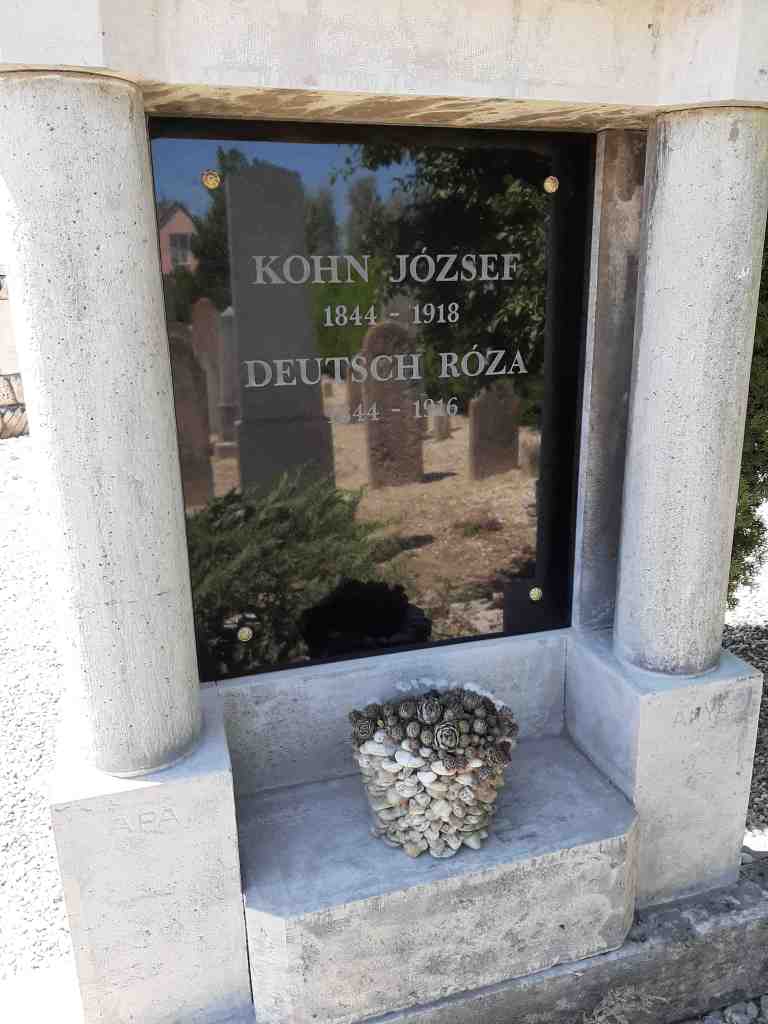
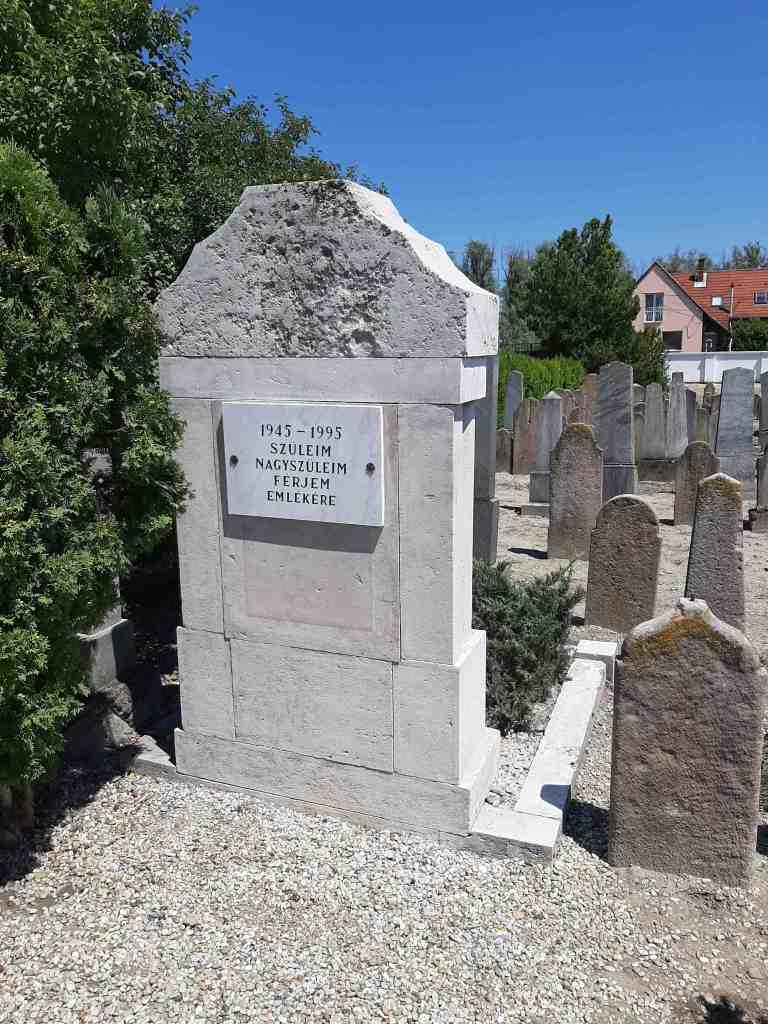
Front and rear views of the renovated grave of our great-great-grandparents, Jewish cemetery in Győr-Sziget – photo: PKR
The next grave, near the funeral parlour, is the final resting place of three members of our family. First and foremost, our father, Károly Krausz (1903-1983), whom we simply called Édes (Sweetheart), our paternal grandfather, Lajos Krausz (1873-1924), and finally our uncle, Zoltán Krasznai (Krausz) (1913-1986), who never found his place in distant Australia after emigrating in 1956 and as often as he could he returned to visit us.
We rebuilt this grave twice subsequent to our father’s death, most recently in 2021. On the back of the previous stones there was a memorial stone for the martyrs of the family, which was installed by our father in the 1960s. Not only do the graves often bear witness on their reverse side to the suffering of ancestors, but behind every living Jew today stand his or her innocent family members and ancestors who were persecuted and murdered. The names of our paternal grandmother, our father’s five sisters, our aunts whom we never met, and, with two exceptions, their husbands and children were inscribed on this plaque. The names of our father’s first wife, Natalka, and her two beloved daughters, Mártika and Veronka, our half-sisters, were also engraved here (link).
They were all murdered in Auschwitz. The names on the memorial stone were finally engraved on the back of the new gravestone during the last renovation.


The old memorial plaque on the back of the shared grave of our grandfather, father, and Uncle Zoli, with the new gravestone next to it – photo: PKR
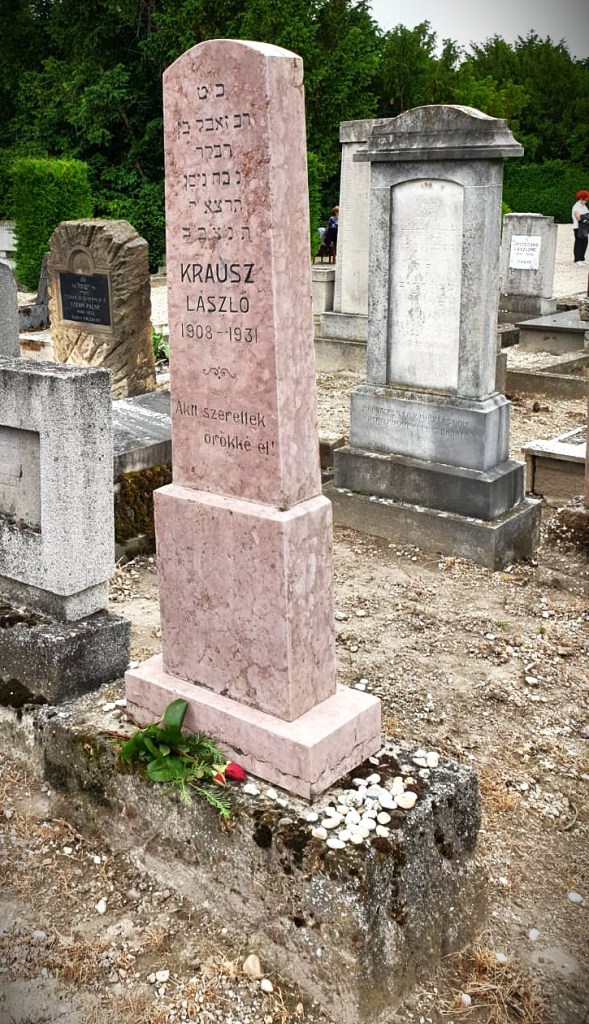
Our father’s brother, Uncle Laci (1908-1931), has a simple, reddish memorial stone carved from Süttő stone, located on the left side of the path leading from the main entrance of the cemetery to the Holocaust pyramid. He was the second of three brothers, born after our father. He died young of tuberculosis.

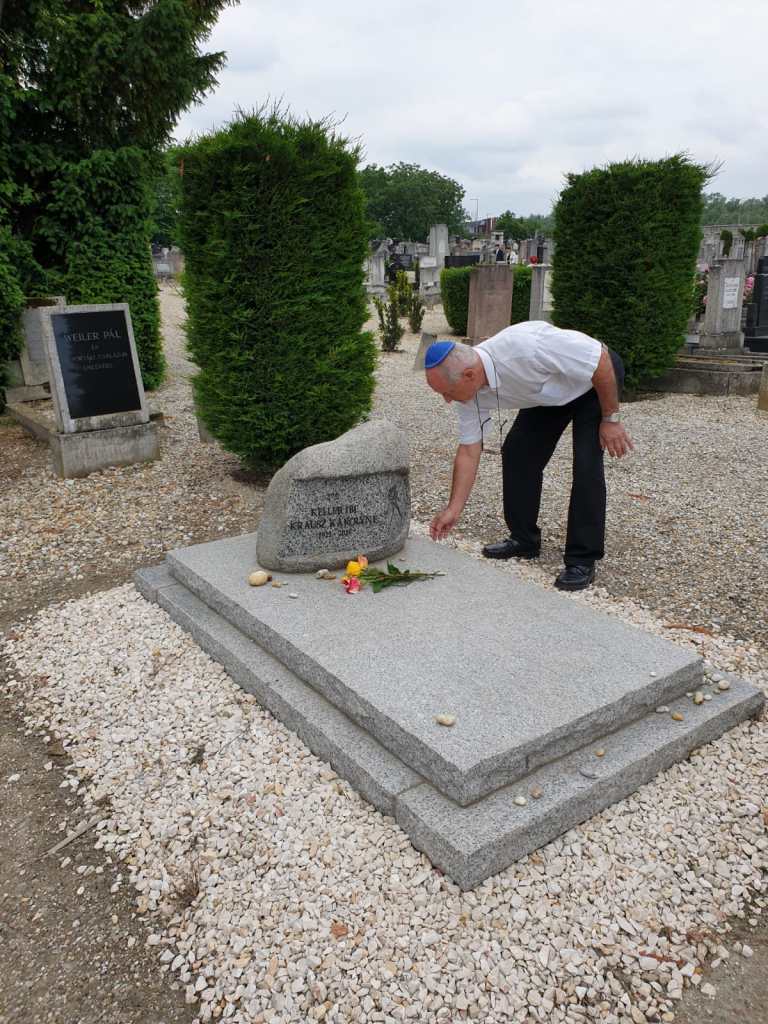
Finally, our mother’s grave is located in the immediate vicinity of the Pyramid. It is symbolic that it stands in the shadow of the memorial, as her entire life was marked by the terrible trauma of losing her entire family. Károlyné Krausz, Ibi Keller, 1921-2018. She passed away seven years ago at the age of 97, and we still sometimes want to call or visit her, but that is no longer possible.
Father’s Ancestors
Where should I continue? Perhaps with what we know about our father’s family.
In the late 1990s and early 2000s, our mother gave two detailed interviews about her life at the initiative of foreign Holocaust researchers. These are available online, and my brother and I compiled our mother’s family history in a family publication for her 90th birthday. So, our mother’s life is relatively well documented. I will, of course, return to her life later. (Biography: Centropa1 and Centropa2 2002; an interview with her was also recorded on September 30, 1999 – USC Shoah Foundation Visual History Archive, “Ibolya Krausz”, interview code: 50430)
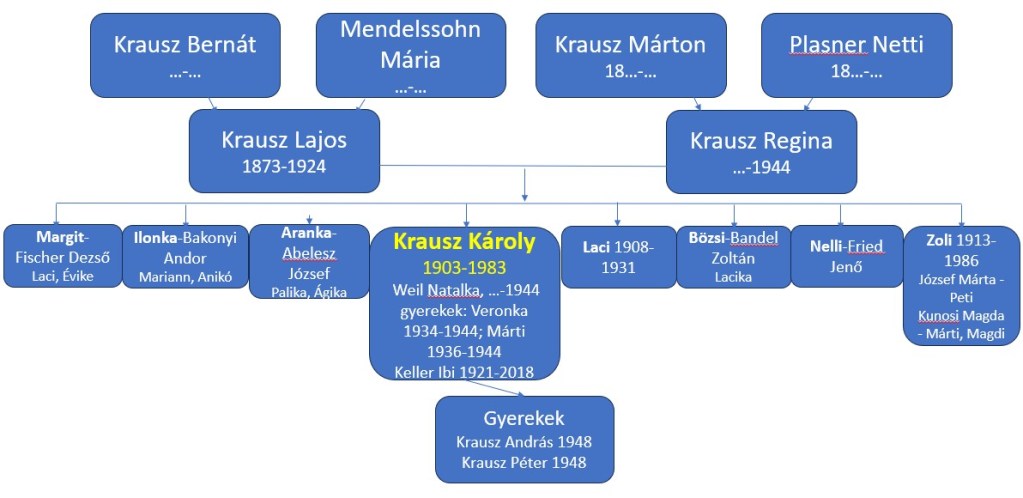
However, our father’s life was not “documented”, except for one key moment. A few years ago, my brother and I published a booklet containing the school documents, certificates, and drawings of our murdered sisters Márta and Veronika that we found among our father’s posthumous papers. These have also been posted on the internet, and the whole family is aware of them (link). In addition, we were fortunate to be able to ask our father about his ancestors and compile a family tree.
The name of our paternal grandfather’s father, one of our great-grandfathers, has been preserved: Bernát Krausz. He earned his living as a slipper maker, and his wife was called Mária Mendelssohn. We do not know their exact dates of birth and death, but I assume they lived between 1840 and 1900, perhaps somewhere in the Transdanubia region.
Our paternal grandfather, Lajos Krausz, as already mentioned in connection with the grave, lived from 1873 to 1924, passing away at the age of 51 due to illness. His brothers were Simon and Márton. Grandfather Lajos was born in Tápszentmiklós, and father was also born in this village. Tápszentmiklós is located near the Bakony Hills, not far from Pannonhalma, about 30 km southeast of Győr.
I wonder why we never visited this village with father. I don’t know. However, I remember well how much he enjoyed taking us, his young schoolchildren, on trips in the 1950s to the not-too-distant ruins of Porva-Csesznek Fortress in the Bakony Hills, which was also the scene of our first skiing trips, organized by him. For him, these trips were almost like coming home. Tápszentmiklós, as we can see on the map, is nestled near the larger village of Győrasszonyfa. According to the internet, Győrasszonyfa had a significant synagogue and Jewish cemetery before the Holocaust. Perhaps the Krausz family’s life and social connections were also linked to this village.
Our paternal grandmother, named Regina Krausz (a very common Jewish surname in Hungary!), was the daughter of our other paternal great-grandfather, Márton Krausz, who was a teacher, probably teaching young children at a Jewish school. Only the name of his wife, our great-grandmother, has survived: Netti Plasner. They lived most of their lives in the second half of the 19th century. Grandmother Regina had four siblings: Janka, Samu, Izidor, and Vilmos.
Titusz Hard, Director General of the Pannonhalma Archabbey School Administration, a prominent supporter of our foundation’s activities and our friend, wrote the following the other day:
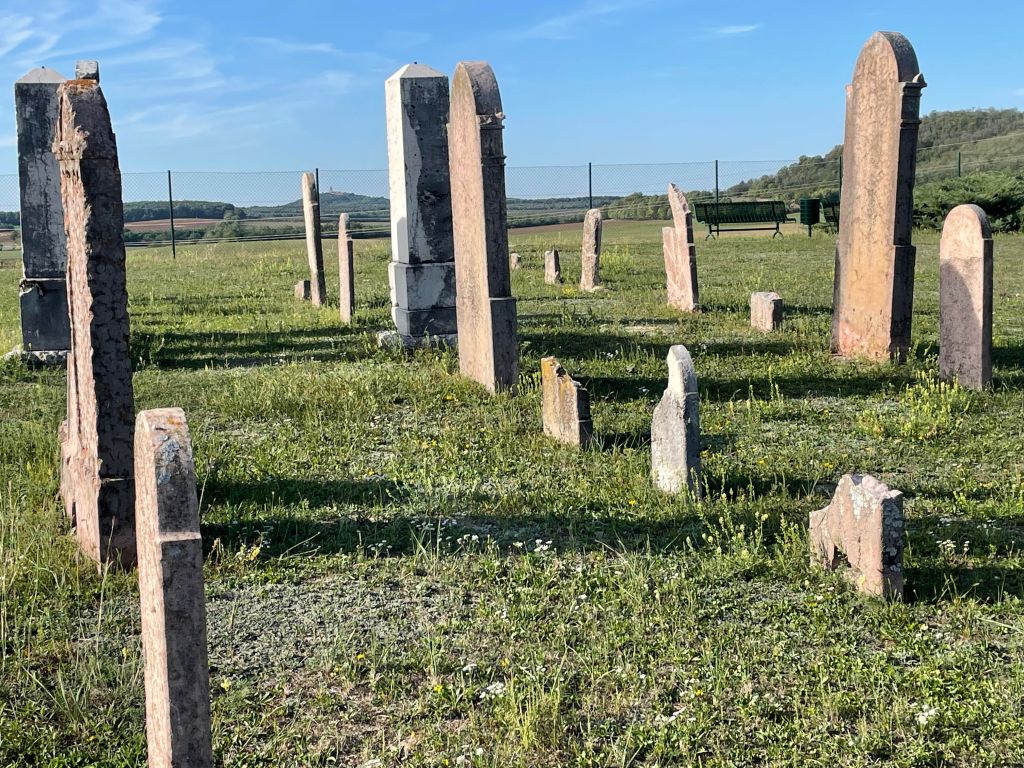
“On Sunday, I was cycling in Győrasszonyfa. I stopped at the Jewish cemetery. I found at least four or five Krausz graves. I am sure they are your distant relatives. Shall I take photos of the graves?” My affirmative answer was followed by: “Today, I went to the Jewish cemetery in Győrasszonyfa again. It is very well maintained. There is a picturesque view from the cemetery, and you can even see Pannonhalma in the distance. There are not many graves in the cemetery, less than 100. Based on the dates, there was already a small but viable Jewish community in the village in the 19th century.”
Titusz sent me photographs of four Krausz graves, among which I found the grave of Krausz Netti (1828-1889), who, perhaps under her maiden name (Plasner, see our father’s family tree), is identical to our great-grandmother, Krausz Netti, who bore the rare first name Netti.
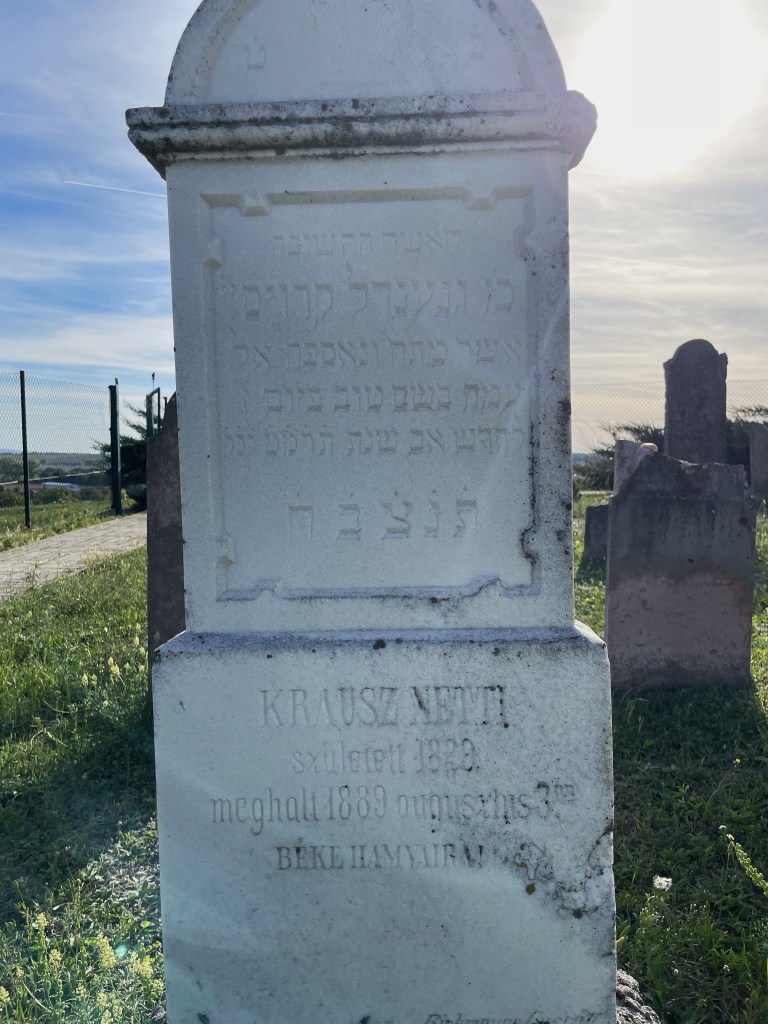

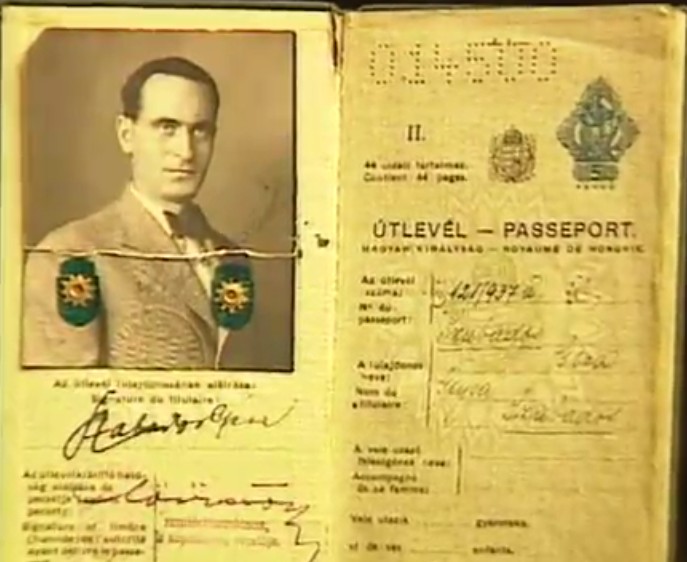
We do not know when and where our grandfather Lajos married our grandmother Regina. Considering the year of birth of their first child, this must have been around the turn of the 19th and 20th centuries. Our father was also born in Tápszentmiklós on September 1, 1903, the traditional first day of the school year in Hungary. His full name was Krausz Károly Bertalan. His second name was commonly used by family, friends, and coworkers as Berci. He was very popular, and many people affectionately called him Bercikém (a further diminutive form of his second name).
I don’t know when our family moved to Győr, or more precisely to Győr-Sziget, but it was obviously after our father’s birth in September 1903.
Father’s life in Győr-Sziget at the beginning of the 20th century
So, our grandfather and his family settled in a poor Jewish neighbourhood called Sziget, near Győr. Sziget has undergone transformation and some redevelopment only in the last few decades. However, scattered here and there, you can still see the former very primitive, single-story, long, village-like courtyards with saltpetre protruding high on the walls.

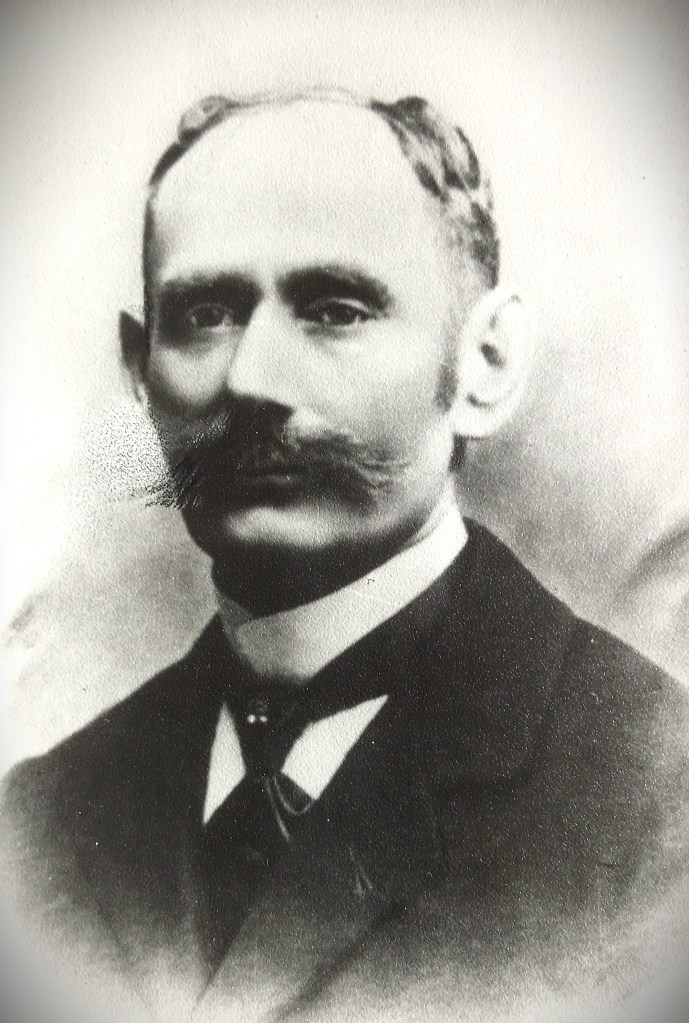
Father was the firstborn in a rapidly growing family, which eventually included three boys and five girls. Our grandfather supported his large family single-handedly as an iron turner at the Győr wagon factory, the predecessor of the later Rába Works. At the end of the 19th century and the beginning of the 20th century, Győr underwent rapid development and became an industrial city. One of the most significant milestones in this development was the founding of this factory in 1896. We do not know how our grandfather became a factory worker or how he mastered the lathe operator’s craft, which was considered an elite profession at the time.
I glance at his friendly face with a large moustache in a prominent place in our family gallery, but it reveals nothing. Unfortunately, he died too early, and I am ashamed to say that I do not remember what illness he suffered from, although our father certainly mentioned it. Grandmother Regina outlived him by twenty years, sadly experiencing the end in Auschwitz, along with her daughters and grandchildren.

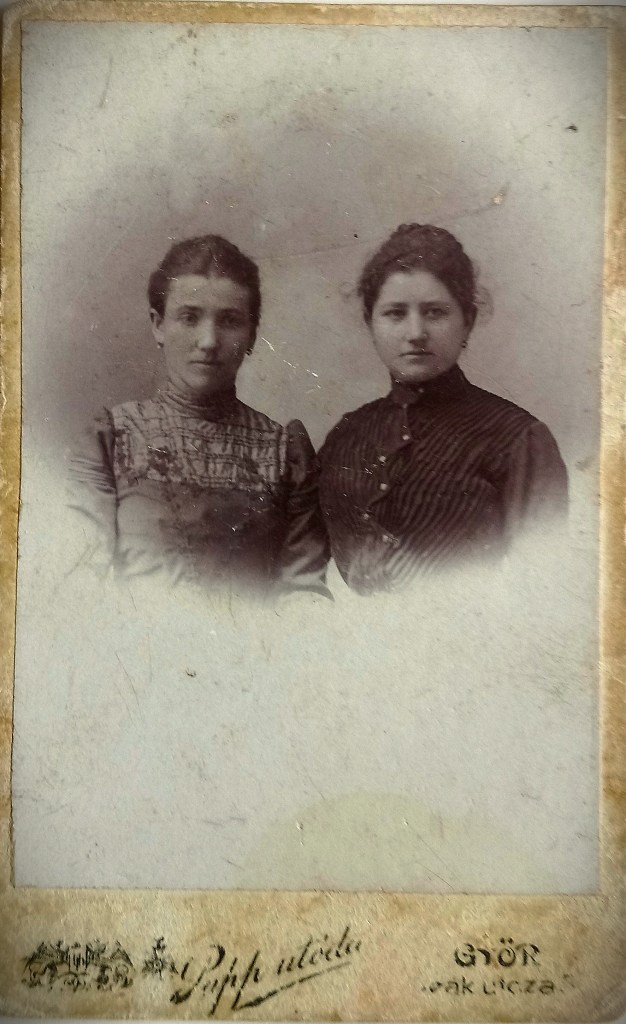
As a reminder, here is the list of the children of Lajos and Regina, our paternal grandparents: Károly (our father), Margit, Ilonka, Aranka, Bözsi (Erzsi), Nelli, Laci (1908-1931) and Zoli (1913-1986). I do not know the dates of birth of our great-aunts; they all died in the gas chambers of Auschwitz in the summer of 1944.
Father’s early years
As the firstborn, he attended secondary school and graduated with a high school diploma. He told us that he studied outside in the evenings by the light of street lamps, as their house did not yet have electricity and they used kerosene lamps. They had to economize on kerosene.

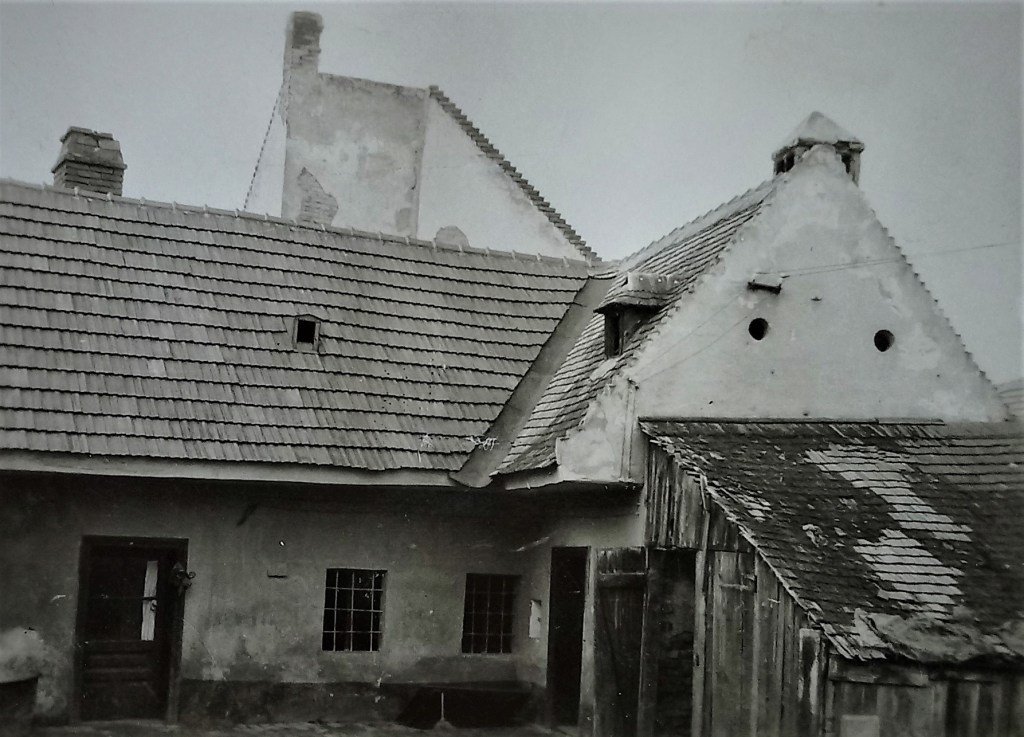
We can only imagine the poor living conditions of a family of ten, with perhaps only a shared water tap in the yard and a toilet that was certainly located outside the cramped apartment.

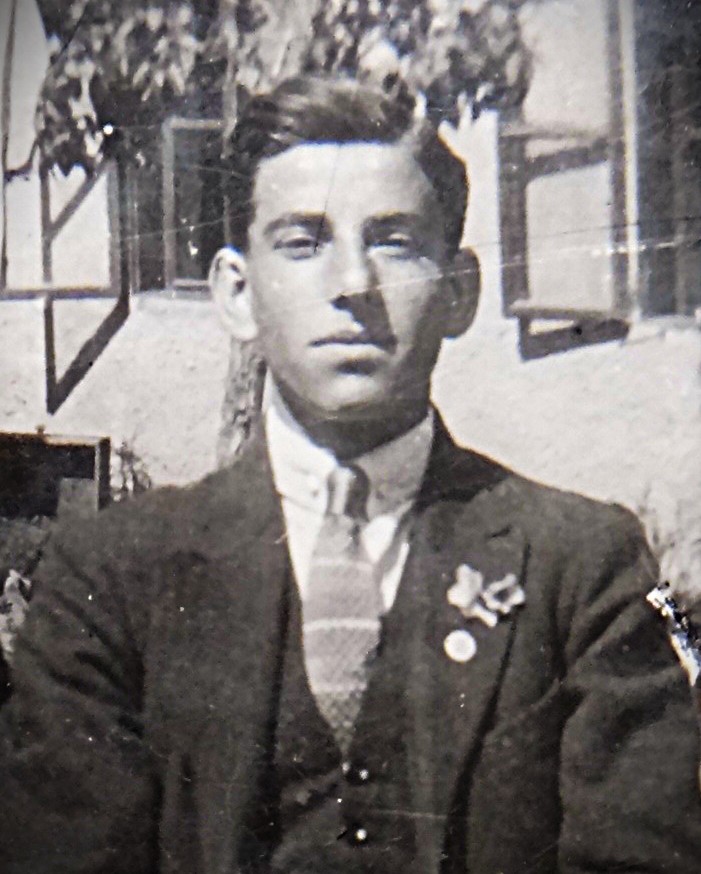
Father passed his Hungarian high school exams with honours in 1921, reciting Petőfi’s poetry in the presence of the president of the Petőfi Society, who had travelled from Pest to Győr for the occasion. He always remembered this with great pride.
Following the early death of our grandfather in 1924, he soon found work thus becoming the breadwinner of the family. I only know of one place where he worked, the Back Mill in Győr. As a grain purchaser, he travelled daily around Győr and the neighbouring counties in the mill’s small truck. He bought grain from farmers. It was not an easy job, and even under the traffic conditions of the time, there were dangers lurking. On one occasion, his truck got in front of a speeding train, and the locomotive swept away the cargo compartment along with its load. Father got out of the truck unharmed.
During those years, he considered his most important task to be marrying off his five sisters. He lived a full life, sympathized with the Zionist movement, attended related meetings, and numerous yellowing photographs bear witness to large, social outings, mainly in the Bakony Hills, rowing on the Danube, and skiing. Due to his obligations to his siblings and mother, he could not think of starting a family of his own.
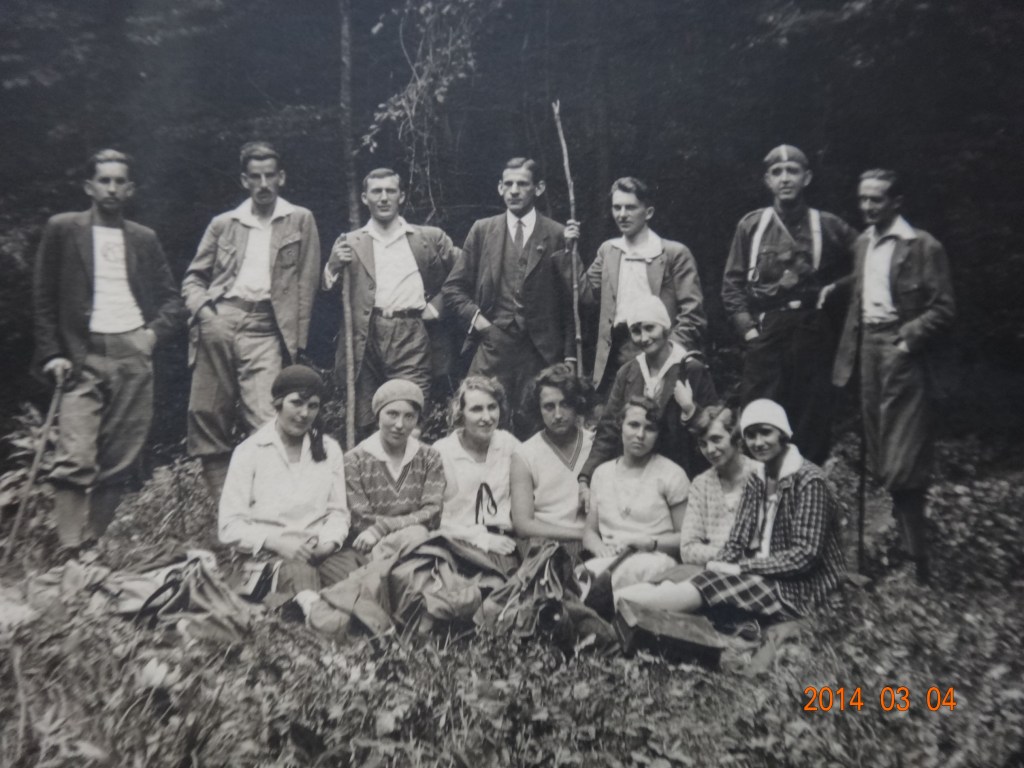
He married off her sisters one by one, raised his naughty younger brother Zoli, and buried Laci, his other younger brother. Later, Zoli also got married, to Márta József, and they had a little boy named Peti.
Father’s first marriage
Father finally married around 1930. He married Natalka Weil, who was a few years older than him and had a pretty, kind face. They had two charming little girls, Veronka in 1934 and Mártika around 1936.

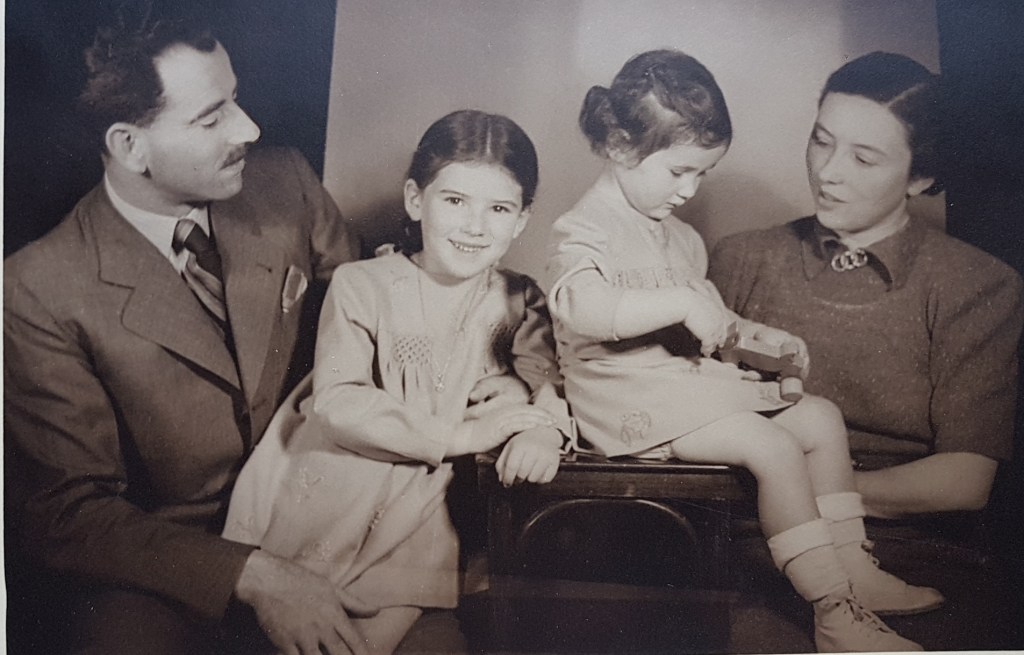
The children studied very well at the Jewish elementary school in Győr, and Veronka was particularly outstanding. As I mentioned earlier, we had published her children’s drawings, which miraculously survived and sent them to the Jewish Museum in Budapest commemorating the child victims of the Holocaust, as well as to a traveling exhibition about the Holocaust, and also posted them on the internet (link).

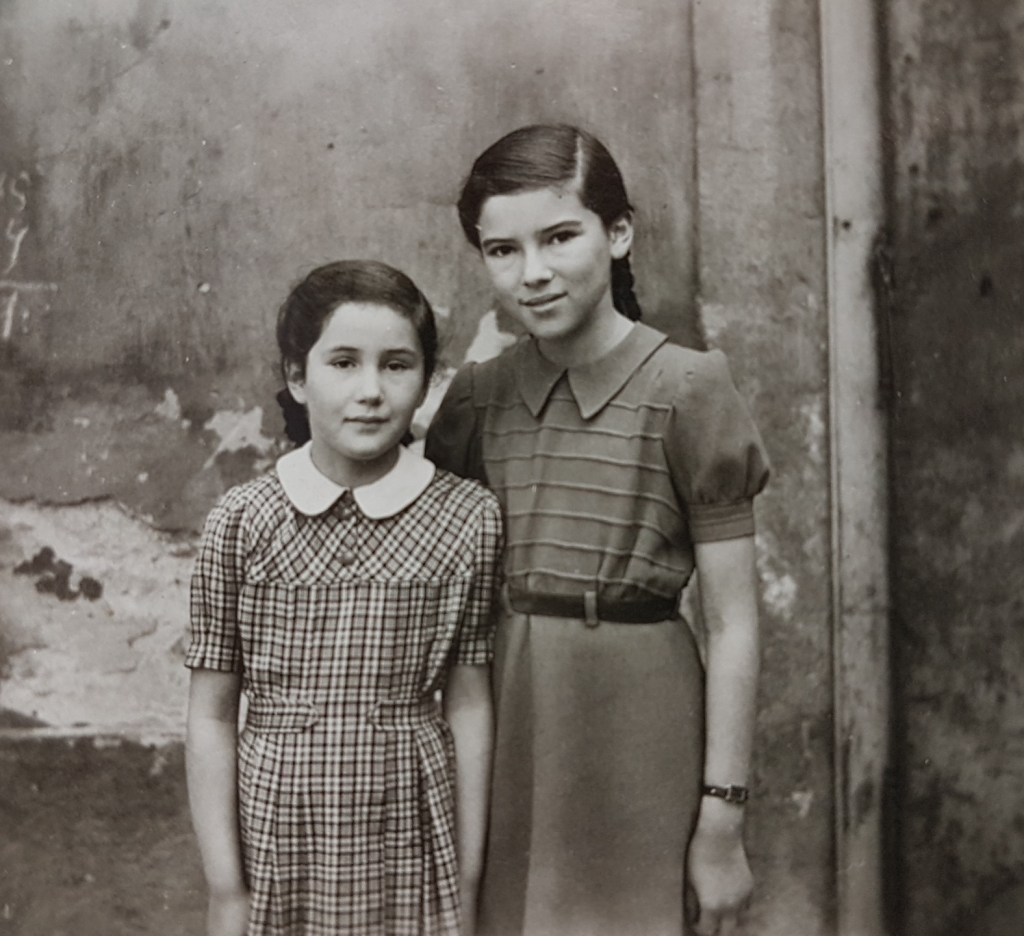
We knew Natalka’s two siblings, her brother, Lipót Weil (chemical engineer, USA), only by correspondence with our father, and Aunt Fridka, whom we often visited in Pest. She worked as a seamstress in the post-war decades. We are still in touch with her descendants today.
More distant paternal relatives
Before continuing with the story, I would like to briefly mention the collateral branches of the former Krausz family. Three of the five children of our paternal grandfather’s brother Simon (his wife’s name has not been handed down in the family) – Rózsi, Bella, and Hédi – survived deportation and made aliyah to Israel. Unfortunately, we know nothing about Simon’s two sons, Miksa and Ármin. Father sometimes mentioned his Israeli cousins, and he even corresponded sporadically with one or two of them. However, this thread has been cut off, and we have never met any of them. Sadly, all contact has been lost. It’s a great pity.

Father in forced labour camp and Russian captivity
Uncle Zoli escaped from forced labour and ended up in Pest, where, according to family legend, he dressed as a member of the Arrow Cross in the fall of 1944 and walked in and out of the Budapest ghetto, helping his friends and acquaintances who had been locked up as much as he could. After losing his wife and child, he met Magda, our future aunt, in Aunt Fridka’s sewing workshop, and they soon got married.
Father was also forced into labour service in the 1940s, along with tens of thousands of others. When his turn came in 1943-44, the defeat of Germany and its loyal ally Hungary seemed certain.

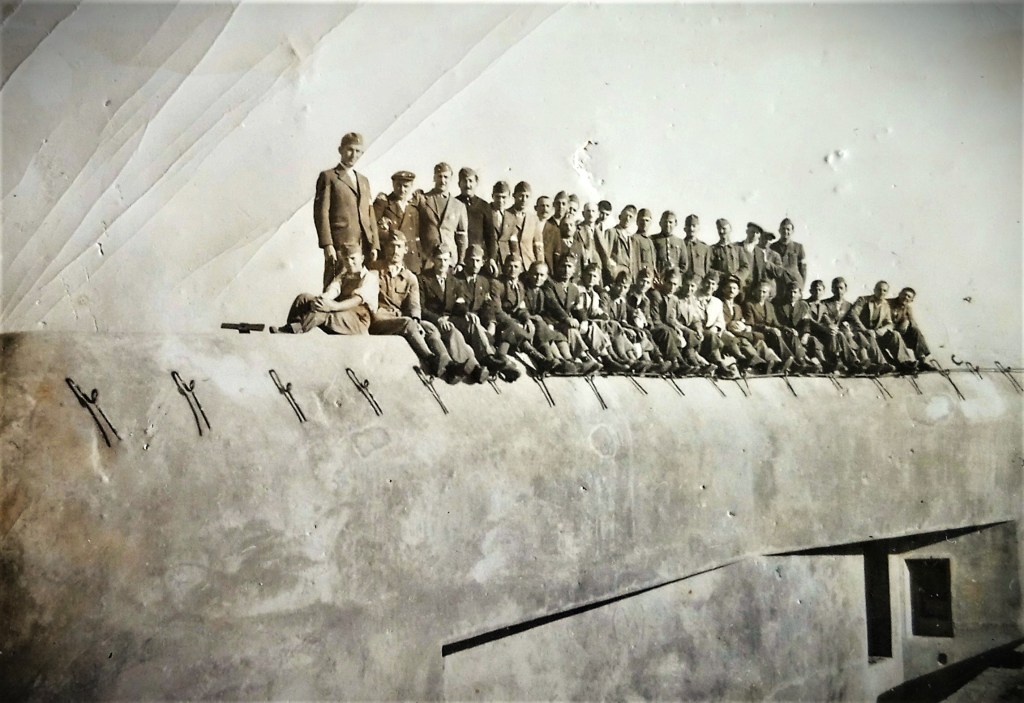
He did not serve on the Russian front, but was assigned to forced labour, which consisted of building completely useless and impractical fortifications, within the borders of the “reclaimed” Hungarian territories.
He learned from his wife’s, Natalka’s, desperate letter – which we have also published in their daughters’ memorial book (link) – that his family had been deported to the Győr-Sziget ghetto. I have already mentioned their terrible subsequent fate above. It is difficult to imagine how father could cope with this terrifying news.

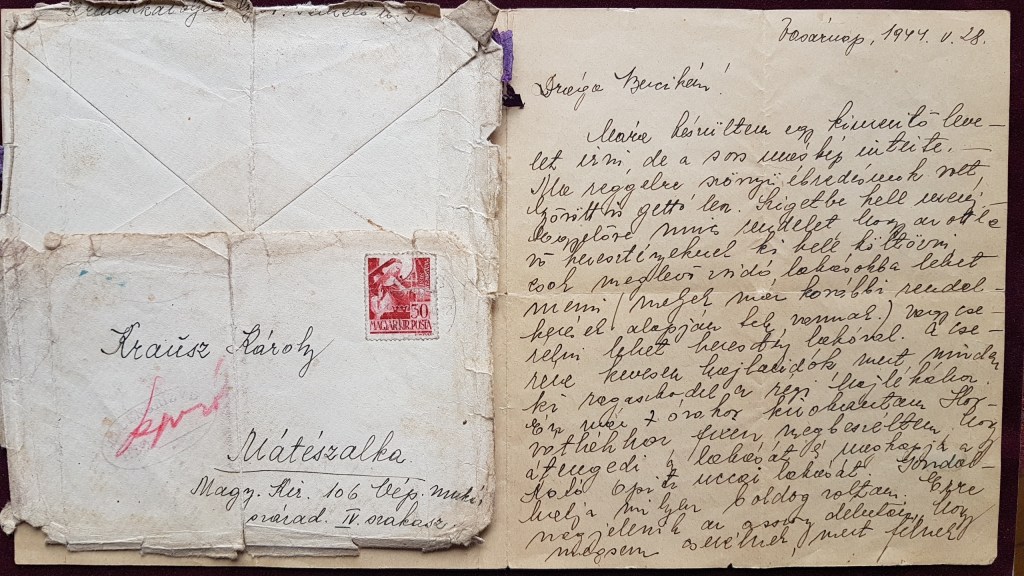

Russian troops advanced relentlessly into the Carpathian Basin, and the Hungarian army and Jewish labour battalions were shattered. Father and many of his fellow labourers fell behind the battalion at that moment and fled.
Unfortunately, they took the wrong turn at a crossroads and ran straight into the arms of the Russians, who were not at all moved by the sight of unarmed and persecuted Jewish forced labourers; anti-Semitism knows no boundaries. They were taken prisoner and sent to another labour camp for malenkij robot, this time in the Soviet hinterland. I know from father that he spent his captivity near the city of Taganrog on the coast of the Sea of Azov (link).
He was forced to do hard physical labour, and on one occasion, while unloading wagons, he slipped from high up and dislocated his shoulder, which caused him limited mobility and occasional pains for decades to come. Fortunately, he befriended a German military surgeon, the camp doctor, who recommended that father be sent home on medical grounds at the first possible opportunity. Thus, after a year, he was among the first to return home, where he found no one from his large family except his younger brother Zoli.
As can be seen on our father’s gravestone, ten small children from our family, including Peti, my father’s children Márti and Veronka, fell victim to the frenzied Hungarian-German anti-Semitism in 1944. Out of respect and as a sign of our love, here is their complete list of names: Márti, Veronka, Peti, Lacika (Margit’s little son), Évike, Marian, Anikó, Ágika, Palkó, and Lacika (Bözsi’s little son). To this we must add the number of adult victims who belonged to the close-knit family: five of my Krausz aunts, their two spouses, my father’s first wife, and my grandmother. The shocking total is nineteen.
I was able to meet one or two of the surviving husbands of our unknown aunts. While the husbands of Margit and Nelli, Dezső Fischer and Jenő Fried, did not return from the labour camp, some, like our father, survived the forced laboru. This is how we met Ilonka’s ex-husband, Andor Bakonyi, whom my father sometimes visited at his new family’s home in Győr. We knew and loved József Abelesz (Angyal after the war), Jóskus, our aunt Aranka’s former husband, who moved to Pest after the war, where he lived in his second marriage. In the 1970s, I stayed with them as a tenant.
I think I saw Bözsi’s ex-husband, Zoli Bandel, once. He emigrated to Israel with his new family in 1956.
So, 1946. Is it possible to start over in a situation like that?
Our parents meet
So, our father came home. But “is there still a home there …?” x
Our parents knew each other vaguely from before the war. They may have been on friendly terms, but their paths had not crossed. At that time, Berci found Natalka, Ibi, our future mother, met Géza Szabados. Berci and Géza also knew each other and had even been in the forced labour service together. Before 1945, the Jewish community in Győr numbered around five thousand, which is the population of a large village, where essentially everyone knew everyone else. It is shocking that only a few hundred of them returned, and the survivors were justified in thinking that they no longer had a home there x.
Berci and Ibi eventually found each other in the shrunk community of Győr. Their very similar family dramas and mutual attraction brought them together despite the large age difference. You could say that opposites attract: father was a rational, athletic individual with a talent for leadership and an interest in social and political issues, while mother was more romantic, looking to the past and unable to come to terms with it, burdened (or blessed?) with a father complex and a strong will. Over the years, the strongest bond between them became their unconditional devotion and love for us. The minor conflicts that arose between them were always resolved in this spirit.
Mother’s family: the Brauns and the Kohns
So far, I have mostly recalled father’s memories. It is high time to introduce mother’s life. We also asked her many times about her ancestors and their details, which enabled us to compile also her family tree.
A few years ago, through the mediation of Mari Takács/Friedlaender, mother’s remote relative who had been living in Canada since 1956 and had called our mother several times during her long illness, I got in touch with Gabi Bíró/Braun, who lived in Budapest. I had only met both of them as a little boy, as our mother kept loose contact with her distant cousins, with whom we were only related through our great-grandparents. Gabi Bíró sent me the family tree he had compiled, which included a large number of our maternal ancestors from the Keller and Braun branches.

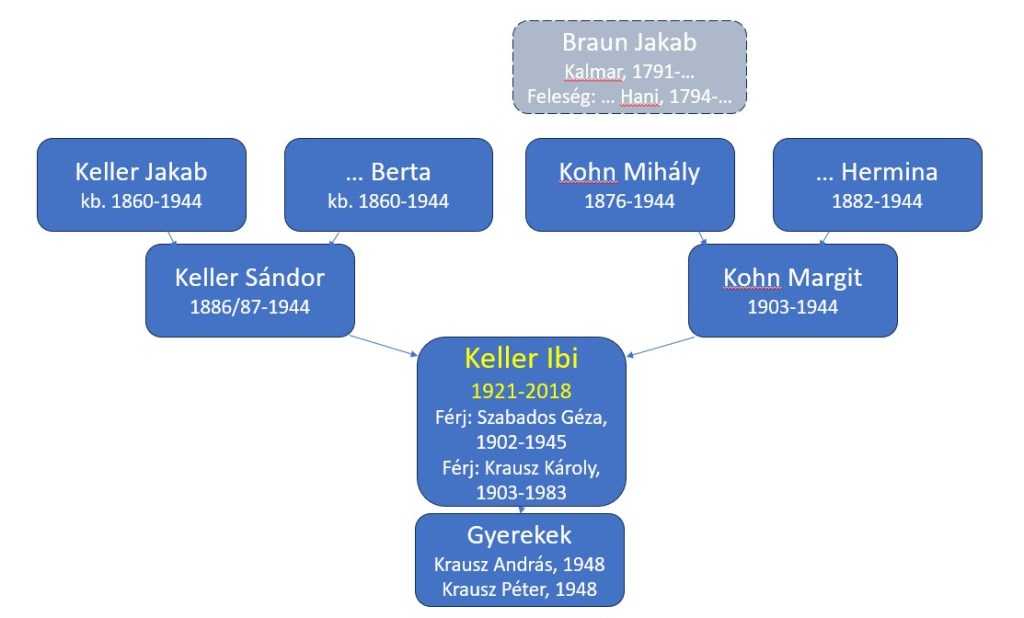
Mother’s closest family – composed by PKR
I often wonder why people say that outstanding individuals come from old, historic families. What kind of glory is that, since every single person alive today necessarily comes from some ancient, historic family? Biologically, it cannot be otherwise. That said, I was equally amazed when the details collected by Gabi Bíró traced our maternal family line, the Braun(-Kohn) line, all the way back to 1791. That was when Jakab Braun was born in Kalmar. That’s quite something! I almost feel like a descendant of an ancient “Hungarian noble family”! According to Google, Kalmar is a Swedish city with a significant past. Could this be the city in question? Or perhaps Colmar, near the Swiss-French-German border in the middle of Europe? In any case, it is difficult to imagine distant Sweden as a place of origin. Jakab Braun’s wife, Hani, was born in 1794.
Braun Hermina, mothers’ maternal grandmother, was a direct descendant of Braun Jakab, who lived in the 18th century. Jakab’s youngest son, Dávid, born in 1834, may have had a son who was born around 1860, who was mothers’ maternal great-grandfather. His daughter, Braun Hermina, was mother’s beloved maternal grandmother, one of our great-grandmothers. She was married to our great-grandfather, Mihály (Muki) Kohn. I don’t know their dates of birth, but I would guess around 1890. They found their deaths in Auschwitz.
Before I get further tangled up in the incomprehensible family tree, let me tell you a story to untangle things a bit. According to family legend, our great-grandfather Mihály (Muki) was once visiting relatives in Pest. Our great-grandmother Hermina called them from Győr to ask how her husband, Muki, was doing. Muki…? Well, there’s a bit of a problem, he just climbed up… on the curtain rod, came the shocking reply… because the family’s squirrel in Pest was also called Muki.
My great-grandfather Muki, who was a livestock dealer at a coffee house, had probably never seen a live cow in his life, but he boldly, skilfully and profitably bought and sold animals at the “animal exchange” in a coffee house in Győr, along with other livestock dealers.


It is worth lingering on the Braun branch of the family tree, mainly because it includes some characters from our great-grandmother Hermina Braun’s generation whom we knew ourselves. These included Aunt Róza (Braun), Hermina’s sister. Aunt Róza lived in Pest until she was almost 100 years old, like a living fossil. Of course, when I look back, our mother also passed away at the age of 97. We visited Aunt Róza several times in Pest, in Trefort Street, where she just sat in a large armchair, hardly speaking, with no teeth left, and we, as small children, had to kiss her “prickly” face. I was afraid of her, which in hindsight was unfair. My fear was only heightened by the fact that her son Jancsi, who was born without legs, moved around the apartment on a low rolling stool with the help of pieces of wood he held in his hands. He was a really friendly person, but I was so anxious that I hardly dared to speak to him, and even today, the memory of him still horrifies me. I now know that my prejudice was based on his appearance. Aunt Róza’s other child was Aunt Kata, whom we often met in Pest or Győr when we were children, and who often looked after us when we were still little kids. She used to prepare for us our favourite dish, cheese pancake with a lot of cheese in it.
Aunt Kata told us that one of her uncles, Gyula Braun, a railway engineer, spent most of his life in Turkey. When he came home, or just visited home in the early 20th century, he gave his sister Kata a small Turkish table, which we inherited from her in the late 1970s. It is a family heirloom from the distant past.
Our great-grandmother Hermina and Aunt Róza’s two other brothers were the Brauns who lead us to Aunt Irénke Braun Takács, the mother of Mari Takács from Canada, and the aforementioned Gabi Bíró.
Let’s pause again for a moment. Aunt Irénke, Mari, and Takács Pista, Irénke’s second husband, left Hungary via Győr during the events of 1956. They spent perhaps one night at our house, and we were supposed to leave with them for the West. Together with my brother Andris, who was seven at the time, we waited for our departure in full gear, wrapped in several layers of clothing and wearing boots, preparing for the expected cold winter “hike.” At dawn, the prearranged truck arrived. The Takács family left, and we stayed behind. Seeing our mother’s objections, our father did not dare to take on the enormous responsibility of emigration alone. As he said, at the age of 53, he could not start another new life. It was around this time that our uncle Zoli set off for Australia with our aunt Magda and our two cousins, Márti and Magdi.
Mother’s paternal relatives: the Keller/Kolarik branch
I will now briefly turn to our mother’s paternal ancestors. I gathered my relevant knowledge also from mother, perhaps too late, when she could only remember the essentials, and even then, not entirely. This makes the overview necessarily simpler than that of the Braun branch.
On her father’s side, the Keller and Kolarik families may have become closely related through marriage in the 1880s. I know nothing about their ancestors. Their descendant, Jakab Keller, our maternal great-grandfather, whose exact year of birth I can only estimate, died in Auschwitz in 1944. Compared to our other great-grandfather, Mihály Kohn, the cattle dealer, Jakab Keller lived in modest circumstances and was a basket weaver. He married twice and had two sons from his first marriage. The firstborn was our grandfather, our mother’s beloved father, Sándor Keller, who was born in 1886/87 and was also killed in Auschwitz in 1944. Our grandfather Sándor Keller married Margit Kohn in 1919/20. This is where the Braun/Kohn and Keller/Kolarik families met.
Mother, the only child of Sándor and Margit, was born on July 10, 1921, in Győr.
Life of mother’s parents
Our grandfather Sándor Keller did not take over his parents’ basket weaving business. He opened a haberdashery wholesale store in Deák Ferenc Street in Győr, which certainly did not make him rich. At his peak, he had two assistants working for him. According to our mother, he spent his days from early morning until late at night in the shop’s warehouse doing administrative work: orders, shipping, inventory, invoicing, bookkeeping, and so on. He returned home for lunch to their rented apartment in Baross Street, just around the corner, where the family ate together.
He struggled with constant financial difficulties, and his wife, grandmother Margit, loved beautiful clothes and didn’t really care where the money to buy them came from. She cooked and supervised the maid, and strummed cheerful songs and contemporary hits on the piano, as mother told us. From time to time, she would sit at the cash register in the store, supposedly to help out, but perhaps it was just so she could find the money for her next dress in the cash register drawer. Mother admitted that she sometimes followed her example. Grandmother Margit was a full-figured woman who loved good food and sweets. Mother, as I said, adored her father, grandfather Sándor, and she was very fond of her maternal grandparents, Mihály Kohn and Hermina. Mihály often helped his son-in-law, grandfather Keller, out of financial difficulties. The cattle brought in a good income.
Grandma Hermina cooked the holiday lunches and dinners. They would gather in their relatively large, two-story house on Kossuth Lajos Street, not far from the Neologue synagogue in Győr. They rented out the ground floor apartments. One of the tenants, in those critical days, treacherously reported mother’s grandfather, the wealthy homeowner, to the Hungarian and German authorities.
They beat him for two days to find out what he was hiding and where. No one knew how he managed to escape for the short time that remained before the ghettoization and deportation. “Shhh,” he repeated, “I mustn’t say anything about this.” This is how mother told us, who lived a carefree life until 1944.
“Blue blood,” father used to say about her during their life together, half seriously, half-jokingly, such was the contrast between the life and opportunities of Győr-Sziget’s working class and the small bourgeois families of the city centre. The differences were tragically levelled out in the summer of 1944.
Mother’s youth
I have already mentioned my mother’s carefree youth.


Mother attended the elementary school run by the Jewish community, and Grandpa Mihály Kohn accompanied her there every day, calling her “little star.” Mother often mentioned the religion teacher, whom she disliked because of his strictness. With her parents’ support, she chose to continue her education at a commercial high school that provided practical skills, and even today I don’t understand why she didn’t graduate, even though she completed her final year. Was it a lack of parental rigor or personal will and perseverance? She often went dancing and to the movies with her mother and friends, sometimes even to Budapest to visit relatives, certainly Aunt Róza and Aunt Kata.
Being pretty, boys swarmed around her. In the summer, she spent a few weeks in Balatonfüred and Hévíz with her mother and grandparents. After leaving school, she had to learn a trade, so she decided to become a milliner. Her teachers were Bözsi Vogl in Győr and Klára Rotschild in Pest, but she only worked for a few weeks at the Rotschild salon in Váci Street, perhaps as an excuse for a longer stay in Pest.
So, there were lots of young men buzzing around our mother, but she chose the comforting security of a father figure in the person of Géza Szabados, a divorced man 21 years her senior with a child. This encounter came at the most difficult time, and their wedding took place in early 1944. Géza worked as the owner and director of a small freight forwarding company in Győr.
They were only able to live together for a few weeks before Géza was called up for forced labour.

Mother in tragic times
Mother’s life was torn apart in 1944 when her family was deported. She was only able to visit her husband, Géza Szabados, once in the labour camp. What a dramatic omen that this visit fell on 19 March 1944, the day German troops marched into the country. They never saw each other again. With the arrival of Eichmann and some German henchmen of his in Hungary, but above all due to the efficient cooperation of hundreds of thousands of Hungarian civil servants, gendarmes, and railway workers, orchestrated by Horthy and the Hungarian government, and with the tacit consent of public opinion, the dramatic events accelerated.
Within a few weeks, our mother and her entire family, along with the other Jews of Győr, were deported to the Győr-Sziget ghetto, then to the barracks in Budai út, and finally, in June 1944, to Auschwitz. From there, mother was taken to Bremen and Bergen-Belsen. She was the only member of the family to survive this tragedy, along with her husband Géza Szabados’ teenage daughter Panni, who stayed close to mother in the camp. Mother recounts her experiences in the camps in detail in her memoirs, which I have already mentioned.

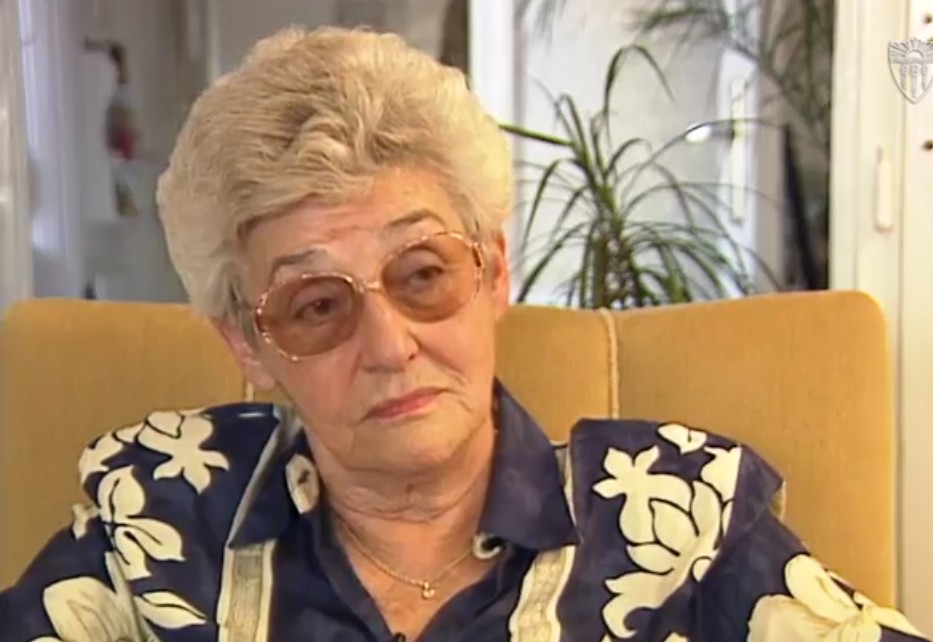
I will try to add up the murdered members of our mother’s family. I can count twelve people in the immediate family, but inaccuracies in the family tree and gaps in my knowledge make it impossible to give an exact number of more distant relatives. Therefore, the actual number is certainly higher. Mom never got over this terrible loss, even with her new family and two sons. Her melancholy, fears, depression, or, as people used to say, her “bad nerves” and perhaps even some of her physical ailments can be traced back to this terrible trauma.
After the war
Mother was liberated by the British in the Bergen-Belsen camp. She pulled herself together and returned home in the fall of 1945, unlike many of her fellow survivors who did not want to see Hungary again, where the barbarity that had befallen their families had taken place. She suspected, she knew, that her parents and grandparents were no longer alive, but she hoped very much that her husband, Géza, would return from forced labour. The last word she had of him was that, shortly before his release, he was being transported by train with hundreds of others somewhere in Transylvania when he had to get off at a station to find a doctor because of a nasty ulcer on his hand. No one ever heard from him again.
Strangers were already living in mother’s family’s former rented apartment in Győr, as the authorities there had wasted no time in handing over the vacated Jewish apartments to Aryan Hungarian families. He found temporary accommodation with friends. Géza’s former employee, Miklós Krausz, whom we had met as children in Pest, returned and started working again at Géza Szabados’s forwarding agency, from where he supported mother financially in the months that followed. It was a glimmer of hope that the colonial furniture set ordered and paid for in advance by our great-grandfather for the young couple before the Holocaust was returned in full to mother by the honest cabinetmaker in Győr. Several pieces from this set are still in our family’s possession.
Mother’s journey led her to meeting our father, as I mentioned above. Like Géza, our future father, with his additional eighteen years and vast life experience, became a solid support for mother.
With a few detours along the way, I arrived at the intertwined fates of our immediate ancestors, mother and father at the end of the line.
xxx
From this point on, a new chapter began, a new story, and perhaps someone will write that too.
xxx
In lieu of an epilogue:

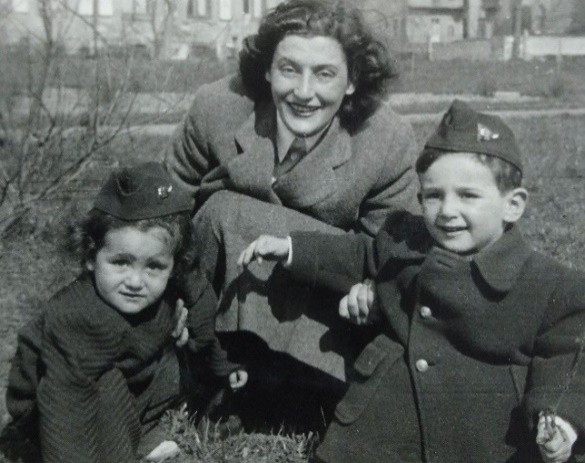


Mother and father in 1955 – photo from a photograph by András Krausz


x Reference to Miklós Radnóti‘s poem ‘Seventh eclogue’
Based on my “Covid diary” kept in 2020–2021.
Written, edited, and translated into English by Péter Krausz
One reply on “Double Tribute to Our Parents”
[…] National Savings Bank branch, Dezső Rudas, or the chief accountant of a county retail company, Berci Krausz, and a few others, took note of me, presumably out of gratitude for my grandfather. By this I mean […]